
Alibaba's Qwen3-1.7B Brings Reasoning to Edge Devices at Millions of Downloads
Alibaba's tiny 1.7B open-weight model brings on-demand chain-of-thought reasoning, tool calling and 32K context to laptops and edge hardware under Apache 2.0.
 Pro
Takeaways
- Qwen3-1.7B is a 1.7B dense open-weight model with 32K context, Apache 2.0, on Hugging Face.
- Ships with a thinking/non-thinking switch via
enable_thinkingor/thinkand/no_thinkprompt tags. - Outperforms larger Qwen2.5 baselines on many STEM and coding benchmarks, per the Qwen3 tech report.
- Runs on vLLM, SGLang, Ollama, LM Studio, llama.cpp, MLX-LM, with 348+ community quantizations available.
- First-class tool calling and MCP support through Qwen-Agent, usable in both reasoning modes.
- Now a popular base for post-training research, including automated systems that beat the official instruct variant.
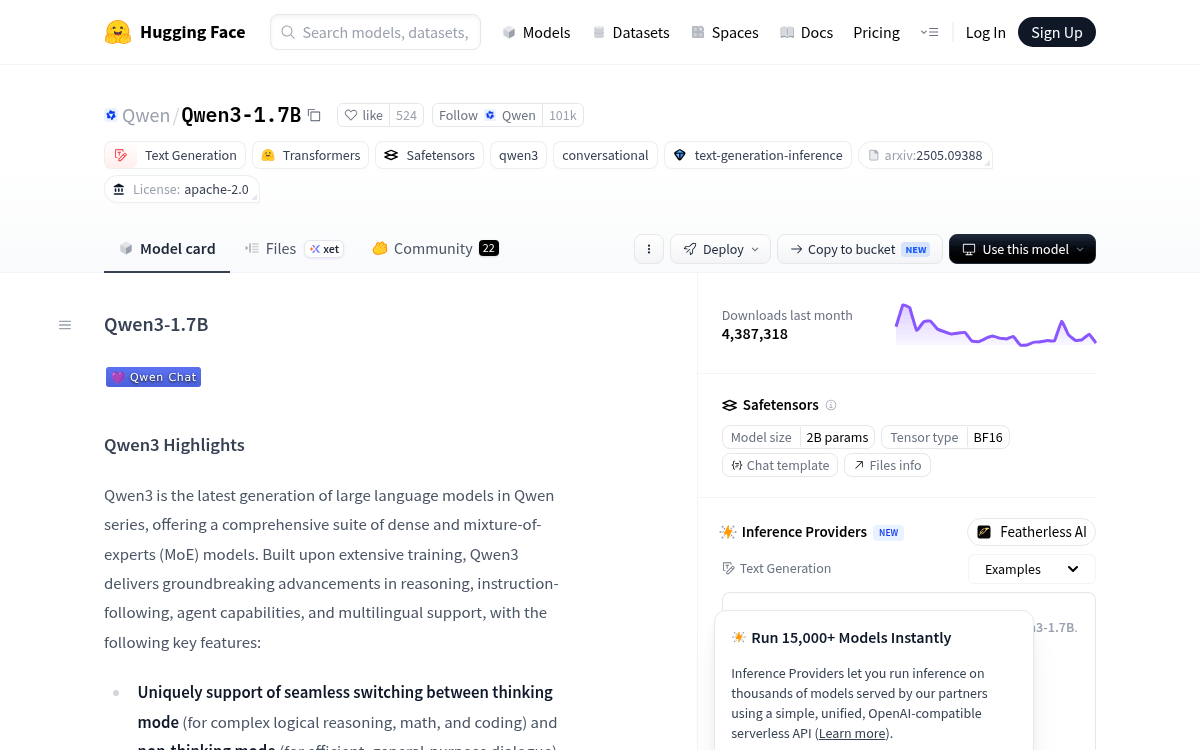
A small model that can flip between deep chain-of-thought reasoning and fast conversational replies is rare at the 1.7B parameter scale, but that is what Qwen3-1.7B offers. Released under Apache 2.0 by Alibaba's Qwen team, it has become one of the most downloaded compact language models on Hugging Face, with millions of pulls and a wave of community fine-tunes built on top of it.
The pitch is straightforward. You get a dense, edge-friendly model that behaves like a reasoning system when you want it to, and like a normal instruction-tuned chatbot when you do not. It sits at the bottom of the Qwen3 family, which spans dense and Mixture-of-Experts models in 0.6B, 1.7B, 4B, 8B, 14B, 32B, 30B-A3B and 235B-A22B configurations.
What is actually inside
The architecture is deliberately conventional so it plays nicely with existing tooling. Qwen3-1.7B is a causal language model with 1.7B total parameters (1.4B non-embedding), 28 layers, grouped-query attention with 16 query heads and 8 key/value heads, and a 32,768 token context length. Weights ship in BF16 and slot into the standard transformers pipeline, provided you are on version 4.51.0 or newer, since older releases throw a KeyError: 'qwen3'.
The most interesting design decision is dual-mode inference. Thinking Control integrates two distinct modes, non-thinking and thinking, letting users choose whether the model should reason through a problem step by step before answering. In thinking mode, the model emits a <think>...</think> block containing its scratchpad, then produces the final response.
Flipping the reasoning switch
You control the mode at the chat template level with a single flag, and you can also toggle it mid-conversation with /think or /no_think tokens in the user message. Here is the minimal version:
text = tokenizer.apply_chat_template(
    messages,
    tokenize=False,
    add_generation_prompt=True,
    enable_thinking=True  # or False for fast replies
)
The two modes need different sampling settings to behave well. For thinking mode, the recommendation is Temperature=0.6, TopP=0.95, TopK=20, MinP=0, and explicitly not greedy decoding, which the team warns can cause performance degradation and endless repetitions. For non-thinking, bump temperature to 0.7 and top-p to 0.8. If you see repetition loops, setting presence_penalty around 1.5 is the documented fix.
Punching above its weight
The technical report positions this as an edge-tier release, but the comparison targets are notable. Qwen3-1.7B is benchmarked against DeepSeek-R1-Distill-Qwen-1.5B and DeepSeek-R1-Distill-Llama-8B in thinking mode, and against Gemma-3-1B-IT, Phi-4-mini, Qwen2.5-1.5B-Instruct and Qwen2.5-3B-Instruct in non-thinking mode. Overall, these edge-side models outperform baselines even with more parameters, including the previous Qwen2.5 generation. The Qwen3-8B, 4B and 1.7B base models even beat larger Qwen2.5-14B, 7B and 3B base models on over half of the benchmarks, especially on STEM and coding tasks.
The tradeoffs are what you would expect from something this small:
- Strong at math, coding, and structured reasoning when thinking mode is on, particularly relative to its parameter count.
- Solid multilingual coverage, with the family claiming support for 100+ languages.
- Weaker on broad world knowledge than 7B-plus models, since the parameter budget simply cannot store as many facts.
- Latency in thinking mode can balloon, since the model may spend thousands of tokens reasoning before it answers. The team recommends a 32,768-token output budget for most queries and 38,912 for competition-style problems.
- Tool-use benchmarks put it in the same ballpark as much larger Qwen2.5 instruct models on some slices, though specialized function-calling models still lead.
Agents on a budget
Tool calling is a first-class feature here. The team recommends pairing it with Qwen-Agent, which handles the tool-call templates and parsers, and accepts MCP server configs directly so you can wire up things like a fetch tool or a local time server without writing glue code. The model can call tools in both thinking and non-thinking modes, which matters if you are building latency-sensitive agents that occasionally need a slow, deliberate reasoning step.
Deployment paths
Because it is small and BF16, this is one of the easiest recent reasoning models to actually run. Supported paths include:
vllm serve Qwen/Qwen3-1.7B --enable-reasoning --reasoning-parser deepseek_r1for an OpenAI-compatible endpoint.- SGLang with
--reasoning-parser qwen3for the same, with its own thinking-mode toggle in the API. - Local runtimes including Ollama, LM Studio, MLX-LM, llama.cpp and KTransformers, plus 348 community quantizations on the Hub for GGUF, AWQ and GPTQ workflows.
The full BF16 checkpoint is around 2B params of weights, which fits comfortably on a single consumer GPU and, once quantized, on phones and Raspberry-Pi-class hardware.
Why researchers keep coming back to it
The 1.7B tier has become a favorite baseline for post-training research, partly because a full RL or SFT run is cheap enough to iterate on. Intology recently claimed its Locus system is SOTA on PostTrainBench and can post-train Qwen3 1.7B-Base variants that surpass the official human-tuned Qwen3 1.7B Instruct model under expanded compute budgets. The same post says Locus generalized to live Kaggle competitions, reaching the 4th highest average rank after 16 days. Whether or not you buy the automated post-training pitch, people using this checkpoint as the substrate for that kind of work says something about how usable the base model is.
When to reach for it
Try this model when you want reasoning behavior without paying for a 7B or 14B footprint. Concrete fits include on-device assistants, function-calling agents where each hop needs to be fast, structured extraction over long documents that benefits from a real 32K context, and any research project where you want a reasoning-capable base you can fine-tune on a single node. If you need broad factual recall, code generation across large repos, or long-horizon agent traces, you will probably want to step up to Qwen3-4B or Qwen3-8B. For a large slice of practical workloads, the 1.7B tier is now genuinely enough.