
Alibaba's Qwen3-0.6B-Base Hits 1M Downloads Trained on 36 Trillion Tokens
Alibaba's smallest Qwen3 checkpoint packs 36 trillion training tokens and 32K context into a 600M dense model built for edge deployment.
 Pro
Takeaways
- Qwen3-0.6B-Base is Alibaba's smallest Qwen3 dense base model, Apache 2.0 licensed.
- 600M parameters, 28 layers, grouped-query attention (16 Q / 8 KV), 32K context window.
- Pretrained on 36 trillion tokens across 119 languages using a three-stage curriculum.
- Outperforms similar-size Gemma-3, Llama-3, and Qwen2.5 base checkpoints on most benchmarks.
- Runs on Transformers 4.51+, vLLM, SGLang, and has 79 community quantizations.
- Technical report details scaling-law tuning and qk-layernorm architectural refinements.
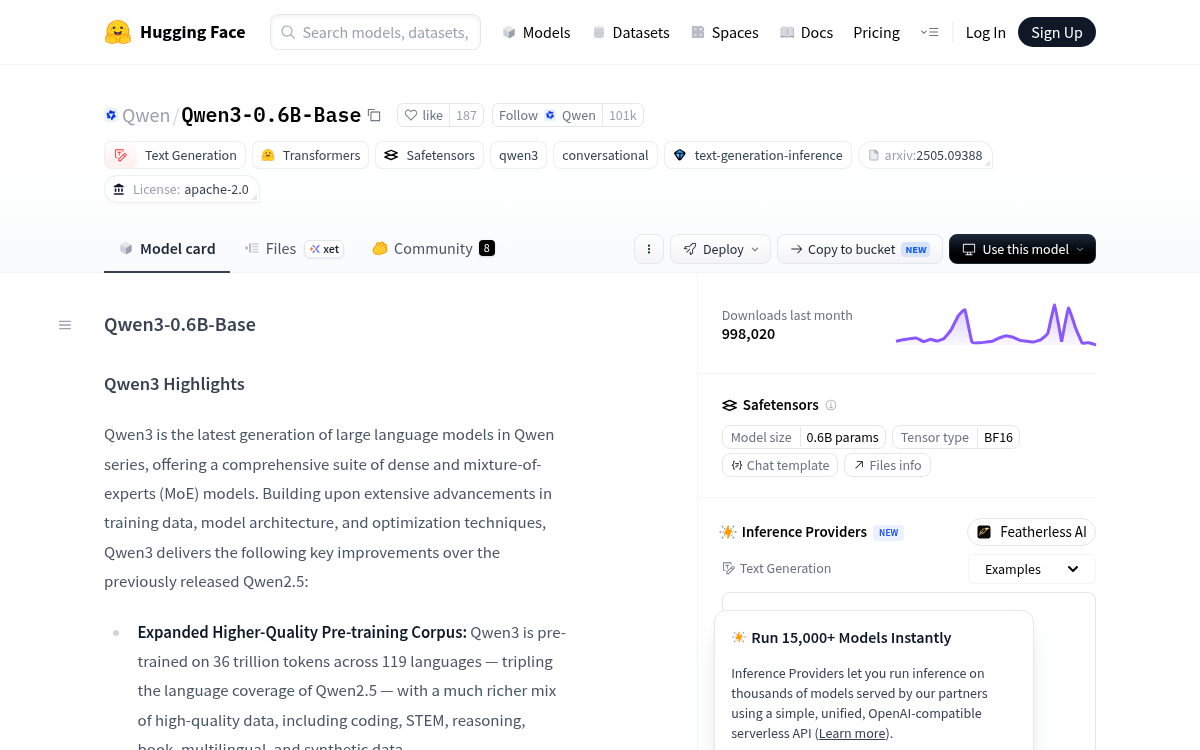
Alibaba's Qwen team quietly dropped one of the more useful small base models around, and it is showing up everywhere in fine-tunes, adapters, and quantized builds. Qwen3-0.6B-Base is the raw pretrained checkpoint from the Qwen3 family: a 600M-parameter dense transformer released under Apache 2.0, aimed at edge inference, research baselines, and anyone who needs a tiny LLM they can actually fine-tune on a single GPU.
It has already crossed roughly a million downloads on the Hub, with the community shipping hundreds of finetunes and quantizations on top of it. Here is what sits inside, and where it fits.
A tiny model with a heavyweight training recipe
On paper the specs look modest: a decoder-only transformer with around 600 million parameters, the smallest publicly released member of the Qwen3 family. What sits underneath is more interesting. The architecture uses 28 decoder blocks with grouped query attention, SwiGLU activations, RMSNorm, and QK-Norm layers, 16 query heads paired with 8 key/value heads, 0.44B non-embedding parameters, and a native 32,768-token context window.
The training recipe distinguishes it from other sub-billion-parameter bases. Qwen3 is pretrained on 36 trillion tokens across 119 languages, tripling the language coverage of Qwen2.5, with a much richer mix that includes coding, STEM, reasoning, book, multilingual, and synthetic data. That data budget is usually reserved for frontier-scale models, poured into a 0.6B checkpoint.
Pretraining is split into three stages, each with a different objective:
- Stage 1 covers broad language modeling and general knowledge acquisition.
- Stage 2 pushes reasoning-heavy data, focusing on STEM, coding, and logical reasoning.
- Stage 3 extends sequence lengths up to 32K to build long-context comprehension.
The team also ran scaling law sweeps to tune learning rate schedules and batch sizes separately for dense and MoE variants, and added global-batch load balancing loss for MoE models and QK layernorm across all models, which improved stability and overall performance.
Where it lands on benchmarks
According to the Qwen3 technical report, the 8B, 4B, 1.7B, and 0.6B base models maintain strong performance across nearly all benchmarks. The 8B, 4B, and 1.7B variants even outperform the larger Qwen2.5-14B, 7B, and 3B base models on more than half of the benchmarks, especially STEM and coding tasks. The 0.6B tier is compared against Gemma-3-1B, Llama-3, and prior Qwen2.5 small bases, and holds its own despite the size gap.
Where the checkpoint is genuinely useful:
- A strong starting point for domain fine-tunes on a single consumer GPU.
- Multilingual coverage across 119 languages, handy for non-English pipelines.
- Long documents, thanks to the 32K context trained natively in stage 3.
- Edge and on-device inference, where the ~1.2GB BF16 footprint (smaller with quantization) matters.
One caveat: this is a base checkpoint, so out of the box it does next-token prediction, not chat. Developers looking for a ready-to-use assistant should reach for the sibling Qwen3-0.6B post-trained model. The base version is meant to be fine-tuned or continued-pretrained.
Getting it running
The model is Apache 2.0, free to use commercially, and integrated into recent Hugging Face Transformers. One gotcha worth flagging: you need transformers>=4.51.0, otherwise loading fails with a KeyError: 'qwen3'.
from transformers import AutoTokenizer, AutoModelForCausalLM
tok = AutoTokenizer.from_pretrained("Qwen/Qwen3-0.6B-Base")
model = AutoModelForCausalLM.from_pretrained(
    "Qwen/Qwen3-0.6B-Base", device_map="auto"
)
out = model.generate(**tok("The capital of France is", return_tensors="pt").to(model.device), max_new_tokens=20)
print(tok.decode(out[0]))
It also works out of the box with vLLM (vllm serve "Qwen/Qwen3-0.6B-Base"), SGLang, and Docker Model Runner. The Hub lists 79 community quantizations for llama.cpp, Ollama, and LM Studio if you want to run it on CPU or a laptop.
Why the ecosystem is converging on it
Combine the release with Apache 2.0 licensing and a reproducible training pipeline, and Qwen3-0.6B-Base becomes a standard baseline for thin-client, edge, and resource-constrained work that still needs chain-of-thought reasoning, broad multilingual support, and quick adaptation to new domains. It is also the backbone the Qwen team used to build the widely adopted Qwen3 Embedding and Reranker series, so anyone picking a small foundation to fine-tune for retrieval, classification, or agent routing will find most of the ecosystem already pointed here.