
Alibaba's Qwen2-VL Squeezes Powerful Image and Video AI Into 2B Parameters
Alibaba's Qwen team released Qwen2-VL-2B-Instruct, a compact 2B-parameter vision-language model on Hugging Face under Apache 2.0.
 Pro
Takeaways
- Alibaba's Qwen team released Qwen2-VL-2B-Instruct on Hugging Face under Apache 2.0.
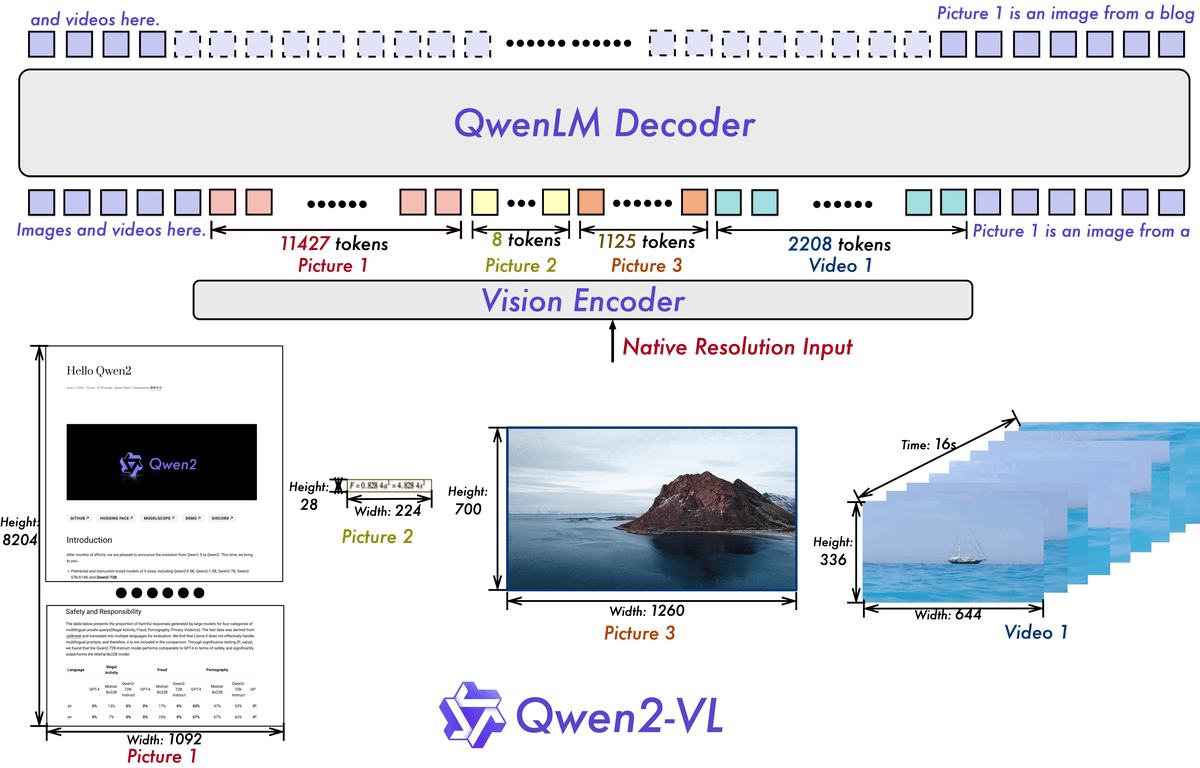
- Uses Naive Dynamic Resolution, mapping arbitrary image sizes to variable visual token counts.
- Multimodal Rotary Position Embedding (M-RoPE) encodes text, 2D image, and 3D video positions separately.
- Scores 90.1 on DocVQA and 794 on OCRBench, leading peer 2B vision-language models.
- Handles 20-minute-plus video QA and text in European, Japanese, Korean, Arabic, and Vietnamese scripts.
- Supports vLLM, SGLang, Docker, and 53 quantizations; see the GitHub repo.
Alibaba's Qwen team has released Qwen2-VL-2B-Instruct, the instruction-tuned 2-billion parameter member of the Qwen2-VL family. Published on Hugging Face under an Apache 2.0 license, it sits alongside 7B and 72B siblings and targets the case where you want strong image and video understanding without spinning up a data-center GPU.
The headline architectural change is that the model reads images at their native shape. Qwen2-VL introduces a Naive Dynamic Resolution mechanism that processes images of varying resolutions into different numbers of visual tokens, producing more efficient representations that align more closely with human perception. In practice, a receipt, a 4K screenshot, and a wide panorama each get turned into a different token count instead of being squashed into a fixed grid.
Untangling position information
The second change is how the model tracks where things are. Multimodal Rotary Position Embedding (M-RoPE) fuses positional information across text, images, and videos by splitting the rotary embedding into components that separately encode text order, 2D pixel coordinates, and the time axis for video frames. One flat sequence of positions becomes three coordinated ones.

That decomposition is what lets a 2B model reason over long video. The team applies a unified paradigm for handling both images and clips to enhance visual perception, and investigates scaling laws for large vision-language models as part of the release. The 2B sits on the small end of those scaling experiments.
What the small one is actually good at
Despite the size, the 2B holds its own against peers in the same weight class. From the numbers reported in the model card:
- DocVQA test: 90.1, ahead of InternVL2-2B at 86.9
- OCRBench: 794, versus 605 for MiniCPM-V 2.0
- TextVQA val: 79.7
- MMMU val: 41.1
- RealWorldQA: 62.9
- Video benchmarks: MVBench 63.2, Video-MME 55.6 without subtitles
Document parsing, OCR, and chart or screenshot reading are where the 2B punches above its weight, which lines up with the dynamic-resolution design. It also handles video question answering on clips longer than twenty minutes and reads text embedded in images across European languages, Japanese, Korean, Arabic, and Vietnamese.
Getting it running
The model plugs into the standard Hugging Face stack. You need a recent transformers build plus the helper package qwen-vl-utils, which handles base64, URLs, and interleaved image or video inputs. A minimal server via vLLM looks like this:
pip install vllm qwen-vl-utils
vllm serve "Qwen/Qwen2-VL-2B-Instruct"
From there it exposes an OpenAI-compatible chat completions endpoint that accepts image_url content parts. SGLang and Docker Model Runner are supported the same way, and there are already 53 community quantizations for llama.cpp, Ollama, and LM Studio if you want to run it on a laptop.
One useful knob for cost control is the visual token budget. The processor accepts min_pixels and max_pixels arguments so you can clamp each image to a token range, for example 256 to 1280, trading a bit of accuracy for memory and latency. For fine-grained work you can instead pass resized_height and resized_width, which get rounded to multiples of 28 to match the patch size.
Where it falls down
The model card is unusually direct about limitations. The model does not process audio tracks in videos, its image training data only runs through June 2023, and it struggles with recognizing specific individuals or brand IP. Counting objects in cluttered scenes and reasoning about 3D spatial relationships are also called out as weak spots, and complex multi-step instructions can trip it up.
Where the 2B fits
The natural home for this release is on-device and high-throughput pipelines: mobile agents, screenshot understanding, document ingestion, and batch OCR over large corpora, where a 72B model would be overkill and a text-only LLM plus a separate vision encoder would be clunkier to operate. For anything that hinges on precise counting, fine-grained spatial reasoning, or post-2023 world knowledge, you will still want to reach for a larger model or wire in retrieval. The GitHub repo and the technical report have the full recipe if you want to fine-tune from the base checkpoint.