
Alibaba's Qwen2 Tiny 1.5B Model Jumps 75% on Math Benchmarks
Qwen ships a 1.5B instruction-tuned model that runs on modest hardware while roughly doubling coding and math scores over its predecessor.
 Pro
Takeaways
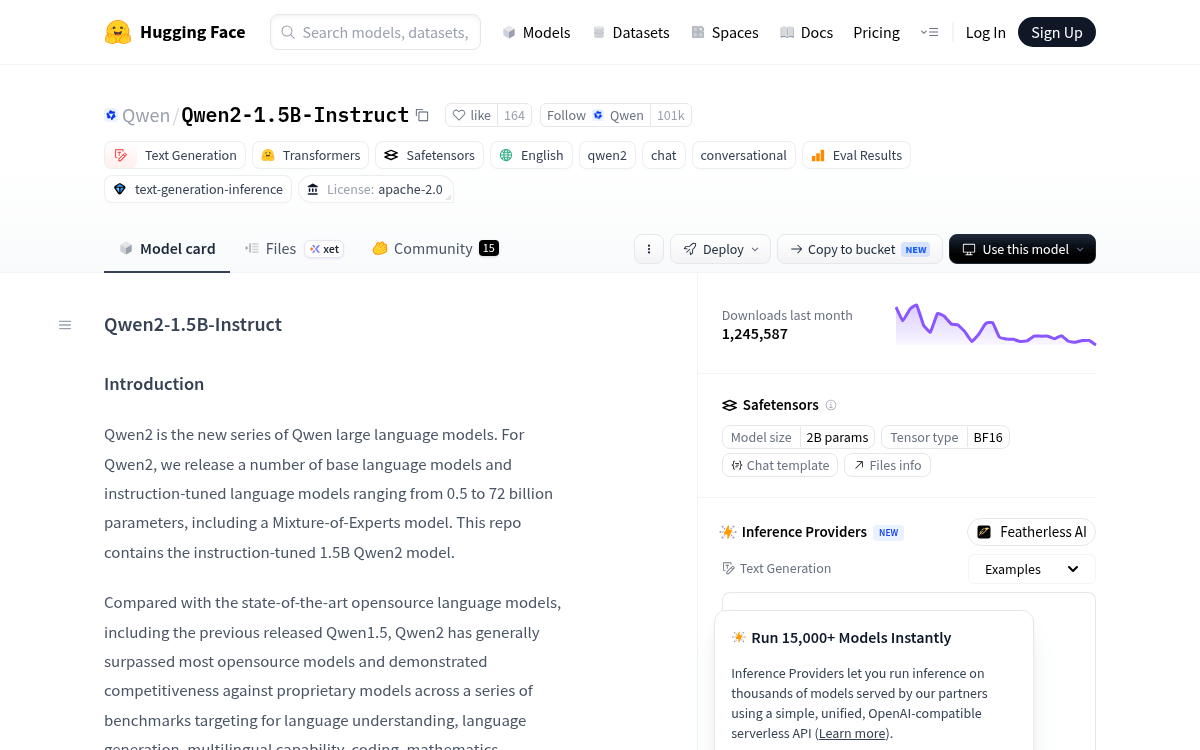
- Qwen ships Qwen2-1.5B-Instruct, an Apache 2.0 instruction-tuned model with 32K context.
- GSM8K nearly doubles versus Qwen1.5-1.8B-Chat, jumping from 35.3 to 61.6.
- HumanEval reaches 37.8 and MMLU 52.4, both well ahead of the previous 1.8B chat model.
- Architecture uses Group Query Attention, SwiGLU, and tied embeddings for efficient small-model inference.
- Post-trained with supervised fine-tuning plus direct preference optimization on a multilingual corpus.
- Deployable via Transformers, vLLM, SGLang, llama.cpp, and Ollama with quantized builds available.
Alibaba's Qwen team has released Qwen2-1.5B-Instruct, a small chat model that punches noticeably above its weight. It belongs to a broader family spanning five sizes, and the 1.5B variant is aimed squarely at edge deployments, laptops, and cost-sensitive inference where a 7B or larger checkpoint would be overkill.
The full Qwen2 lineup includes pretrained and instruction-tuned models at 0.5B, 1.5B, 7B, a 57B Mixture-of-Experts, and 72B. The smaller checkpoints ship under Apache 2.0, which makes them safe to embed inside commercial products without additional licensing gymnastics.
What actually changed under the hood
Qwen2-1.5B-Instruct is a decoder-only transformer with SwiGLU activations, attention QKV bias, and Group Query Attention (GQA), a technique that shares key and value projections across multiple query heads to cut inference memory and speed up decoding. The tokenizer was reworked to handle multiple natural languages and code more efficiently, and the base model was pretrained on data covering 27 additional languages beyond English and Chinese.
Post-training is where the instruct variant earns its name. The team combined supervised fine-tuning with direct preference optimization (DPO), a lighter-weight alternative to RLHF that skips training a separate reward model and instead optimizes directly on pairs of preferred and rejected responses. Context length for the 1.5B sits at 32K tokens, plenty for typical chat, RAG chunks, and short document workloads.
The numbers that matter
The most useful comparison is against the previous generation Qwen1.5-1.8B-Chat, which had more parameters. Qwen2-1.5B-Instruct wins across the board:
| Benchmark | Qwen1.5-1.8B-Chat | Qwen2-1.5B-Instruct |
|---|---|---|
| MMLU (general knowledge) | 43.7 | 52.4 |
| HumanEval (Python coding) | 25.0 | 37.8 |
| GSM8K (grade-school math) | 35.3 | 61.6 |
| C-Eval (Chinese) | 55.3 | 63.8 |
| IFEval (instruction following) | 16.8 | 29.0 |
The GSM8K jump from 35 to 61 is the headline. Grade-school math word problems have been a reliable stress test for whether a small model can chain simple reasoning steps, and crossing 60 at this size was not a given a year ago. HumanEval climbing to 37.8 puts basic Python function generation within reach for a model that fits comfortably in a few gigabytes of VRAM.
The Qwen team credits the gains largely to pre-training data scaling, arguing that data scaling remains an effective strategy for improving performance even at sub-billion parameter sizes.
Where a 1.5B model earns its keep
Small models don't compete with GPT-4o. They compete with running nothing at all because a bigger model would be too slow, too expensive, or too private to send to an API. Realistic use cases include:
- On-device assistants for laptops, phones, and browser extensions where latency and offline operation matter
- High-volume classification, routing, extraction, or summarization pipelines where each call needs to be cheap
- Draft-and-verify setups where the 1.5B produces candidates that a larger model reviews
- Speculative decoding as a draft model to accelerate a larger Qwen2 sibling
- Fine-tuning targets for domain-specific chatbots, since the base is already coherent and instruction-following
- Synthetic data generation and agent scaffolding where throughput matters more than peak quality
Community adoption reflects that positioning. The checkpoint has racked up several million downloads on Hugging Face, and the surrounding ecosystem is large: over 950 adapter checkpoints, more than 120 full finetunes, and dozens of quantized variants targeting llama.cpp, Ollama, LM Studio, and MLX.
Running it
Integration is standard Hugging Face Transformers. Anything on version 4.37.0 or later already knows about the qwen2 architecture, so no custom code is required.
from transformers import AutoModelForCausalLM, AutoTokenizer
tok = AutoTokenizer.from_pretrained("Qwen/Qwen2-1.5B-Instruct")
model = AutoModelForCausalLM.from_pretrained(
    "Qwen/Qwen2-1.5B-Instruct", torch_dtype="auto", device_map="auto"
)
messages = [
    {"role": "system", "content": "You are a helpful assistant."},
    {"role": "user", "content": "Explain GQA in one paragraph."},
]
inputs = tok.apply_chat_template(messages, add_generation_prompt=True,
                                 return_tensors="pt").to(model.device)
out = model.generate(inputs, max_new_tokens=256)
print(tok.decode(out[0][inputs.shape[-1]:], skip_special_tokens=True))
For production, vLLM and SGLang both serve the model with an OpenAI-compatible API out of the box, and quantized GGUF builds let you run it on a CPU or a modest consumer GPU with a couple of gigabytes of memory to spare.
The broader context
Small, competent open models have become their own category. Qwen has since positioned the 1.5B and 0.5B checkpoints as options for edge applications in highly resource-constrained environments, and successor lines like Qwen2.5 and specialized branches such as Qwen2.5-Math and Qwen2.5-Coder have continued to push what sub-2B models can do. For anyone building products that need a locally hosted language model with a permissive license, Qwen2-1.5B-Instruct remains one of the more sensible starting points in its size class.