
Alibaba's Qwen2.5-VL Squeezes a 33B Vision Model onto a Single Consumer GPU
Alibaba's 32B vision language model gets a 4-bit AWQ release, cutting VRAM needs while keeping most of the benchmark quality intact.
 Pro
Takeaways
- Alibaba released Qwen2.5-VL-32B-Instruct-AWQ, a 4-bit quantized vision language model under Apache 2.0.
- MMMU drops from 70.0 to 67.8, DocVQA holds at ~94, MathVista slips ~1 point versus bf16.
- Fits on a single 24GB consumer GPU instead of needing 60+ GB VRAM.
- Serves through vLLM, SGLang, Transformers, and Docker with an OpenAI-compatible endpoint.
- Supports video over one hour, bounding box grounding, JSON output, and GUI agent use.
- Reinforcement learning boost for math reasoning and human-aligned response formatting.
Alibaba's Qwen team has shipped an AWQ-quantized build of Qwen2.5-VL-32B-Instruct, squeezing a 33B parameter vision language model down to 4-bit weights while preserving most of the full precision quality. It ships under Apache 2.0, plugs directly into Transformers, vLLM, SGLang, and Docker Model Runner, and targets teams that want a strong open weights VLM without renting an H100 cluster.
AWQ, or Activation-aware Weight Quantization, inspects activation magnitudes to decide which weights matter most, protects those channels, and compresses the rest to 4 bits. In practice that turns a model that would otherwise want 60+ GB of VRAM in bf16 into something that fits comfortably on a single 24 GB consumer card, with a small accuracy hit as the tradeoff.
What the quantization actually costs you
The model card publishes side-by-side benchmarks against the unquantized 32B base. The gap is small enough that most application workloads will not notice.
| Benchmark | 32B Instruct | 32B Instruct AWQ |
|---|---|---|
| MMMU | 70.0 | 67.8 |
| DocVQA_VAL | 93.91 | 94.15 |
| MMBench_DEV_EN | 87.3 | 86.9 |
| MathVista_MINI | 74.7 | 73.6 |
DocVQA actually ticks up slightly, MMBench and MathVista lose about a point, and MMMU takes the biggest hit at roughly two points. For document parsing, OCR heavy pipelines, and general chart or UI understanding, the AWQ build is effectively a drop-in swap.
Why the 32B tier exists
The 32B variant was positioned as a middle ground between the 7B and 72B releases, and Qwen's own benchmarks claim it beats Gemma 3 27B, Mistral Small 3.1 24B, and GPT-4o-0513 on selected multimodal evals. The team continued to tune the model with reinforcement learning and released it under Apache 2.0, adjusting the output style toward more detailed, better-formatted answers that align more closely with human preferences. Complex math accuracy improved noticeably, as did image parsing, content recognition, and visual logic deduction.
What the model can actually do
Beyond captioning, Qwen2.5-VL is built as a general purpose visual reasoner. The headline capabilities:
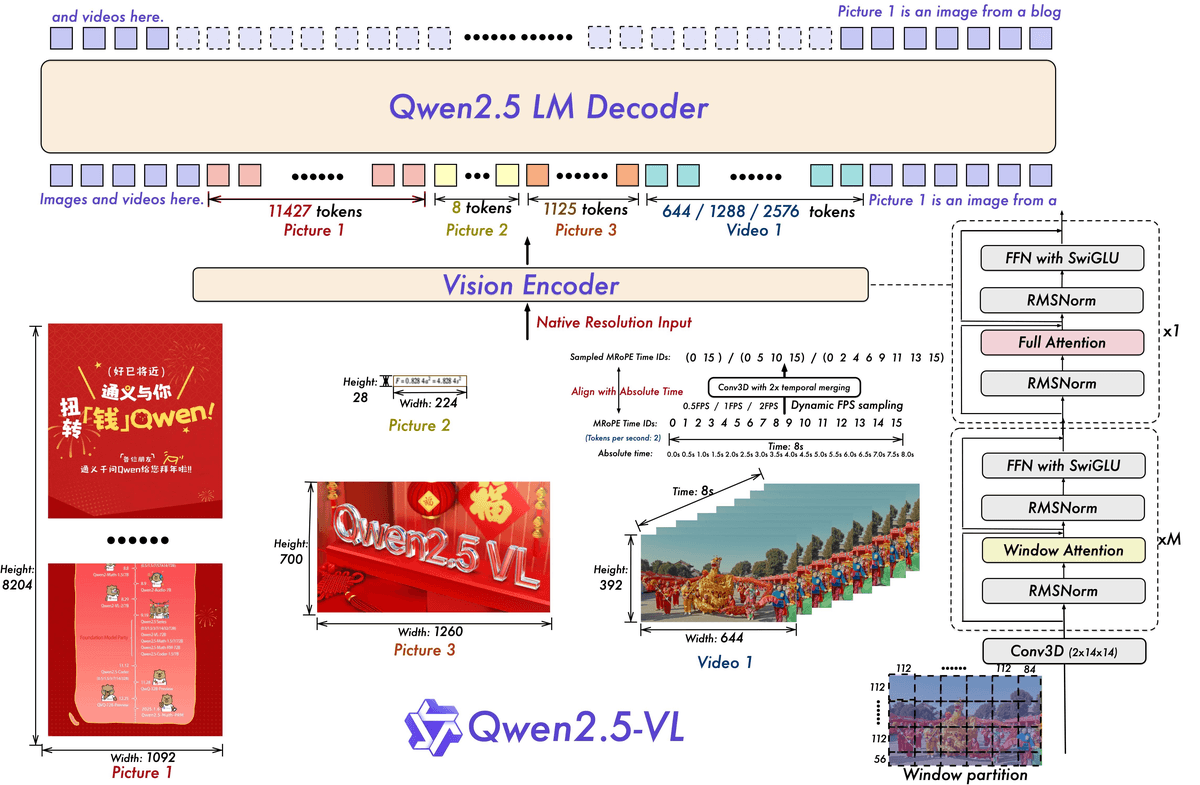
- Dynamic FPS video sampling with mRoPE updated in the time dimension using IDs and absolute time alignment, so the model can learn temporal sequence and speed and pinpoint specific moments in videos over an hour long.
- Visual grounding that emits bounding boxes or points as stable JSON, useful for downstream detection pipelines.
- Structured outputs from scans, invoices, forms and tables, useful in finance and commerce workflows.
- Agentic use, meaning it can drive a computer or phone UI by reasoning over screenshots and dispatching tool calls.
- A ViT vision encoder using window attention, SwiGLU and RMSNorm, aligning it with the structure of the Qwen2.5 LLM for faster training and inference.
Running it
The path of least resistance is vLLM, which serves the model behind an OpenAI-compatible endpoint:
pip install vllm
vllm serve "Qwen/Qwen2.5-VL-32B-Instruct-AWQ"
SGLang and a docker model run one-liner are also documented. For Transformers users, the code lives in recent releases, but if you hit KeyError: 'qwen2_5_vl' you need to install from source. A helper called qwen-vl-utils handles base64, URLs, and interleaved image or video inputs so you can feed the processor a message list without wiring up preprocessing yourself.
Two knobs matter for cost and speed. The min_pixels and max_pixels arguments on the processor let you cap visual tokens per image, defaulting to a range of 4 to 16384 tokens. The current config.json sets context length to 32,768 tokens, and YaRN can extend it further, though the Qwen team warns it degrades temporal and spatial localization and recommends simply raising max_position_embeddings for long video instead.
Where it fits
The obvious sweet spot is on-prem document intelligence: invoice extraction, form parsing, chart QA, and OCR heavy workflows where DocVQA-class performance matters and sending customer data to a hosted API is a non-starter. The agent story, driving GUIs from screenshots, remains more experimental, though it gets meaningfully more practical when the model fits on a single GPU. The weaknesses are the usual ones for a mid-size VLM: fine-grained spatial reasoning in cluttered scenes, long-horizon video reasoning, and cases where you actually need frontier-tier world knowledge, where GPT-5 class proprietary models still lead. For everything else, a 4-bit 32B open weights VLM under Apache 2.0 is a very reasonable default.