
Alibaba's Qwen2.5-VL Hits 8M Downloads Running Agents on a Single GPU
Alibaba's compact vision-language model brings document parsing, hour-long video comprehension, and GUI agent skills under an Apache 2.0 license.
 Pro
Takeaways
- Alibaba released Qwen2.5-VL-7B-Instruct, a 7B vision-language model under Apache 2.0.
- Beats GPT-4o-mini on DocVQA (95.7), ChartQA (87.3), OCRBench (864), MathVista (68.2).
- New window attention in ViT plus dynamic FPS sampling for efficient inference and hour-long video.
- Agent-ready: 84.7 on ScreenSpot, 93.7 on Android Control Low, 91.4 on MobileMiniWob++.
- Outputs bounding boxes, points, and JSON for structured extraction from invoices and forms.
- Runs on Transformers, vLLM, SGLang, Ollama; 150+ quantizations and 1,180+ finetunes available.
Alibaba's Qwen team has pushed Qwen2.5-VL-7B-Instruct onto Hugging Face, and the community has responded with over 8 million downloads. It sits at the sweet spot of the Qwen2.5-VL lineup: small enough to run on a single GPU, yet trained for document parsing, video understanding, and screen navigation tasks that used to demand frontier closed models.
A vision model that acts like an agent
The 7B checkpoint is the instruction-tuned middle child of a three-model family spanning 3B, 7B, and 72B parameters. It ships under Apache 2.0, so commercial deployment carries no licensing friction.
Qwen2.5-VL works as a visual agent that reasons and directs tools, with hooks for computer and phone control. It handles videos over an hour long and can pinpoint the relevant segment for a given event. For static images, it localizes objects with bounding boxes or points, emits stable JSON for coordinates and attributes, and returns structured output for scans of invoices, forms, and tables.
What changed under the hood
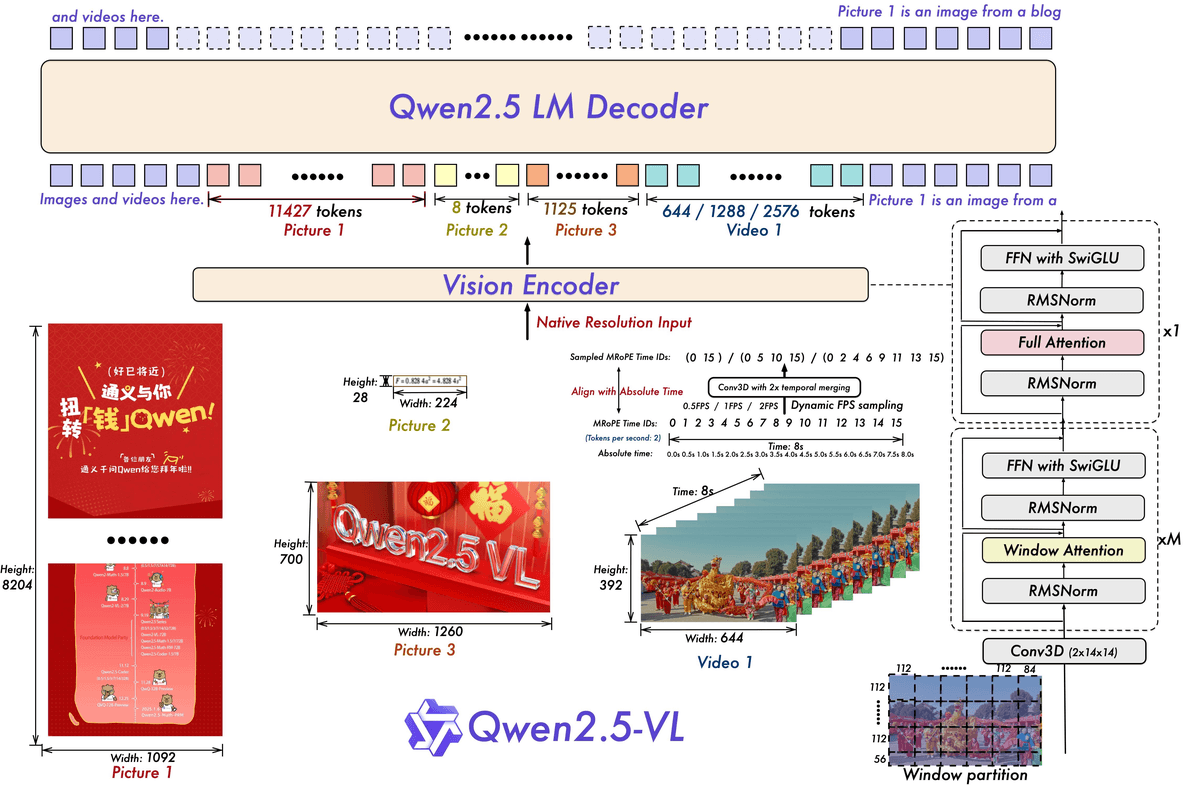
Two architectural moves separate this release from the previous Qwen2-VL generation. The team implemented window attention in the ViT to speed up training and inference, and further optimized the ViT with SwiGLU and RMSNorm to align it with the Qwen2.5 LLM. Window attention scales computational cost linearly with the number of patches rather than quadratically, and the model mixes full and window attention for a better performance-efficiency tradeoff.
Video understanding got a more interesting upgrade. Dynamic resolution now extends to the temporal dimension through dynamic FPS sampling, letting the model comprehend videos at various sampling rates. mRoPE was updated in the time dimension with IDs and absolute time alignment, so the model learns temporal sequence and speed. Translation: instead of feeding a fixed number of frames and hoping for the best, the model learns real wall-clock time, which is what lets it answer questions like "when does X happen?" in a long video.
The benchmark picture
On paper-heavy tasks the 7B model beats GPT-4o-mini and its own predecessor across most document and chart benchmarks:
| Benchmark | Qwen2-VL-7B | GPT-4o-mini | Qwen2.5-VL-7B |
|---|---|---|---|
| DocVQA test | 94.5 | - | 95.7 |
| InfoVQA test | 76.5 | - | 82.6 |
| ChartQA test | 83.0 | - | 87.3 |
| OCRBench | 845 | 785 | 864 |
| MathVista mini | 58.2 | 52.4 | 68.2 |
| MMMU val | 54.1 | 60.0 | 58.6 |
Video scores hold up well for a 7B: MVBench 69.6, Video-MME 71.6 with subtitles, LongVideoBench 54.7. The agent evaluation is where the numbers get interesting. On ScreenSpot the model scores 84.7, on Android Control Low it hits 93.7, and MobileMiniWob++ reaches 91.4. The weak spot is ScreenSpot Pro at 29.0, the harder desktop-app version of the same benchmark. Community leaderboards echo this pattern: on Roboflow's legacy Vision Evals the model landed at 52.2% on Visual Understanding with 47.6s average response time, suggesting raw visual reasoning still trails the biggest closed models.
Getting it running
The model plugs into the usual serving stacks. A minimal Transformers path looks like this:
from transformers import Qwen2_5_VLForConditionalGeneration, AutoProcessor
from qwen_vl_utils import process_vision_info
model = Qwen2_5_VLForConditionalGeneration.from_pretrained(
    "Qwen/Qwen2.5-VL-7B-Instruct",
    torch_dtype="auto",
    device_map="auto",
    attn_implementation="flash_attention_2",
)
processor = AutoProcessor.from_pretrained("Qwen/Qwen2.5-VL-7B-Instruct")
For production serving, one line brings up an OpenAI-compatible endpoint:
pip install vllm
vllm serve "Qwen/Qwen2.5-VL-7B-Instruct"
SGLang and Docker Model Runner are supported too, and 150+ community quantizations are available for llama.cpp, Ollama, and LM Studio. Context length is 32,768 tokens by default, extendable with YaRN, though the team notes YaRN significantly degrades temporal and spatial localization and is therefore not recommended for those use cases. A useful control knob is the pixel budget per image via min_pixels and max_pixels, which trades visual tokens for latency.
Where it earns its keep
The concrete workloads that make this model worth reaching for:
- Extracting structured JSON from invoices, forms, receipts, and tables without a bespoke OCR pipeline
- Chart and diagram question answering where the numbers actually need to be read off the axes
- GUI agents for mobile and web where clicking the right element matters more than raw reasoning
- Long-form video indexing where you need timestamps back, not just a summary
- Grounded visual tasks that need bounding boxes or points as first-class outputs
Where it will disappoint: highly cluttered desktop screenshots (ScreenSpot Pro), open-ended reasoning that requires world knowledge outside the image, and anything where you would previously reach for a 70B+ model. The Qwen2.5-VL technical report puts the 72B version in the same league as Claude 3.5 Sonnet on visual benchmarks, while the 7B is a working horse rather than a frontier competitor.
Why this release matters
A year ago, agentic vision at this quality was a closed-model story. With a permissively licensed 7B checkpoint hitting 93.7 on Android Control Low and 95.7 on DocVQA, the assumption that you need to call an API for solid document and UI agents is worth revisiting. The 8 million download count on Hugging Face, along with over 1,180 finetunes and 150 quantizations spawned from this base, suggests the community has already decided.