
Alibaba's Qwen2.5-VL-3B Hits 5M Downloads Beating the Previous-Gen 7B
Alibaba's compact 3B vision-language model brings document parsing, hour-long video understanding, and GUI agent skills to edge hardware.
 Pro
Takeaways
- Qwen2.5-VL-3B-Instruct is Alibaba's edge-focused vision-language model, now past 5M downloads on Hugging Face.
- Outperforms the previous-gen Qwen2-VL-7B on document, math, and chart benchmarks despite being less than half the size.
- Scores 93.9 on DocVQA, 77.1 on InfoVQA, 62.3 on MathVista, and 90.8 on AndroidWorld_SR.
- Adds dynamic FPS sampling and mRoPE with absolute time alignment for hour-long video understanding and moment localization.
- Streamlined ViT with window attention, SwiGLU, and RMSNorm speeds up training and inference on high-resolution images.
- Free weights, vLLM and SGLang servers supported, plus 92 community quantizations for laptop-class deployment. Full blog.
Alibaba's Qwen team has quietly turned Qwen2.5-VL-3B-Instruct into one of the most downloaded open vision-language models on Hugging Face, crossing five million downloads. It is the smallest member of the Qwen2.5-VL family, positioned explicitly as an edge-AI option, and it ships with the full feature set of its 7B and 72B siblings: document parsing, long-video reasoning, bounding-box localization, and GUI agent behaviors. What matters here is what a 3B model can now do without a cloud call.
A 3B that punches above its class
The headline claim from the Qwen team is that Qwen2.5-VL-3B works as an edge-AI solution and outperforms the 7B model of the previous Qwen2-VL generation. That is a generation-over-generation jump large enough to reset what you should expect from a small multimodal model running on a single consumer GPU.
The model card frames the release around five concrete capabilities:
- Visual understanding beyond object recognition: analyzing texts, charts, icons, graphics, and layouts within images, not just naming what appears in them.
- Agentic control: acting as a visual agent that can reason and call tools for computer use and phone use.
- Long-video comprehension: parsing videos over an hour long and pinpointing the segments relevant to a query.
- Visual localization: producing bounding boxes or points with stable JSON output for coordinates and attributes.
- Structured extraction: structured outputs for scans of invoices, forms, and tables, useful in finance, commerce, and similar workflows.
What changed under the hood
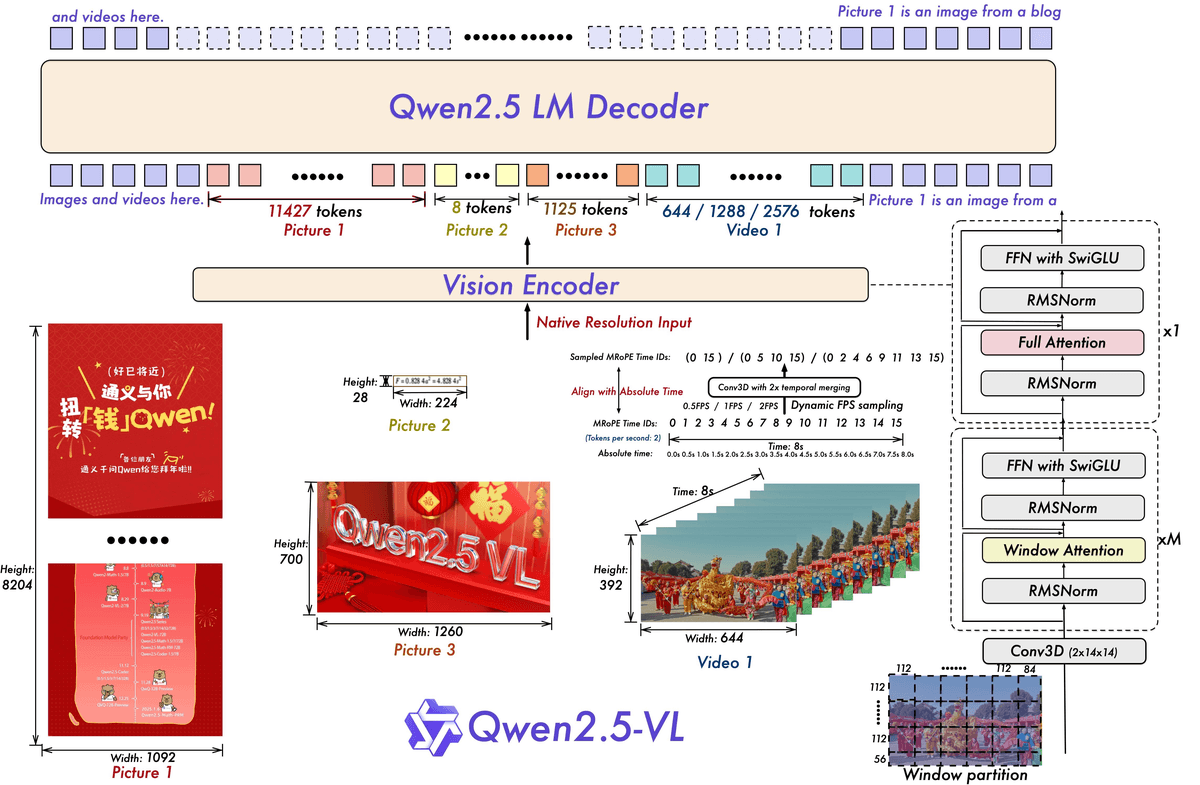
Two architectural updates do most of the heavy lifting. The video pipeline was rebuilt around dynamic frame rates, extending dynamic resolution to the temporal dimension via dynamic FPS sampling so the model can comprehend videos at various sampling rates. mRoPE was updated in the time dimension with IDs and absolute time alignment, letting the model learn temporal sequence and speed and pinpoint specific moments. In practical terms, the model does not just see frames, it knows how far apart in real time they are, which is why it can answer questions like when in a video something happened.
The vision encoder was also streamlined. Window attention was added to the ViT to speed up training and inference, and the ViT was further optimized with SwiGLU and RMSNorm to align it with the Qwen2.5 LLM structure. Window attention restricts each image patch to attend to nearby patches inside a local window instead of the entire image, which keeps compute manageable on high-resolution inputs. Aligning ViT activations and normalization with the language model side also removes a small but real source of representational mismatch between the two towers.
How it scores
Against comparable small models, the 3B is competitive and in several places ahead of the previous-gen 7B. Highlights from the model card:
| Benchmark | InternVL2.5-4B | Qwen2-VL-7B | Qwen2.5-VL-3B |
|---|---|---|---|
| DocVQA (test) | 91.6 | 94.5 | 93.9 |
| InfoVQA (test) | 72.1 | 76.5 | 77.1 |
| MathVista (mini) | 60.5 | 58.2 | 62.3 |
| MathVision (full) | 20.9 | 16.3 | 21.2 |
| MMMU (val) | 52.3 | 54.1 | 53.1 |
| TextVQA (val) | 76.8 | 84.3 | 79.3 |
The document and math scores are where the 3B justifies itself. A third-party summary notes strong results on DocVQA (93.9), InfoVQA (77.1), and MathVista (62.3), with slight underperformance versus larger Qwen2 variants on MMBench and MMStar. If your workload is documents, charts, and structured images, this size is enough. For general visual conversation quality closer to a 7B or 32B, reach further up the family.
On the agent side, the model card reports 55.5 on ScreenSpot, 76.9 on AITZ_EM, and 90.8 on AndroidWorld_SR. Screen understanding is the weakest link at 23.9 on ScreenSpot Pro, which uses harder professional-application screens like AutoCAD and IDE layouts.
Running it locally
The model is released via Hugging Face, ModelScope, GitHub, and Qwen Chat, with weights in BF16 and roughly 4B total parameters counting the vision tower. A minimum-viable transformers snippet looks like this:
from transformers import Qwen2_5_VLForConditionalGeneration, AutoProcessor
from qwen_vl_utils import process_vision_info
model = Qwen2_5_VLForConditionalGeneration.from_pretrained(
    "Qwen/Qwen2.5-VL-3B-Instruct", torch_dtype="auto", device_map="auto"
)
processor = AutoProcessor.from_pretrained("Qwen/Qwen2.5-VL-3B-Instruct")
messages = [{"role": "user", "content": [
    {"type": "image", "image": "file:///path/to/invoice.jpg"},
    {"type": "text", "text": "Extract line items as JSON."},
]}]
text = processor.apply_chat_template(messages, tokenize=False, add_generation_prompt=True)
image_inputs, video_inputs = process_vision_info(messages)
inputs = processor(text=[text], images=image_inputs, videos=video_inputs,
                   padding=True, return_tensors="pt").to("cuda")
out = model.generate(**inputs, max_new_tokens=512)
print(processor.batch_decode(out, skip_special_tokens=True))
A few knobs matter more than usual with this family. The processor accepts min_pixels and max_pixels to cap the visual token budget per image, which is the main lever for balancing accuracy against latency and VRAM. The default context is 32,768 tokens and can be extended with YaRN for long text, though the model card warns this hurts spatial and temporal localization and is discouraged when you care about those tasks. For long videos it recommends raising max_position_embeddings directly instead.
Serving is well supported. Both vllm serve Qwen/Qwen2.5-VL-3B-Instruct and an SGLang launcher work out of the box, and there are 92 community quantizations for llama.cpp, Ollama, and LM Studio if you want to run it on a laptop.
Availability and cost
The weights are free to download from Hugging Face. If you would rather hit an API, Qwen2.5-VL-3B-Instruct is offered on OpenRouter, accepting text and images as input and returning text, and Fireworks hosts it as well. Because it fits comfortably in a single 12-16 GB GPU at BF16, and much less when quantized, self-hosting is realistic for most teams.
Where it fits in a stack
The practical use cases follow directly from what it does well:
- Document intelligence: invoice and form extraction into JSON, with DocVQA and InfoVQA scores that used to require 7B-class models.
- Chart and diagram QA: MathVista and MathVision numbers that beat the previous-gen 7B suggest it can actually reason over what it reads.
- Mobile and desktop agents: strong AndroidWorld and AITZ scores make it a plausible policy model for phone automation when paired with a screen-capture loop.
- Video segment retrieval: dynamic FPS and absolute time alignment let it answer time-anchored questions on hour-long footage.
- On-device multimodal assistants: with quantization, a 3B VL model becomes deployable on laptops and edge boxes without a network round trip.
The wider context
Qwen2.5-VL is now a family of four sizes from Alibaba Cloud, available at 3B, 7B, 32B, and 72B, with the 32B variant released under Apache 2.0 after further reinforcement-learning optimization. The 3B occupies the edge slot in that lineup, and it is the version picking up the most integrations in downstream projects, with over 850 fine-tunes and 273 adapters listed on Hugging Face at the time of writing.
The assumption worth updating is the old rule that serious document parsing, GUI agents, and video localization require large closed models. A 3B open checkpoint clearing 93 on DocVQA and 90 on AndroidWorld_SR means many of these workloads can move on-device, into private VPCs, or into cost-sensitive batch pipelines without giving up much accuracy. For a lot of teams, that changes the build-versus-call decision.