
Alibaba's Qwen2.5 Tiny 1.5B Model Doubles Math Scores and Runs Anywhere
Alibaba's compact 1.54B instruction-tuned model doubles math and coding scores over its predecessor while running comfortably on a laptop.
 Pro
Takeaways
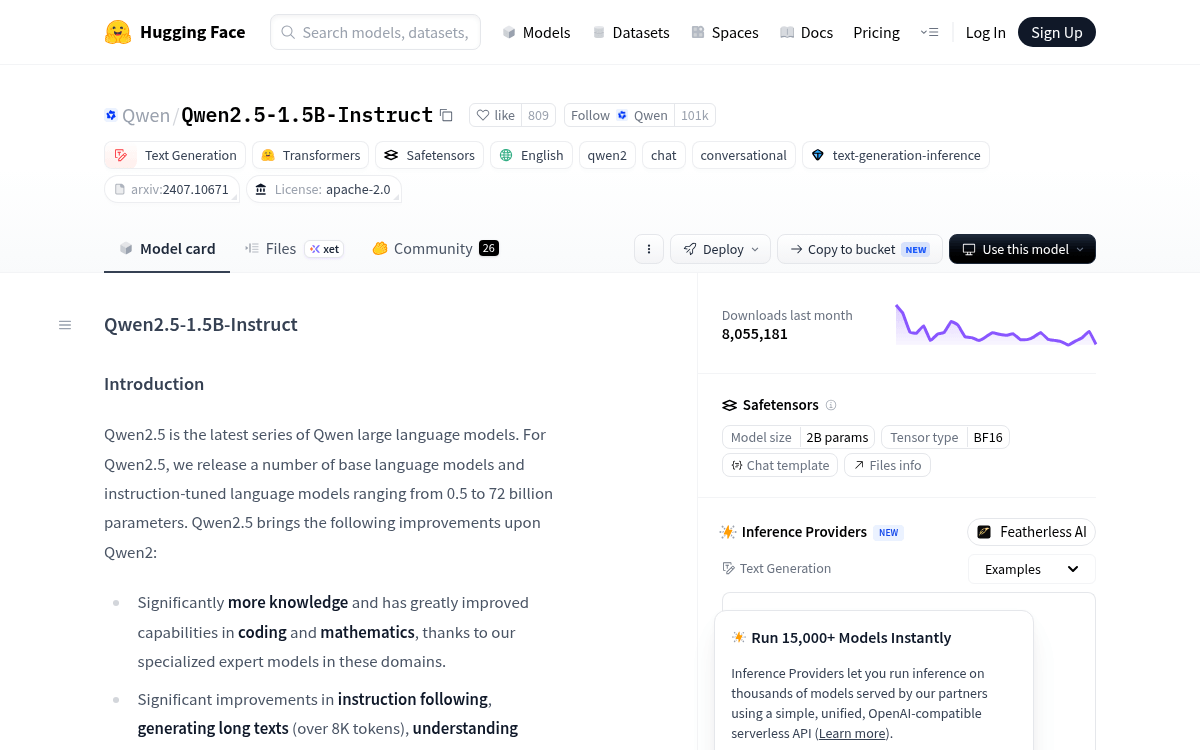
- Qwen2.5-1.5B-Instruct is a 1.54B parameter edge model from Alibaba under Apache 2.0.
- MATH score jumps from 25.3 to 55.2 and HumanEval from 42.1 to 61.6 over Qwen2-1.5B.
- 32K context, 8K generation, GQA with 12 Q heads and 2 KV heads across 28 layers.
- Trained on up to 18 trillion tokens with multilingual support for 29+ languages.
- Over 8 million downloads and 1,700+ community fine-tunes on Hugging Face.
- Runs via Transformers, vLLM, SGLang, llama.cpp, and Ollama on modest hardware.
Alibaba's Qwen team shipped Qwen2.5-1.5B-Instruct, a compact instruction-tuned language model that has quietly become one of the most downloaded small LLMs on Hugging Face with over 8 million pulls. It sits at the smallest end of the Qwen2.5 lineup, aimed squarely at edge deployments, on-device assistants, and anywhere you can't spare a GPU with double-digit gigabytes of memory.
The release ships under Apache 2.0, so you can fine-tune it, embed it in commercial products, and redistribute derivatives without a licensing conversation. That combination of tiny footprint, permissive license, and unusually strong benchmark numbers is why it has become a default base for adapters, quantizations, and downstream fine-tunes.
A small model with surprisingly grown-up numbers
The headline story is how far the 1.5B tier has come in a single generation. Qwen's own evaluation reports that Qwen2.5-1.5B-Instruct and Qwen2.5-0.5B-Instruct have seen large performance improvements over their previous versions, making them well-suited for edge-side applications in highly resource-constrained environments. The jumps over Qwen2-1.5B-Instruct are not incremental:
- MATH climbs from 25.3 to 55.2, more than doubling.
- GSM8K goes from 61.6 to 73.2 on grade-school math word problems.
- HumanEval jumps from 42.1 to 61.6, and MBPP from 44.2 to 63.2 on Python coding.
- MMLU-Pro rises from 22.9 to 32.4, and IFEval strict-prompt from 29.0 to 42.5 on instruction following.
Those coding scores land in the same neighborhood as much larger models from a year prior. The 1.5B tier is now credibly useful for autocomplete-style assistants and simple agent loops rather than being a toy.
What is actually inside
The architecture is a standard modern decoder-only transformer with the usual tricks. According to the model card, it uses transformers with RoPE, SwiGLU, RMSNorm, Attention QKV bias and tied word embeddings, packing 1.54B parameters (1.31B non-embedding) across 28 layers with grouped-query attention using 12 Q heads and 2 KV heads. Context length reaches 32,768 tokens with up to 8,192 tokens of generation.
The gains come from data and training rather than architecture. Qwen scaled pre-training from 7 trillion tokens up to 18 trillion, and folded in the specialist recipes from their Qwen2.5-Coder and Qwen2.5-Math projects. The Qwen2.5 release also promises significant improvements in instruction following, generating long texts over 8K tokens, understanding structured data such as tables, and producing structured outputs (especially JSON), along with multilingual support spanning 29+ languages.
Where a 1.5B model earns its keep
Small models are not universal tools. This one shines for narrow, well-scoped jobs where latency and cost matter more than raw reasoning. Realistic fits include:
- On-device chat, summarization, and rewriting inside mobile or desktop apps.
- Function-calling and JSON extraction as the last mile of a RAG pipeline.
- Draft-model roles for speculative decoding paired with a larger sibling.
- Base for LoRA fine-tunes: the community has already published 1,700+ derivative fine-tunes and 1,300+ adapters.
- Local coding assistants for boilerplate, given the HumanEval and MBPP results.
Expect it to disappoint on anything requiring deep world knowledge, long multi-hop reasoning, or tool use in the wild. Independent tool-use benchmarking shows the 1.5B model trailing its larger 7B and 14B siblings by wide margins on realistic agent tasks, which is expected but worth remembering before wiring it into an autonomous workflow.
Getting it running
The model is drop-in compatible with the Hugging Face Transformers stack. The one gotcha is that you need transformers>=4.37.0, otherwise loading fails with a KeyError: 'qwen2'. A minimal chat example:
from transformers import AutoTokenizer, AutoModelForCausalLM
name = "Qwen/Qwen2.5-1.5B-Instruct"
tok = AutoTokenizer.from_pretrained(name)
model = AutoModelForCausalLM.from_pretrained(name, torch_dtype="auto", device_map="auto")
msgs = [{"role": "user", "content": "Explain RoPE in two sentences."}]
prompt = tok.apply_chat_template(msgs, tokenize=False, add_generation_prompt=True)
out = model.generate(**tok(prompt, return_tensors="pt").to(model.device), max_new_tokens=200)
print(tok.decode(out[0], skip_special_tokens=True))
For serving at scale, both vLLM and SGLang expose OpenAI-compatible endpoints with a single command, and 264 community quantizations covering llama.cpp, Ollama, LM Studio, and Jan mean you can run the weights on essentially any modern machine, including CPU-only laptops.
The broader signal is that the useful floor for local LLMs keeps dropping. A 1.5B parameter model that can solve half of MATH problems and write reasonable Python did not exist as an open weight a year earlier, and now it fits in less than 4 GB with room to spare for a KV cache. For teams building anything privacy-sensitive or latency-critical, that changes the calculus of when you actually need to call a frontier API.