
Alibaba's Qwen2.5-Omni-7B Sees, Hears, and Talks Back in Real Time
Alibaba's new open-weight model handles text, images, audio, and video inputs while streaming both text and speech responses under Apache 2.0.
 Pro
Takeaways
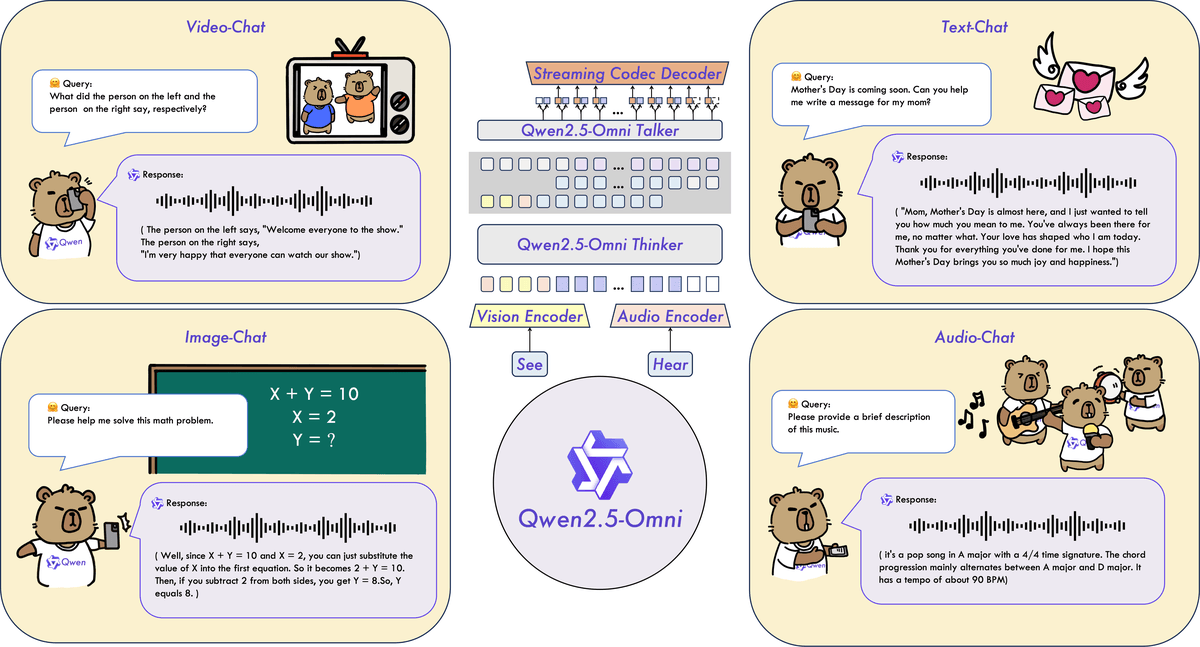
- Qwen2.5-Omni-7B accepts text, images, audio, and video, and generates both streaming text and speech.
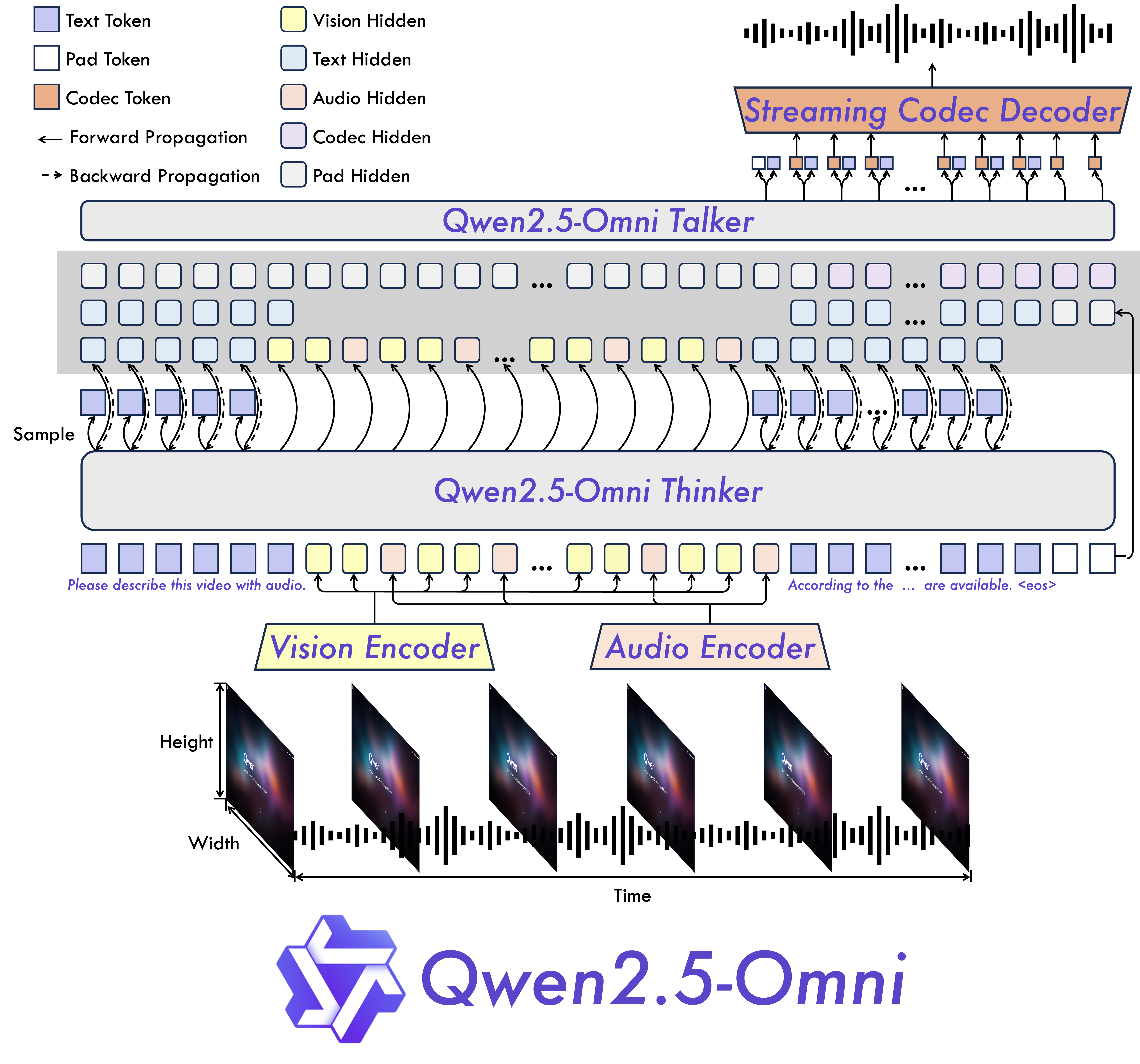
- Thinker-Talker architecture separates language reasoning from speech synthesis, coordinated by TMRoPE time-aligned position embeddings.
- Apache 2.0 license, available on Hugging Face and GitHub.
- State-of-the-art 56.13% on OmniBench, beating Gemini-1.5-Pro across cross-modal reasoning tasks.
- BF16 needs ~31 GB VRAM for 15-second video; GPTQ-Int4 and AWQ cut memory over 50%.
- Smaller 3B sibling and two built-in voices (Chelsie, Ethan) support on-device deployment.
Alibaba's Qwen team has released a single 7B model that reads text, images, audio, and video, then talks back in real time. Qwen2.5-Omni-7B ships as open weights under Apache 2.0, and it targets consumer hardware rather than a datacenter rack. The team frames it as the new flagship end-to-end multimodal model in the Qwen series, and the numbers back that claim across audio, vision, and speech generation benchmarks.
One model, every modality, streaming out
The system ingests text, images, audio, and video while delivering real-time streaming responses through both text generation and natural speech synthesis. That last part is the interesting bit. Most open multimodal models either stop at understanding or bolt on a separate TTS. Qwen2.5-Omni-7B produces spoken audio inside the same generation loop, with two built-in voices named Chelsie (female) and Ethan (male) that you select via a speaker parameter at generation time.
Input limits are practical rather than generous. The model accepts roughly 10 MB per image, 10 MB and 3 minutes per audio file, 150 MB and 40 seconds per video, all within a 32,768 token context. That fits a short clip plus a question, but not hour-long video reasoning.
The Thinker-Talker split
The core architectural idea separates what to say from how to say it. Thinker handles text generation and Talker handles speech synthesis, minimizing interference between the two modalities. Alongside this split, TMRoPE (Time-aligned Multimodal RoPE) synchronizes video and audio through position embeddings, and Block-wise Streaming Processing keeps audio latency low.
TMRoPE is the piece worth understanding. Standard rotary position embeddings encode where a token sits in a sequence. When video frames arrive at 24 fps alongside audio at 16 kHz, positions have to agree on wall-clock time so that a spoken word lines up with the mouth movement that produced it. TMRoPE encodes timestamps so the model treats video and audio as one time-aligned stream rather than two parallel sequences.
Under the hood the model is a composite. It combines a pretrained Qwen 2.5 7B text transformer, a Qwen2.5-VL vision encoder, a Whisper-large-v3 audio encoder, a speech transformer, and an audio decoder built on BigVGAN, with adapters connecting them. Training ran in three stages: the vision and audio encoders and their adapters were trained first with a frozen text transformer on audio-text and image-text pairs, then the full system was pretrained to generate the next text or audio token across 1.2 trillion tokens of multimodal data, and finally the system was tuned on longer multimodal inputs. That is why the parameter count on Hugging Face reads 11B rather than 7B, since the extra weights are the perception and speech stacks bolted onto the 7B language core.
Where it wins on benchmarks
Against similarly sized single-modality models and closed systems like Gemini-1.5-Pro, the numbers range from competitive to strong:
- OmniBench (cross-modal reasoning): 56.13% average versus 42.91% for Gemini-1.5-Pro, a state-of-the-art result for the benchmark.
- Speech recognition (Librispeech test-clean): 1.8 WER, matching Whisper-large-v3 at 1.8.
- Audio reasoning (MMAU average): 65.60 versus 54.90 for Gemini-Pro-V1.5.
- Video with subtitles (Video-MME w/sub): 72.4, beating Qwen2.5-VL-7B at 71.6.
- Voice chat (VoiceBench average): 74.12, ahead of MiniCPM-o and Baichuan-Omni-1.5.
- Image understanding (MMMU val): 59.2, roughly on par with GPT-4o-mini at 60.0.
The one weak spot is pure text reasoning. On MMLU-Pro the model scores 47.0 versus 56.3 for the plain Qwen2.5-7B text model, and on HumanEval it drops to 78.7 versus 84.8. Multimodal training clearly costs some text-only performance, so if you only need a chatbot, reach for the text model.
The VRAM bill
The model card is honest about memory. Running a 15-second video in BF16 takes about 31 GB, a 30-second video needs 41 GB, and 60 seconds pushes past 60 GB. FP32 is essentially impractical outside an A100 or H100. Actual usage typically runs 1.2x higher than the theoretical minimums shown in the docs.
Two escape hatches exist. 4-bit quantized GPTQ-Int4 and AWQ versions maintain comparable performance to the original while cutting GPU VRAM consumption by over 50%. Qwen2.5-Omni-3B, a smaller sibling, is also on Hugging Face and needs only about 18 GB at BF16 for a 15-second video, which fits on a single 24 GB consumer card.
Using it in practice
The model plugs into Transformers with a dedicated processor. Getting audio out requires an exact system prompt or Talker stays silent, a common gotcha in community discussions.
from transformers import Qwen2_5OmniForConditionalGeneration, Qwen2_5OmniProcessor
import soundfile as sf
model = Qwen2_5OmniForConditionalGeneration.from_pretrained(
    "Qwen/Qwen2.5-Omni-7B", torch_dtype="auto", device_map="auto",
    attn_implementation="flash_attention_2",
)
processor = Qwen2_5OmniProcessor.from_pretrained("Qwen/Qwen2.5-Omni-7B")
text_ids, audio = model.generate(**inputs, speaker="Ethan", use_audio_in_video=True)
sf.write("out.wav", audio.reshape(-1).cpu().numpy(), samplerate=24000)
Calling model.disable_talker() after loading saves about 2 GB of VRAM when you only need text. A qwen-omni-utils helper package handles base64, URLs, and interleaved media, and video decoding runs through decord if installed or falls back to torchvision.
Where this actually fits
The obvious targets are voice agents that need to see. Suggested applications include real-time audio descriptions for visually impaired users, step-by-step cooking guidance from video of ingredients, and customer service dialogues. Real-time voice-to-voice chat, meeting summarization from raw audio, and video Q&A over short clips are all viable with a single model instead of a Whisper plus VLM plus TTS pipeline.
The strategic point is that the open ecosystem now has a credible answer to closed voice-mode systems like GPT-4o's audio interface. Latency on a laptop still trails, but you can self-host the whole stack under a permissive license, fine-tune the perception and speech heads separately thanks to the Thinker-Talker split, and swap in the 3B or 4-bit variants when memory is tight. For anyone building assistants that need to hear and speak, the tradeoff between quality and control just shifted.