
Alibaba's Qwen2.5-Coder Hits 2M Downloads Offering GPT-4o Coding Power Locally
Alibaba's mid-tier open-source coding model packs 14.7B parameters, a 128K context window, and Apache 2.0 licensing into a workstation-friendly footprint.
 Pro
Takeaways
- Qwen2.5-Coder-14B-Instruct is a dense 14.7B parameter code model with a 128K token context via YaRN rope scaling
- Trained on 5.5 trillion tokens of code, text-code grounding, and synthetic data on top of Qwen2.5
- Apache 2.0 licensed, permissive for commercial use and redistribution
- Runs at Q4_K_M on a 12GB GPU, or FP16 on a 24-28GB card
- Available via Hugging Face, Ollama, vLLM, and SGLang with OpenAI-compatible endpoints
- Sweet spot between the 7B (too shallow for repo work) and 32B (too heavy for single-GPU inference)
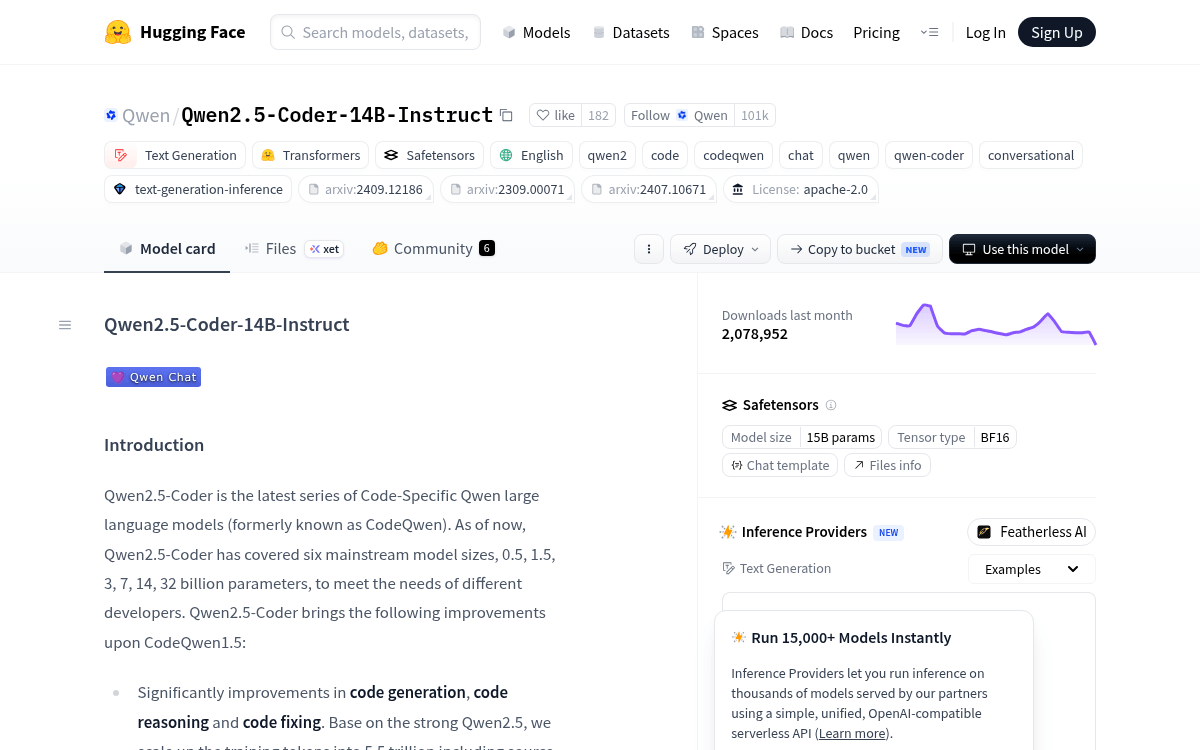
Alibaba's Qwen team has been quietly building one of the most credible open-source coding model families available, and the 14B instruct variant sits between the ultra-light 0.5B experiments and the flagship 32B. Qwen2.5-Coder-14B-Instruct targets developers who want serious coding performance without a data-center GPU bill, and it has already crossed two million downloads on Hugging Face.
Under the hood
Qwen2.5-Coder is the latest series of code-specific Qwen large language models (formerly known as CodeQwen), and the 14B instruct checkpoint is the aligned, chat-ready version of the base weights. Architecturally, it is a dense causal transformer built on the now-standard modern stack: rotary position embeddings, SwiGLU activations, RMSNorm, and grouped-query attention.
- Parameters: 14.7B total, 13.1B non-embedding
- Layers: 48
- Attention heads: 40 query, 8 key/value (GQA)
- Context length: 131,072 tokens
- License: Apache 2.0
The long context is not a native default. The current config.json ships with a context length of 32,768 tokens, and pushing beyond that requires enabling YaRN rope scaling, a technique that stretches the effective context window without retraining. The team notes that vLLM currently supports only static YaRN, so the scaling factor stays fixed regardless of input length and can hurt quality on shorter prompts if left enabled by default.
How it was trained
The base model was pretrained on a large code-heavy corpus before being instruction-tuned. Starting from Qwen2.5, the team scaled training to 5.5 trillion tokens spanning source code, text-code grounding, and synthetic data. Qwen2.5-Coder-32B has become the current state-of-the-art open-source code LLM, with coding abilities matching GPT-4o. The 14B shares the same recipe at smaller scale. According to the Qwen team blog, they observed a clean positive correlation between model size and downstream code performance across the 0.5B, 1.5B, 3B, 7B, 14B, and 32B checkpoints. That is why the mid-tier 14B matters: it captures most of the flagship's gains at less than half the memory footprint.
What it does well
The family was optimized around three axes: code generation, code repair, and code reasoning. Qwen2.5-Coder-32B-Instruct achieved the best performance among open-source models on multiple popular code generation benchmarks (EvalPlus, LiveCodeBench, BigCodeBench), competitive with GPT-4o. The 14B trails the flagship but still lands ahead of most similarly-sized open competitors on those same evaluations. It is also broadly multilingual across programming languages, thanks to careful data cleaning and balancing during pretraining.
Fill-in-the-middle is a less-discussed strength. The 32B variant hit SOTA on Humaneval-Infilling, CrossCodeEval, CrossCodeLongEval, RepoEval, and SAFIM using an 8K sequence length, which is exactly the workload editor integrations like Continue.dev or Cursor depend on.
The weak spots
Third-party evaluations are more sobering once you push past HumanEval-style benchmarks. On CodeCriticBench, which tests a model's ability to critique code rather than write it, Qwen2.5-Coder-14B-Instruct scored 5.57 overall, well below StarCoder2-15B-Instruct at 20.92 and CodeLlama-13B-Instruct at 15.55. Strong at producing code, weaker at reasoning about code someone else wrote. It also inherits the general Qwen2.5 tendency toward caution on open-ended reasoning compared to pure coding tasks.
Running it locally
The model works with any recent Transformers install (4.37+ is required, or you get a KeyError: 'qwen2'). For local use, the community has already produced quantized builds. Qwen2.5-Coder-14B-Instruct needs a 12 GB card at Q4_K_M (9 GB). Stepping up to Q8_0 nearly doubles the footprint to 16 GB, and unquantized FP16 weights take 28 GB. A one-line pull via Ollama gets you running:
ollama run qwen2.5-coder:14bFor serving at scale, the model card documents vLLM and SGLang launch commands that expose an OpenAI-compatible endpoint, which drops cleanly into most existing agent frameworks.
Where the 14B fits
The practical pitch is a local copilot that respects your codebase's privacy. A 128k-token context window is large enough to hold entire repositories' worth of files or long reports in a single prompt, which makes local RAG and document analysis workable. The Apache 2.0 license is permissive, so shipping it inside a commercial product raises no special legal questions. Combine a large context, a real permissive license, and hardware requirements that fit a single 24GB GPU, and you get the default choice for on-prem coding assistants, agent backbones, and fine-tune targets. The Hugging Face page lists 119 downstream fine-tunes and 117 quantized variants, a decent proxy for community adoption.
The gap the 14B fills is specific: teams that found the 7B too shallow for repo-level reasoning and the 32B too heavy for their inference budget now have something that actually runs on the hardware they already own.