
Alibaba's Qwen2.5-Coder-7B Beats 33B Coding Models on a Laptop GPU
Alibaba's 7B code specialist packs 128K context, matches models 3x its size on generation benchmarks, and ships under Apache 2.0.
 Pro
Takeaways
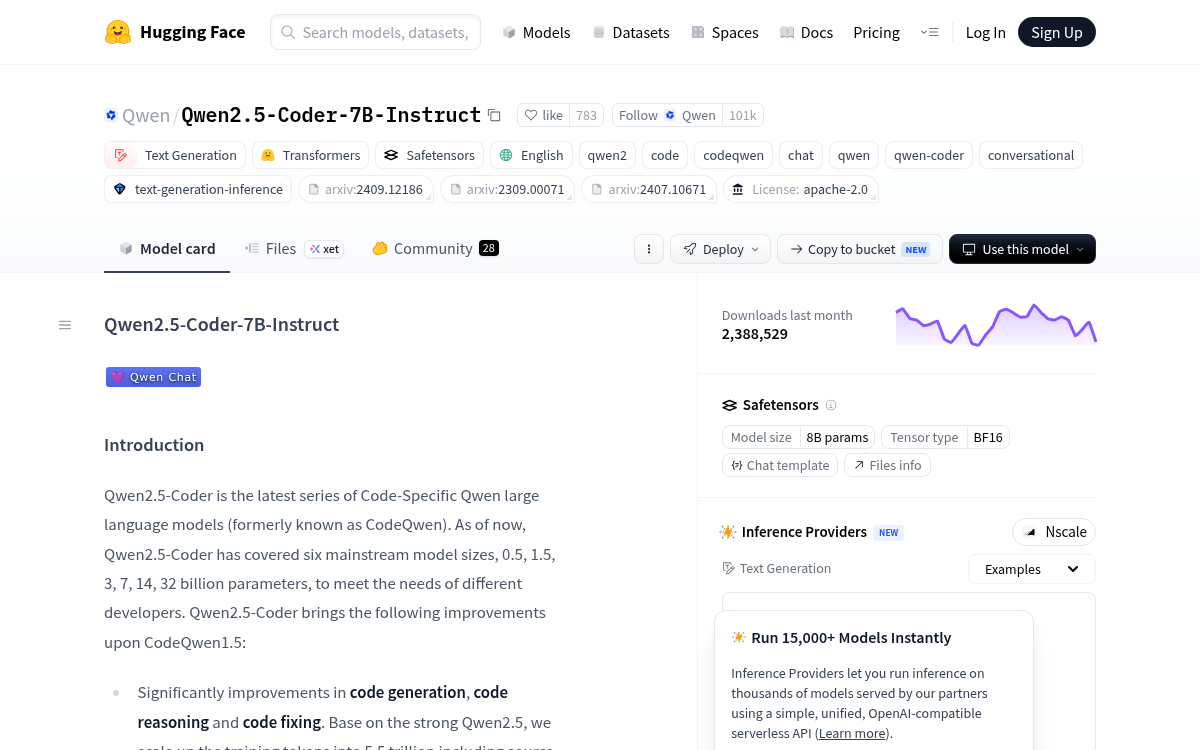
- Qwen2.5-Coder-7B-Instruct is a 7.61B parameter code-specialized model from Alibaba, available on Hugging Face under Apache 2.0.
- Native 131,072 token context via YaRN scaling, using GQA with 28 query and 4 KV heads.
- Outperforms 20B+ models like CodeStral-22B and DeepSeek-Coder-33B-Instruct on generation benchmarks.
- Trained on 5.5 trillion tokens covering 92 programming languages, retains strong math and MMLU scores.
- Runs with transformers, vLLM, SGLang, Ollama, or llama.cpp; 224 quantized variants ship community-side.
- Best for autocomplete, repair, and reasoning tasks; not suited for complex multi-step agent workflows.
Alibaba's Qwen team has quietly turned the 7B parameter class into contested territory. Qwen2.5-Coder-7B-Instruct is the instruction-tuned member of a family spanning six sizes, and it pulls off something unusual for its weight class: beating coder models several times larger on standard benchmarks while running on a single consumer GPU.
The model has racked up over 2.3 million downloads on Hugging Face. The open-source 7B version outperforms larger models like DeepSeek-Coder-V2-Lite and CodeStral-22B on public code benchmarks, and for teams that want a self-hostable coding assistant without renting an H100 cluster, that math is hard to ignore.
Under the hood
Qwen2.5-Coder-7B-Instruct is a dense causal language model built on the Qwen2.5 backbone. The specs tell most of the story:
- 7.61B total parameters (6.53B non-embedding), 28 transformer layers
- Grouped-query attention with 28 query heads and 4 key/value heads, which shrinks the KV cache at inference time
- RoPE positional encoding, SwiGLU activations, RMSNorm, and QKV bias
- Native 131,072 token context window
- Apache 2.0 license, permitting commercial use
The long context comes with caveats. The shipped config.json defaults to 32,768 tokens, and stretching to the full 128K requires enabling YaRN rope scaling, a technique for extending the context window of an already-trained model by rescaling the rotary position embeddings so the model can extrapolate beyond its training length. The Qwen team warns that vLLM only supports static YaRN, so leaving it on can hurt quality on shorter prompts. Flip the switch only when you actually need long inputs.
How it was built
The training recipe separates this from a generic 7B chat model. Qwen2.5-Coder covers 92 programming languages and shows sizable gains over its predecessor on code generation, multi-language generation, completion, and repair tasks. The base model was pretrained on 5.5 trillion tokens spanning source code, text-code grounding data, and synthetic examples, then instruction-tuned to produce this variant.
Critically, the team preserved general capability. The model posts competitive scores on math benchmarks like GSM8K and MATH, and on MMLU and ARC it retains the general reasoning of the base Qwen2.5. That matters if you want a single model handling a coding agent's reasoning loop rather than juggling a coder alongside a general model.
Where it actually wins
The Qwen2.5-Coder technical report is where the punchline lands. On HumanEval and MBPP, the 7B-Instruct model outperforms peers with comparable parameter counts and edges past several models above 20B, including CodeStral-22B and DeepSeek-Coder-33B-Instruct. On the multilingual McEval benchmark, which spans 40 programming languages across 16,000 test cases, it leads open-source models of similar size across a wide language spread.
Concretely, that translates to three practical strengths:
- Code generation from natural language specs and function signatures
- Code repair, fixing broken snippets given error context
- Code reasoning, predicting execution outputs given inputs, useful for verification loops in agents
Where the ceiling shows
The 7B limit is real. On Artificial Analysis's Intelligence Index, Qwen2.5-Coder-7B-Instruct scores 4, below the median of 6 for comparable models. On the newer LiveCodeBench, coding capability is functional but not competitive with larger models. It fits narrow, high-volume, low-complexity tasks like autocomplete, boilerplate generation, or simple code review, and struggles with complex reasoning, multi-step agentic workflows, or client-facing content generation.
Translation: this is a workhorse, not a frontier model. If you need a coding agent that can plan across a whole repo and reason about architectural tradeoffs, reach for the 32B sibling or a dedicated reasoning model. If you need something that autocompletes, refactors, and explains snippets locally, this is the sweet spot.
Getting it running
The model works with any recent Hugging Face transformers install (4.37.0 or newer, otherwise you'll hit a KeyError: 'qwen2'). For production serving, vLLM is the recommended path:
pip install vllm
vllm serve "Qwen/Qwen2.5-Coder-7B-Instruct"
That exposes an OpenAI-compatible endpoint on port 8000, so existing tooling that speaks the chat completions API works without modification. SGLang and Docker Model Runner are supported out of the box, and the community has produced 224 quantized variants for llama.cpp, Ollama, and LM Studio. At 4-bit precision, it runs comfortably on a laptop with 8GB of VRAM.
Why it matters
Weight-class efficiency is becoming the dominant story in open coding models. A year ago, matching a 33B coder required at least 30B parameters. Qwen2.5-Coder-7B-Instruct shows the gap can be closed with better data curation, targeted synthetic examples, and instruction tuning tailored to repair and reasoning rather than raw completion. For teams building IDE plugins, CI-integrated review bots, or local coding copilots, the calculus has shifted: capability and self-hosting are no longer mutually exclusive.