
Alibaba's Qwen2.5-7B-Instruct Hits 10M Downloads Beating Rivals Twice Its Size
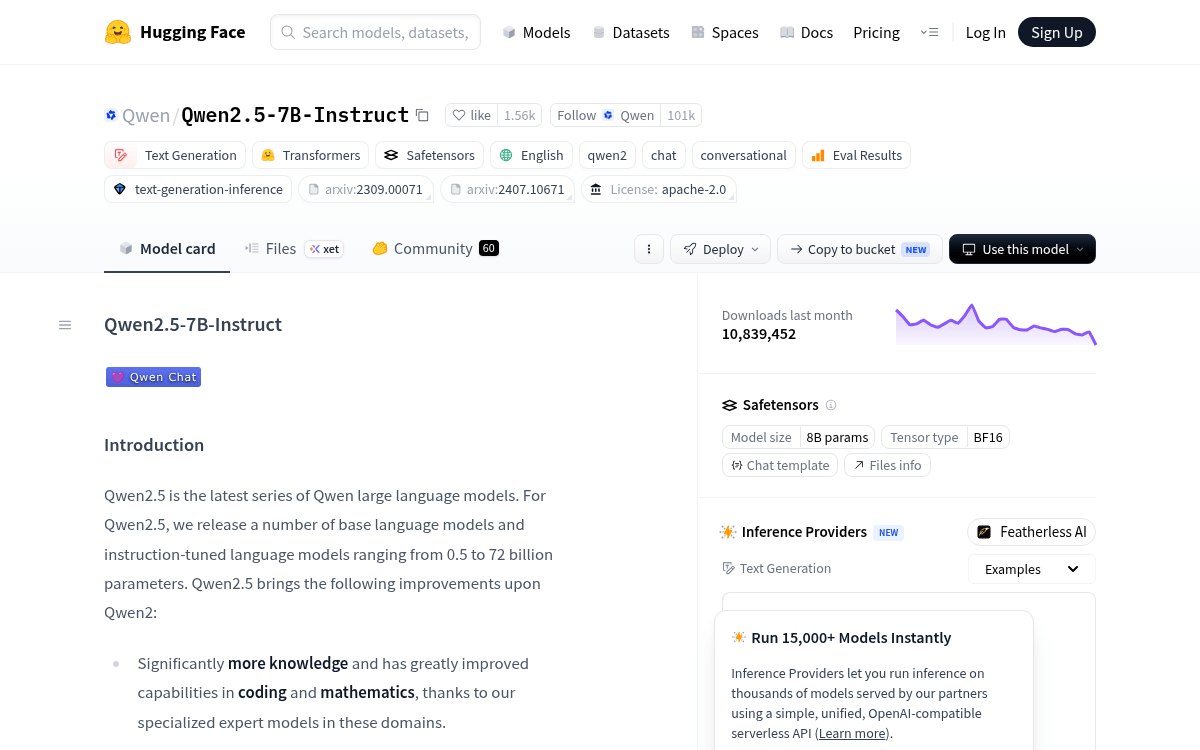
Alibaba's 7B open-weight model pairs 128K context with big gains in coding, math, and structured output, crossing 10 million downloads.
 Pro
Takeaways
- Qwen2.5-7B-Instruct is Alibaba's Apache 2.0 instruction-tuned 7B model, now past 10M downloads on Hugging Face.
- Architecture: 7.61B params, 28 layers, GQA (28 Q / 4 KV), RoPE, SwiGLU, RMSNorm.
- Context window of 131,072 tokens via YaRN rope-scaling, 8K output tokens.
- Scores 74.2 MMLU, 75.5 MATH, 57.9 HumanEval; multilingual across 29+ languages.
- Weak on hard reasoning: 16.67% AIME 2024, 33.84% GPQA Diamond.
- Runs on Transformers, vLLM, SGLang, Ollama, llama.cpp; see the Qwen2.5 blog.
Alibaba's Qwen team keeps quietly shipping some of the most useful open-weight models in the sub-10B range, and Qwen2.5-7B-Instruct has become the poster child. The model recently crossed roughly ten million downloads on Hugging Face, driven by a mix of long context, strong math and coding scores, and a permissive license that lets you actually put it into production.
The short version
Qwen2.5-7B-Instruct is the instruction-tuned 7B member of Alibaba Cloud's Qwen2.5 family, released under Apache 2.0. Commercial use is fine, and the model card ships ready-to-run recipes for Transformers, vLLM, SGLang, and Docker Model Runner.
Across the wider Qwen2.5 series, Alibaba reports significant improvements in instruction following, long-form generation (up from 1K to over 8K tokens), understanding structured data like tables, and emitting structured outputs, especially JSON. The models also handle a wider variety of system prompts, which helps role-play and chatbot conditioning. The 7B slot is the sweet spot where a single consumer or workstation GPU can host it without exotic tricks.
What is under the hood
The architecture is a fairly standard modern decoder-only transformer, but the numbers are worth pinning down:
- 7.61B total parameters, 6.53B non-embedding
- 28 transformer layers
- Grouped Query Attention with 28 query heads and 4 key/value heads
- RoPE positional embeddings, SwiGLU activation, RMSNorm, QKV bias
- Context length of 131,072 tokens, generation up to 8,192 tokens
To push context past the pretraining window, the team uses YaRN, a rope-scaling method for length extrapolation. The default config.json is set for 32,768 tokens, and you enable YaRN by adding a rope_scaling block if you actually need the full 128K window. One catch worth knowing: vLLM currently only supports static YaRN, so the scaling factor is fixed regardless of input length and can hurt quality on shorter prompts. The Qwen team recommends flipping it on only when you truly need long context.
How it was trained
Pretraining ran on 18 trillion tokens, with Grouped Query Attention, SwiGLU, and Rotary Positional Embeddings chosen to improve inference speed, long-context handling, and stability. Post-training layered supervised fine-tuning, DPO-based RL, and knowledge distillation on top.
The math and coding gains trace back to a feedback loop with specialized expert models. According to the Qwen2.5 blog, integrating Qwen2-Math's techniques lifted MATH benchmark scores for the 7B and 72B Instruct variants from 52.9 and 69.0 in the Qwen2 generation to 75.5 and 83.1. That is a very large jump at the 7B tier.
Where it shines on benchmarks
General capability numbers put this model firmly ahead of previous 7B instruct releases: 74.2 on MMLU, 49.8 on MATH for the base 7B, and 57.9 on HumanEval, all with fewer non-embedding parameters than several rivals. The 75.5 MATH figure above applies to the instruction-tuned variant with the math-focused post-training.
Coding is another area where the family punches above its weight. In the Qwen2.5-Coder technical report, Qwen2.5-Coder-7B-Instruct hit 37.6% Pass@1 on LiveCodeBench (2407-2409), beating models of similar size and even larger ones like CodeStral-22B-v0.1 and DS-Coder-33B-Instruct. The base 7B chat model shares much of that DNA.
Multilingual coverage is broad. Byte-level BPE and a corpus spanning over 30 languages give solid results in English, Chinese, Spanish, French, German, Japanese, Arabic, and more.
Where it is weak
Reasoning-heavy benchmarks expose the ceiling of a non-reasoning 7B model. Community evaluations report the original Qwen2.5-7B-Instruct scoring 16.67% on AIME 2024, 33.84% on GPQA Diamond, and 77% on MATH500. AIME in particular is a reminder that competition math and multi-step scientific reasoning still favor much larger models or explicit reasoning-style training.
External composite scorecards agree. On Artificial Analysis, Qwen2.5 Coder Instruct 7B rates below average in intelligence but well priced compared to other open-weight non-reasoning models of similar size, with a 131K token context window. For frontier reasoning quality, look higher up the size ladder. For a fast, cheap, permissively licensed workhorse, this fits.
Running it
The fastest way to try it locally is the standard Transformers recipe from the model card:
from transformers import AutoModelForCausalLM, AutoTokenizer
model_name = "Qwen/Qwen2.5-7B-Instruct"
tok = AutoTokenizer.from_pretrained(model_name)
model = AutoModelForCausalLM.from_pretrained(
    model_name, torch_dtype="auto", device_map="auto"
)
messages = [
    {"role": "system", "content": "You are Qwen, a helpful assistant."},
    {"role": "user", "content": "Explain YaRN in two sentences."},
]
text = tok.apply_chat_template(messages, tokenize=False, add_generation_prompt=True)
inputs = tok([text], return_tensors="pt").to(model.device)
out = model.generate(**inputs, max_new_tokens=512)
print(tok.decode(out[0][inputs.input_ids.shape[-1]:], skip_special_tokens=True))
You will need transformers>=4.37 or you will hit a KeyError: 'qwen2'. For serving, vLLM and SGLang both expose an OpenAI-compatible API with a one-line launch command, and quantized GGUFs are widely available for llama.cpp, Ollama, and LM Studio.
Who should actually use it
The practical sweet spots for this model:
- Structured output pipelines. The JSON and table handling improvements make it a solid drop-in behind a schema validator.
- Long-document workflows. Summarization, extraction, and RAG over 100K-token contexts, with YaRN enabled.
- Multilingual assistants where GPT-4o-class quality is overkill and self-hosting is the goal.
- Coding autocomplete and scripting help, especially with the Coder variant swapped in.
- Fine-tuning bases. Thousands of community fine-tunes and adapters already build on it, which tells you how well the base absorbs new behavior.
The gap between open-weight 7B models and closed frontier APIs on everyday tasks keeps narrowing. Qwen2.5-7B-Instruct will not beat a reasoning-tuned frontier model on olympiad math, but for a large slice of production LLM work, the download counter is telling you what the field has already decided.