
Alibaba's Qwen2.5-72B Beats Meta's 405B Model at One-Fifth the Size
Alibaba's 72-billion-parameter instruction-tuned model matches Llama-3.1-405B on key benchmarks with one-fifth the parameters, 128K context, and open weights.
 Pro
Takeaways
- Alibaba released Qwen2.5-72B-Instruct, a 72.7B dense model with 128K context and 8K generation length.
- Trained on 18 trillion tokens, matching Llama-3.1-405B on many benchmarks at one-fifth the parameters.
- Standout scores: MATH 83.1, LiveCodeBench 55.5, MBPP 88.2, Arena-Hard 81.2, MTbench 9.35.
- Major upgrades in JSON output, structured data understanding, long-form generation, and 29+ language support.
- Priced around $0.36/$0.40 per million input/output tokens via inference providers, well below GPT-4o class.
- Weaknesses: slower output (~28 tokens/sec), weaker agent tool-use, released under Qwen License not Apache 2.0.
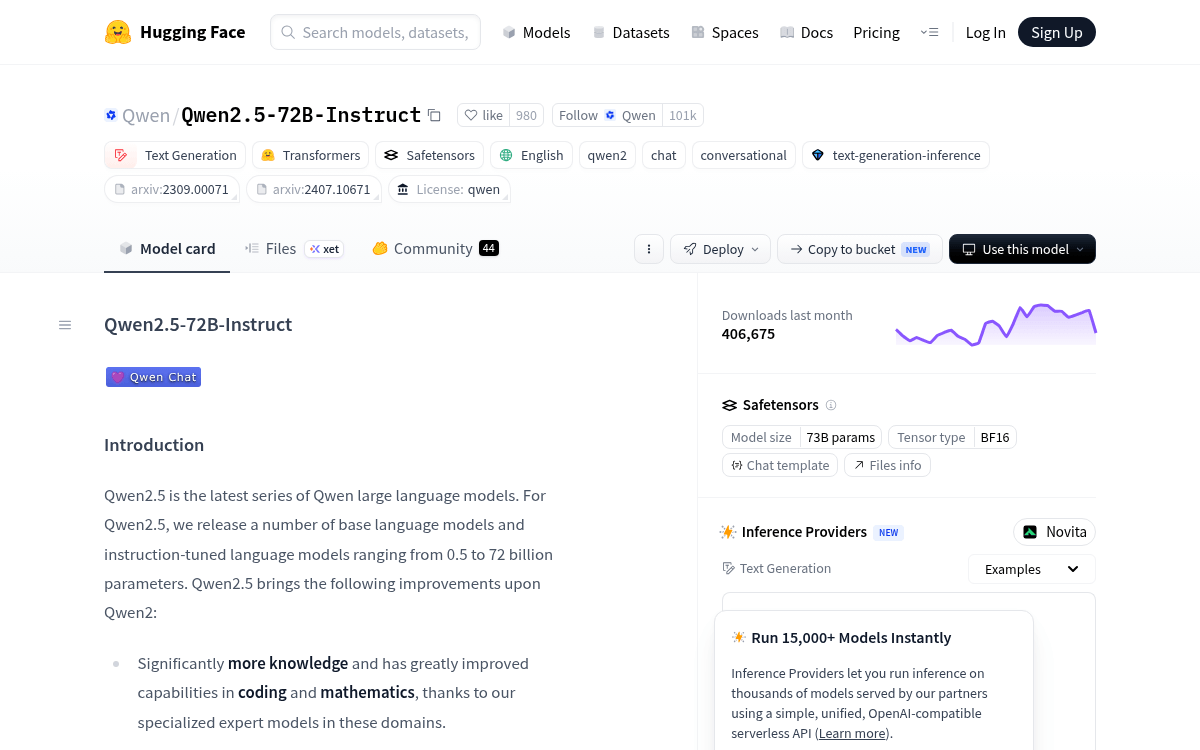
Alibaba's Qwen team has released Qwen2.5-72B-Instruct, the flagship instruction-tuned model in a family spanning seven sizes from 0.5B to 72B parameters. The open-weights model matches Meta's Llama-3.1-405B-Instruct on math, coding, and chat benchmarks while using roughly one-fifth of the parameters, and it ships with a 128K token context window.
For teams paying proprietary API prices to get frontier-level reasoning, this changes the math. The model is downloadable, self-hostable, and priced at roughly a third of what comparable closed models charge through inference providers.
What's actually inside the box
Qwen2.5-72B-Instruct is a dense decoder-only transformer rather than a mixture-of-experts design. It has 72.7B total parameters (70.0B non-embedding), 80 layers, uses Grouped Query Attention with 64 query heads and 8 key/value heads, and supports a full 131,072 token context with up to 8,192 tokens of generation. The architecture uses RoPE positional embeddings, SwiGLU activations, RMSNorm, and QKV attention bias.
Pre-training was scaled to 18 trillion tokens, up from 7 trillion for Qwen2, which drives much of the knowledge and reasoning gains. The team credits two specialized sibling projects for domain lifts: Qwen2.5-Coder contributes the coding jump, and techniques from Qwen2-math were folded in for mathematical reasoning.
The benchmark story
The numbers put Qwen2.5-72B-Instruct in unusual company for an open-weights release. Against Llama-3.1-405B-Instruct and Mistral-Large2, it either wins or trades blows across the standard suite:
| Benchmark | Qwen2.5-72B-Instruct | Llama-3.1-405B-Instruct | Qwen2-72B-Instruct |
|---|---|---|---|
| MMLU-redux | 86.8 | 86.2 | 81.6 |
| MATH | 83.1 | 73.8 | 69.0 |
| MBPP (coding) | 88.2 | 84.5 | 80.2 |
| LiveCodeBench | 55.5 | 41.6 | 32.2 |
| Arena-Hard | 81.2 | 69.3 | 48.1 |
| MTbench | 9.35 | 9.08 | 9.12 |
The Arena-Hard jump is particularly striking: chat quality effectively doubled generation-over-generation, moving from 48.1 to 81.2. On coding, the model posts 55.5 on LiveCodeBench (2305-2409), 75.1 on MultiPL-E, and 88.2 on MBPP, up from 32.2, 69.2, and 80.2 for its predecessor.
The model lags in a few places. It scores 49.0 on GPQA versus Mistral-Large2's 52.0, and 86.6 on HumanEval versus Mistral-Large2's 92.1. Raw output speed is another weak spot: generation runs at 28.4 tokens per second on Alibaba's API, at the lower end for open-weights non-reasoning models of similar size (median: 59.6 t/s). Agent-style tool use also trails top proprietary models.
Where the model actually shines in practice
Beyond the leaderboards, the practical upgrades over Qwen2 target the things developers actually complain about:
- Structured output: much stronger JSON generation and table understanding
- Long-form writing: coherent generation extended from around 1K to over 8K tokens
- Instruction adherence: better handling of multi-constraint prompts (IFeval strict-prompt: 84.1)
- System prompts: more resilient to prompt variation, which matters for role-play, agent personas, and multi-tenant chat products
- Multilingual: coverage across 29+ languages including Chinese, French, Spanish, Japanese, Korean, Arabic, Vietnamese, and Thai
Running it
The model is compatible with the standard Hugging Face stack, requiring transformers>=4.37.0. A minimal load looks like this:
from transformers import AutoModelForCausalLM, AutoTokenizer
model_name = "Qwen/Qwen2.5-72B-Instruct"
model = AutoModelForCausalLM.from_pretrained(model_name, torch_dtype="auto", device_map="auto")
tokenizer = AutoTokenizer.from_pretrained(model_name)
messages = [{"role": "user", "content": "Explain grouped query attention."}]
text = tokenizer.apply_chat_template(messages, tokenize=False, add_generation_prompt=True)
inputs = tokenizer([text], return_tensors="pt").to(model.device)
outputs = model.generate(**inputs, max_new_tokens=512)
For production, vLLM and SGLang both serve the model with OpenAI-compatible endpoints out of the box. One important detail: the shipped config.json is set to 32,768 tokens by default. To unlock the full 128K, enable YaRN scaling, a technique for extending context length without retraining, by adding this to config.json:
{
  "rope_scaling": {
    "factor": 4.0,
    "original_max_position_embeddings": 32768,
    "type": "yarn"
  }
}
The Qwen team notes that current vLLM only supports static YaRN, meaning the scaling factor stays constant regardless of input length and can hurt quality on short prompts. Toggle this only when you actually need the long-context path.
The pricing angle
Pricing runs $0.36 per 1M input tokens (versus a $0.20 average across comparable providers) and $0.40 per 1M output tokens (against a $0.56 average). That sits well below GPT-4o-class pricing, though it isn't the cheapest open-weights option. Independent evaluators have found the total-cost story favorable for agent workloads: roughly $0.036 per average session, less than a quarter what comparable proprietary models cost.
Weights are available on Hugging Face in BF16, and the community has produced 93+ quantized variants for llama.cpp, Ollama, LM Studio, and GPTQ/AWQ workflows. Licensing is the Qwen License rather than the Apache 2.0 terms covering the smaller siblings. Commercial use is allowed, but read the terms if you plan to deploy at scale.
When to pick this over alternatives
A rough decision guide for teams evaluating the model:
- Use it for: multilingual chatbots, structured data extraction, JSON-heavy pipelines, long-document summarization and analysis (up to 128K tokens), math and coding assistants, and any workflow currently sending sensitive data to a closed API.
- Skip it for: latency-critical serving where throughput matters more than accuracy, heavy agentic tool-use workflows where proprietary models still lead, and use cases needing native reasoning traces (Qwen2.5 is not a reasoning-tuned model).
- Consider a smaller sibling if you can: the 32B variant is close in quality on many tasks and much cheaper to serve.
Two assumptions worth retiring
The first assumption due for revision: that you need 400B+ parameters to reach frontier reasoning. The Qwen2.5-72B base model significantly outperforms peers in its category across a wide range of tasks and matches Llama-3-405B while using one-fifth of the parameters. Data quality and training recipe are doing a lot of the work that scale was previously credited with.
The second: that open models trail proprietary ones on standard benchmarks by a meaningful margin. For math and code the gap has largely closed. Parity isn't universal, since agent behavior, tool use, and multi-turn planning remain weak points, but for the majority of production LLM workloads the open option is now genuinely competitive on quality while being dramatically cheaper to run.