
Alibaba's Qwen2.5-3B-Instruct Hits 7M Downloads Running on a Laptop
Alibaba's compact 3B instruction-tuned model punches above its weight class on math and coding while running comfortably on modest hardware.
 Pro
Takeaways
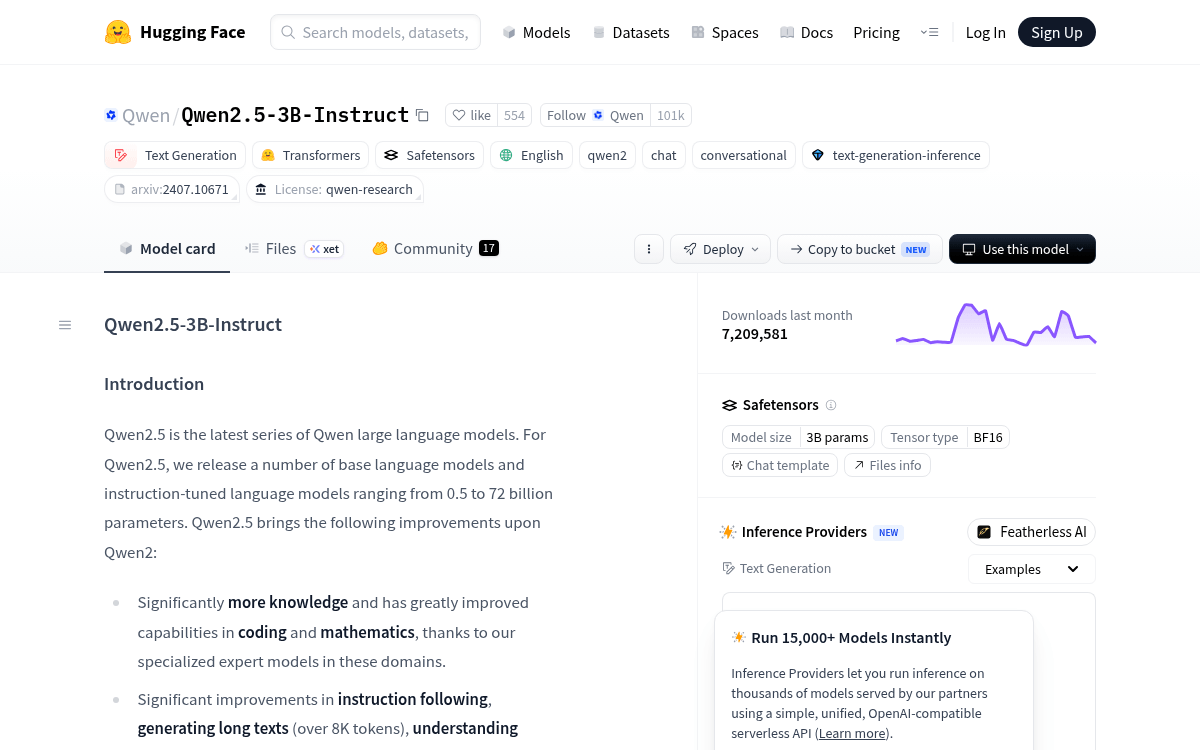
- Qwen2.5-3B-Instruct has crossed 7 million downloads on Hugging Face, becoming a dominant small model
- 3.09B parameters, 36 layers, grouped-query attention with 16 Q and 2 KV heads for lean inference
- 32K token context window, generates up to 8K tokens, supports 29+ languages
- Scores 65.9 on MATH, state-of-the-art among 2-4B models on math and coding
- Trained on 18 trillion tokens with over 1 million instruction-following examples
- Licensed under qwen-research, not Apache 2.0, so verify commercial terms before shipping
Alibaba's Qwen team has quietly turned one of the most downloaded small language models on Hugging Face into a workhorse for anyone who needs solid reasoning without a data center. Qwen2.5-3B-Instruct has crossed 7 million downloads, and the spec sheet plus benchmark numbers explain why it has become a default choice for local deployment and fine-tuning experiments.
The model sits in the middle of the Qwen2.5 family, which spans seven sizes from 0.5B up to 72B parameters. At just over 3 billion parameters, it targets the zone where a single consumer GPU, or even a laptop with enough RAM, can host a capable chat assistant.
What's actually inside
Qwen2.5-3B-Instruct is a medium-scale LLM built on standard transformer techniques (GQA, SwiGLU, RoPE), pre-trained on 18 trillion tokens and fine-tuned on more than 1 million instruction-following examples. The architecture details worth knowing:
- 3.09B total parameters, 2.77B excluding embeddings, across 36 layers
- Grouped-query attention with 16 query heads but only 2 key/value heads, which sharply reduces the KV cache footprint during inference
- 32,768 token context window, with generation capped at 8,192 tokens
- BF16 weights by default, with a wide ecosystem of GGUF, AWQ, and GPTQ quantizations available
Compared to Qwen2, the 2.5 series adds stronger multilingual coverage through mixed original and translated instructions, plus more diverse system prompts that improve role and system prompt handling. Official multilingual support covers more than 29 languages.
Where it punches above its weight
The headline result is that this model competes with much larger systems on structured tasks. It reaches state-of-the-art results among 2 to 4B models, including a 65.9 score on the MATH benchmark, stays competitive on HumanEval and MultiPL-E for coding, and holds its own on general reasoning and instruction following in its size range.
Beyond raw benchmarks, the instruction-tuned build was optimized for behaviors that matter in production:
- Generating long texts over 8K tokens without collapsing
- Reading structured data like tables and returning valid JSON
- Following diverse system prompts, which makes it more usable for role-play and agent scaffolds
- Coding and math, aided by specialized expert models used during training
Where it falls short
A 3B model has hard limits, and this one is no exception. Agentic tool-use benchmarks show the gap clearly: on a recent tool-use evaluation, Qwen2.5-3B-Instruct scored around 9.18% overall, trailing the 7B (7.82%) only marginally but far behind Qwen2.5-72B-Instruct at 11.20% and much larger reasoning models. Long multi-step tool chains, complex code repositories, and nuanced instruction following at the edge of the context window are where you will feel the parameter count.
One more caveat that catches teams off guard: the license is qwen-research, not Apache 2.0 like the 7B and larger variants. Commercial use requires reading the terms carefully, which is why some shops pick the 1.5B or 7B siblings for products.
Getting it running
The model is free to download and self-host from Hugging Face, and it works with every mainstream inference stack. The minimal Transformers path looks like this:
from transformers import AutoTokenizer, AutoModelForCausalLM
tok = AutoTokenizer.from_pretrained("Qwen/Qwen2.5-3B-Instruct")
model = AutoModelForCausalLM.from_pretrained(
    "Qwen/Qwen2.5-3B-Instruct", torch_dtype="auto", device_map="auto"
)
msgs = [{"role": "user", "content": "Explain GQA in two sentences."}]
inputs = tok.apply_chat_template(msgs, add_generation_prompt=True, return_tensors="pt").to(model.device)
print(tok.decode(model.generate(inputs, max_new_tokens=200)[0]))
For serving, a one-liner with vLLM exposes an OpenAI-compatible endpoint: vllm serve "Qwen/Qwen2.5-3B-Instruct". SGLang, Ollama, LM Studio, and llama.cpp all have first-class support, and there are over 260 community quantizations for CPU or low-VRAM setups.
Why 3B is suddenly enough
The model's real value has nothing to do with beating GPT-4 class systems, because it does not. A 3B parameter model is now good enough to serve as the reasoning core of many practical systems:
- On-device assistants where latency and privacy rule out API calls
- Cheap, high-throughput classification, extraction, and JSON generation pipelines
- A strong base for domain fine-tuning, evidenced by variants like Amadeus-Verbo and DistilQwen2.5 that improve performance through tailored instruction tuning and distillation
- Draft models for speculative decoding paired with a 32B or 72B target
The Qwen2.5 family, alongside Llama 3 and Gemma 2, has reset expectations for what small open models can do. If you have been defaulting to a hosted API for tasks that fit in 32K of context and do not need agentic tool orchestration, this is the model to benchmark against your workload before your next invoice arrives.