
Alibaba's Qwen2.5-32B Fills the Open-Weight Gap Between Small and Massive Models
Alibaba's Qwen team drops a 32.5B dense open-weight model with 128K context, Apache 2.0 licensing, and coding and math scores rivaling much larger competitors.
 Pro
Takeaways
- Qwen2.5-32B-Instruct is a 32.5B dense decoder-only model from Alibaba's Qwen team.
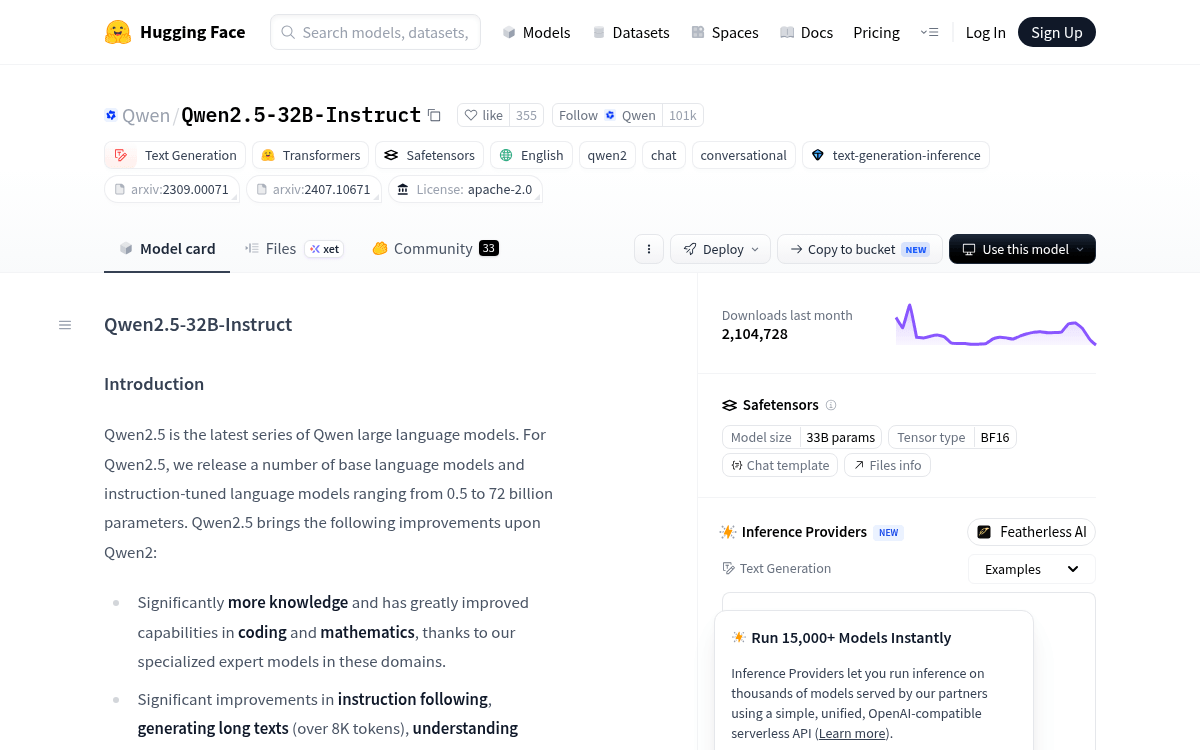
- Licensed under Apache 2.0 with commercial use permitted; over 2.1M downloads on Hugging Face.
- Supports 131K token context via YaRN scaling, generates up to 8K tokens.
- Pretrained on 18 trillion tokens; MMLU 85+, HumanEval 85+, MATH 80+ across the series.
- Improved JSON output, structured data understanding, and tool calling for agent workflows.
- Deploys with vLLM, SGLang, Ollama, llama.cpp; see the Qwen2.5 blog.
Alibaba's Qwen team has quietly filled one of the more awkward gaps in the open-weight lineup with Qwen2.5-32B-Instruct, a mid-large instruction-tuned model that sits between the 7B and 14B checkpoints most people run locally and the 70B-plus flagships that demand a serious GPU cluster. It ships as part of the Qwen2.5 release, which spans seven dense sizes from 0.5B to 72B alongside specialized Coder and Math variants.
The 32B slot hits a sweet spot for single-node inference on an A100 or H100, or on a pair of 24GB consumer cards with quantization, while landing close to frontier quality on knowledge and reasoning benchmarks.
What's actually in the box
Under the hood, this is a standard modern transformer with careful choices. The model has 32.5 billion parameters across 64 layers, with RoPE, SwiGLU, RMSNorm, and attention QKV bias. Attention uses grouped-query attention with 40 query heads and 8 key/value heads, which keeps the KV cache manageable at long context lengths.
Headline capabilities from the model card:
- Context length: 131,072 tokens input, up to 8,192 tokens generation
- Languages: 29+ including Chinese, English, French, Spanish, Japanese, Korean, Arabic, Thai
- License: Apache 2.0, so commercial use is fine
- Weights: BF16 safetensors, roughly 65GB on disk
- Tool calling: Built-in template compatible with vLLM, Ollama, and Transformers
The 18 trillion token diet
The base model was pretrained on 18 trillion tokens, and the Qwen team explicitly used specialized expert models for coding and math domains to lift capability during pretraining. They report MMLU above 85, HumanEval above 85, and MATH above 80 for the series. Enhanced instruction following, stronger coding and math performance, and more reliable handling of structured input and JSON output all trace back to that data mix.
For the 32B specifically, the team positions it against Phi-3.5-MoE-Instruct and Gemma2-27B-IT, claiming it matches or exceeds both across diverse tasks. Post-training work concentrated on four areas developers actually complain about: reliable JSON output, understanding tables and other structured input, long-form generation past 8K tokens, and robustness to weird system prompts for role-play or agent scaffolding.
Long context without the usual asterisk
Long context is where deployment gets interesting. The shipped config.json defaults to 32,768 tokens. To hit the full 131K window, you opt in to YaRN, a rope-scaling technique that stretches the effective context window beyond what the model was originally trained on. Add this to the config:
{
  "rope_scaling": {
    "factor": 4.0,
    "original_max_position_embeddings": 32768,
    "type": "yarn"
  }
}
The team warns that vLLM currently supports only static YaRN, meaning the scaling factor stays constant regardless of input length and can degrade quality on shorter prompts. Practical advice: turn it on only when you actually need long context.
Running it
The fastest path to a working endpoint is vLLM, which serves the model as an OpenAI-compatible API with a single command:
pip install vllm
vllm serve "Qwen/Qwen2.5-32B-Instruct"
SGLang, Ollama, LM Studio, llama.cpp, and TensorRT-LLM all work as well. There are 153 community quantizations tracked on Hugging Face, so 4-bit GGUF and AWQ variants for single-GPU inference on a 24GB card are trivially available.
Where the tradeoffs land
The model is not a reasoning model in the o1 sense. It produces direct responses rather than extended chain-of-thought internal traces, so for hard math or multi-step planning you may still want to layer explicit CoT prompting or a scaffold on top. Agentic tool-use benchmarks also show the 32B trailing newer Qwen3 releases on complex multi-turn tool use, so if you're building agents from scratch today, compare against the newer generation before committing.
Where it shines: single-shot code generation, structured data extraction, multilingual customer support, RAG pipelines that need real reading comprehension over long documents, and any workload where you want strong instruction following without shipping data to a hosted API. It also holds up well as a base for agents that follow complex, multi-step instructions and adapt behavior across diverse system prompts.
Why this size matters
The strategic bet is that many production workloads don't need a 70B model but degrade noticeably with a 7B one. The 32B tier fits a strong instruction-tuned model on a single 80GB GPU in BF16, or on a single 24GB consumer card at 4-bit quantization, which changes the economics of self-hosting significantly. With Apache 2.0 licensing and over two million downloads on Hugging Face, the 32B has become one of the default open-weight choices when teams outgrow smaller models but don't want the operational overhead of a 70B deployment.