
Alibaba's Qwen2.5-14B Beats GPT-4o-mini and Hits 2.7M Downloads
Alibaba's 14.7B parameter instruction-tuned model brings 128K context, sharpened coding and math skills, and GPT-4o-mini level results under Apache 2.0.
 Pro
Takeaways
- Qwen2.5-14B-Instruct is a 14.7B parameter dense model released under Apache 2.0 on Hugging Face.
- Native 128K context via YaRN scaling, 8K generation, GQA with 40 query and 8 KV heads.
- Alibaba claims performance competitive with GPT-4o-mini across benchmarks, per the Qwen2.5 blog.
- Strong coding (HumanEval 83.5), math (GSM8k 94.8, MATH 80), and JSON structured output.
- First-class support for vLLM, SGLang, Transformers, llama.cpp, and Ollama out of the box.
- Over 2.7M downloads and 425+ downstream finetunes make it a default base model for the community.
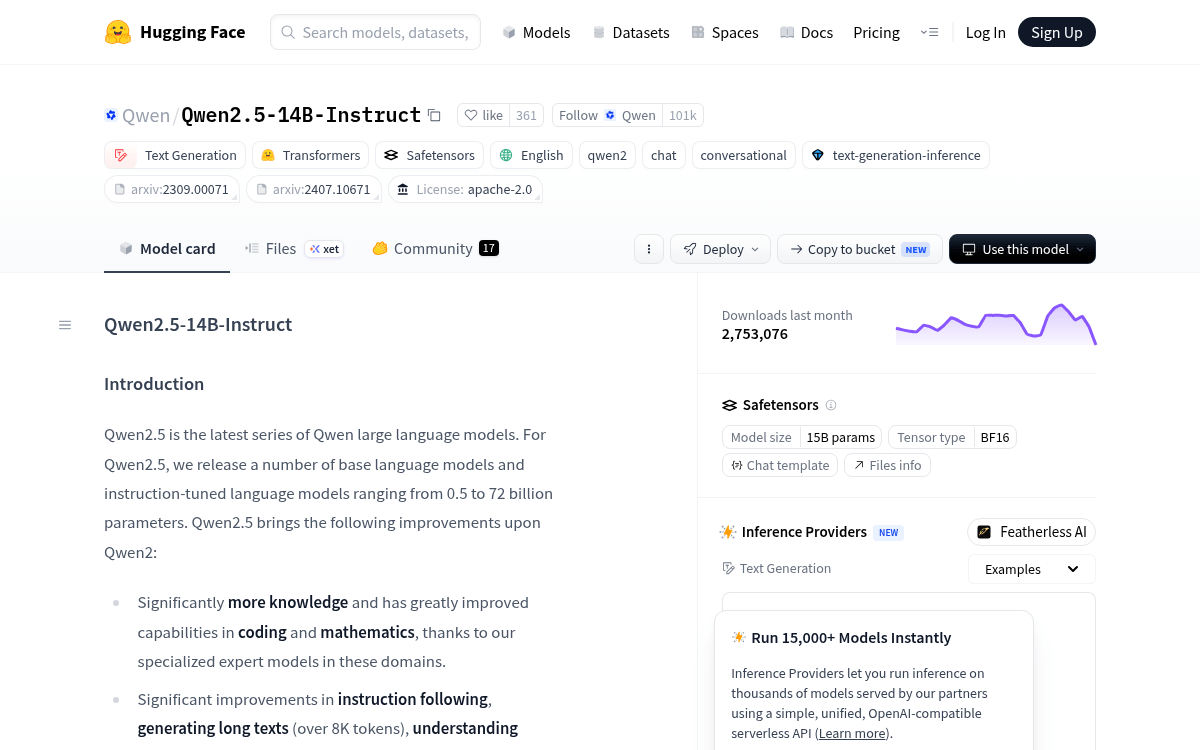
Alibaba's Qwen team dropped a mid-size heavyweight into the open model ecosystem with Qwen2.5-14B-Instruct, an instruction-tuned dense transformer that sits between what fits on a single consumer or workstation GPU and what actually competes with proprietary APIs. It has already pulled in over 2.7 million downloads on Hugging Face, and the reason is simple: it lands in GPT-4o-mini territory on many benchmarks while shipping fully open under Apache 2.0.
What is actually in the box
The 14B slot in the Qwen2.5 family is designed to be the practical workhorse of the lineup. The Qwen team notes that Qwen2.5-14B-Instruct delivers competitive results across all benchmarks compared to GPT-4o-mini, which is the kind of claim that used to be reserved for 70B-plus open weights.
The architecture is deliberately conventional so it plugs into existing inference stacks without friction:
- 14.7B total parameters, 13.1B non-embedding, across 48 layers
- Grouped-query attention with 40 query heads and 8 key/value heads, which shrinks the KV cache without hurting quality
- RoPE positional embeddings, SwiGLU activations, RMSNorm, and QKV bias in attention
- Native 131,072 token context window with generation up to 8,192 tokens
- Multilingual coverage spanning more than 29 languages, including Chinese, English, French, Spanish, Japanese, Korean, Arabic, and Thai
Where the jump from Qwen2 actually shows up
The upgrade story here is less about raw MMLU points and more about behaviors that matter in production. The model was tuned specifically for instruction following, long-form generation past 8K tokens, reading tables and structured data, and emitting clean JSON. It is also described as more resilient to varied system prompts, which matters if you build agent frameworks or role-play scenarios where the system message changes constantly.
The coding and math gains are backed by specialized expert models used during training. On the shared benchmarks it lands at GSM8k 94.8%, HumanEval 83.5%, MBPP 82.0%, MATH 80.0%, and MMLU-Redux 80.0%. The base 14B variant scores 79.7 on MMLU and 78.2 on BBH, outcompeting several larger competitors.
Running it locally
The weights are available today on Hugging Face at zero cost beyond your compute. The card ships a minimal Transformers snippet:
from transformers import AutoModelForCausalLM, AutoTokenizer
model_name = "Qwen/Qwen2.5-14B-Instruct"
tokenizer = AutoTokenizer.from_pretrained(model_name)
model = AutoModelForCausalLM.from_pretrained(
    model_name, torch_dtype="auto", device_map="auto"
)
messages = [
    {"role": "system", "content": "You are a helpful assistant."},
    {"role": "user", "content": "Explain KV cache in one paragraph."},
]
text = tokenizer.apply_chat_template(messages, tokenize=False, add_generation_prompt=True)
inputs = tokenizer([text], return_tensors="pt").to(model.device)
out = model.generate(**inputs, max_new_tokens=512)
For serving, vLLM and SGLang are both first-class citizens with OpenAI-compatible endpoints, and there is a broad ecosystem of quantized checkpoints for llama.cpp, Ollama, and LM Studio. One gotcha worth flagging: the shipped config.json defaults to a 32,768 token context. Reaching the full 128K window requires opting in to YaRN scaling by editing the config:
{
  "rope_scaling": {
    "factor": 4.0,
    "original_max_position_embeddings": 32768,
    "type": "yarn"
  }
}
The team explicitly warns that vLLM only supports static YaRN, meaning the scaling factor remains constant regardless of input length, potentially degrading quality on shorter texts. Toggle it on only when you actually need the long context.
Where it wins, where it flops
The strengths line up with a clear set of practical jobs: code generation and refactoring, math reasoning, structured extraction into JSON or tables, multilingual chat, and long-document summarization. Deployment reports call out notable advancements in instruction following, understanding structured data, and generating structured outputs, particularly in JSON.
The weak spots are equally clear. There is no vision encoder, so image inputs are out. Tool-use benchmarks show it as decent but not dominant among mid-size open models, and newer siblings have since eclipsed it. Qwen3-14B-Base achieves very competitive results compared to Qwen2.5-32B-Base while cutting inference and training costs. Teams chasing the absolute frontier will want to look at the 3.x line, but for a stable, well-supported, easily quantized 14B model with a permissive license, this remains one of the most battle-tested options in the ecosystem.
Why this one keeps getting picked
The 14B size is why this checkpoint has become a default in so many fine-tuning pipelines. It runs on a single 24GB card at 4-bit quantization and on a single A100 at full precision, and it has spawned 425 finetunes, 393 adapters, and 77 merges. That gravitational pull, combined with solid coding and math scores and an Apache 2.0 license that permits commercial use, is why it continues to sit at the center of the open model conversation even as newer releases arrive.