
Alibaba's Qwen2.5-0.5B Hits 6.7M Downloads Running on a Laptop CPU
A 0.5B parameter instruction-tuned model that runs on almost anything, ships under Apache 2.0, and beats models five times its size on math and code.
 Pro
Takeaways
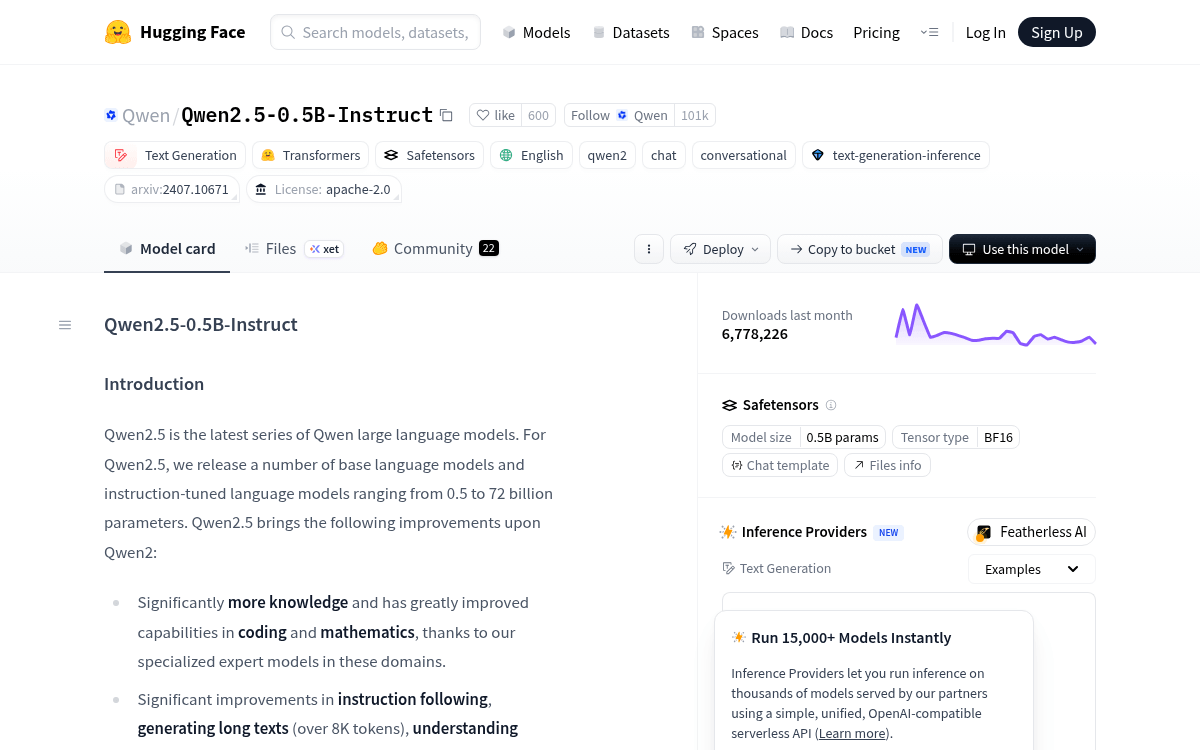
- Qwen2.5-0.5B-Instruct has passed 6.7M downloads and 600 likes on Hugging Face.
- 0.49B params, 24 layers, grouped-query attention, 32K context, 8K generation.
- Apache 2.0 license with multilingual support across 29+ languages.
- Reportedly beats Gemma2-2.6B on several math and coding benchmarks.
- Weak on hard reasoning: roughly 6% OlympiadBench, 31% MATH500.
- Popular as a draft model, fine-tuning base, and on-device assistant.
Alibaba's Qwen team quietly shipped one of the most downloaded small language models on Hugging Face: Qwen2.5-0.5B-Instruct. It has crossed 6.7 million downloads and now sits underneath hundreds of community fine-tunes, adapters, and quantizations. At half a billion parameters, it fits on a laptop CPU, yet it inherits the training pipeline of a frontier model family.
The tiny end of a very large family
Qwen2.5 is the current generation of Alibaba's open-weight LLMs, spanning base and instruction-tuned checkpoints at 0.5B, 1.5B, 3B, 7B, 14B, 32B, and 72B parameters. The 0.5B-Instruct variant is the smallest instruction-tuned member of the lineup, released under Apache 2.0, which makes it one of the few genuinely permissive options at this size.
Under the hood it is a fairly standard decoder-only transformer with a few modern touches:
- 0.49B total parameters, 0.36B excluding embeddings
- 24 layers with grouped-query attention (14 query heads, 2 key/value heads)
- RoPE positional encoding, SwiGLU activations, RMSNorm, and tied word embeddings
- 32,768 token context window with up to 8,192 tokens of generation
- BF16 weights out of the box, with community GGUF and AWQ quantizations available
Grouped-query attention with only 2 KV heads is the interesting design choice. It shrinks the KV cache dramatically, which is what lets a model this small handle 32K tokens without eating all your RAM.
What Qwen2.5 changed versus Qwen2
The instruction-tuned version inherits the broader Qwen2.5 upgrades: significantly better instruction following, long-form generation stretched from 1K to over 8K tokens, stronger handling of structured inputs like tables, and much more reliable JSON output. The models are also more resilient to system prompt variation, which helps for role-play and chatbot condition-setting. Multilingual coverage spans over 29 languages, including Chinese, English, French, Spanish, German, Japanese, Korean, and Arabic.
Where a 0.5B model actually wins
The headline claim from the Qwen team is aggressive for a model this size. Across edge-side variants, Qwen2.5-0.5B, 1.5B, and 3B hold strong performance across nearly all benchmarks, and Qwen2.5-0.5B outperforms Gemma2-2.6B on several math and coding tasks. That is roughly a 5x parameter advantage overcome through better data and training.
The ceiling shows up quickly on hard reasoning. Independent evaluations put Qwen2.5-0.5B-Instruct at 6.2% on OlympiadBench and 31.4% on MATH500, well behind the 1.5B and 7B siblings. For multi-step reasoning, reach for a larger model. For structured extraction, classification, routing, or short-form chat, 0.5B is often enough.
Running it in three lines
The model works with any recent transformers release, but versions below 4.37.0 will throw KeyError: 'qwen2'.
from transformers import pipeline
pipe = pipeline("text-generation", model="Qwen/Qwen2.5-0.5B-Instruct")
messages = [{"role": "user", "content": "Extract the invoice total as JSON."}]
print(pipe(messages, max_new_tokens=128))
For production, vLLM and SGLang both serve it out of the box with an OpenAI-compatible API. A single vllm serve Qwen/Qwen2.5-0.5B-Instruct command is enough to expose a /v1/chat/completions endpoint. Quantized builds targeting llama.cpp, Ollama, and LM Studio are all linked from the model card.
Why it keeps trending
The download counter tells the real story. Most users treat this checkpoint as a starting point rather than an endpoint. The Hugging Face page lists hundreds of derivative models built on top of it, and it powers a lot of production workloads that never make headlines:
- Draft model for speculative decoding in front of Qwen2.5-7B, 14B, or 32B, where a fast small model proposes tokens for a bigger verifier
- On-device assistants on phones, browsers, and Raspberry-Pi-class hardware
- Fine-tuning base for domain-specific chat, routing agents, or SQL and JSON generators where a full 7B is overkill
- Structured output extraction from documents, forms, and logs
- Research substrate for reasoning experiments, since a 0.5B model trains fast enough for rapid iteration on RLHF and distillation methods
The Qwen2.5 launch blog frames the small variants as edge models, though the community has treated them as something more useful: a permissively licensed, well-behaved instruction model small enough to iterate on cheaply. For any task where latency, cost, or hardware constraints outweigh raw reasoning power, this is a reasonable default to try before reaching for something ten times larger.