
Alibaba's Qwen2.5-0.5B Beats Models 5x Its Size on Math
A 500M parameter base model with 32K context, GQA, and Apache-2.0 licensing that punches well above its weight class on math and code.
 Pro
Takeaways
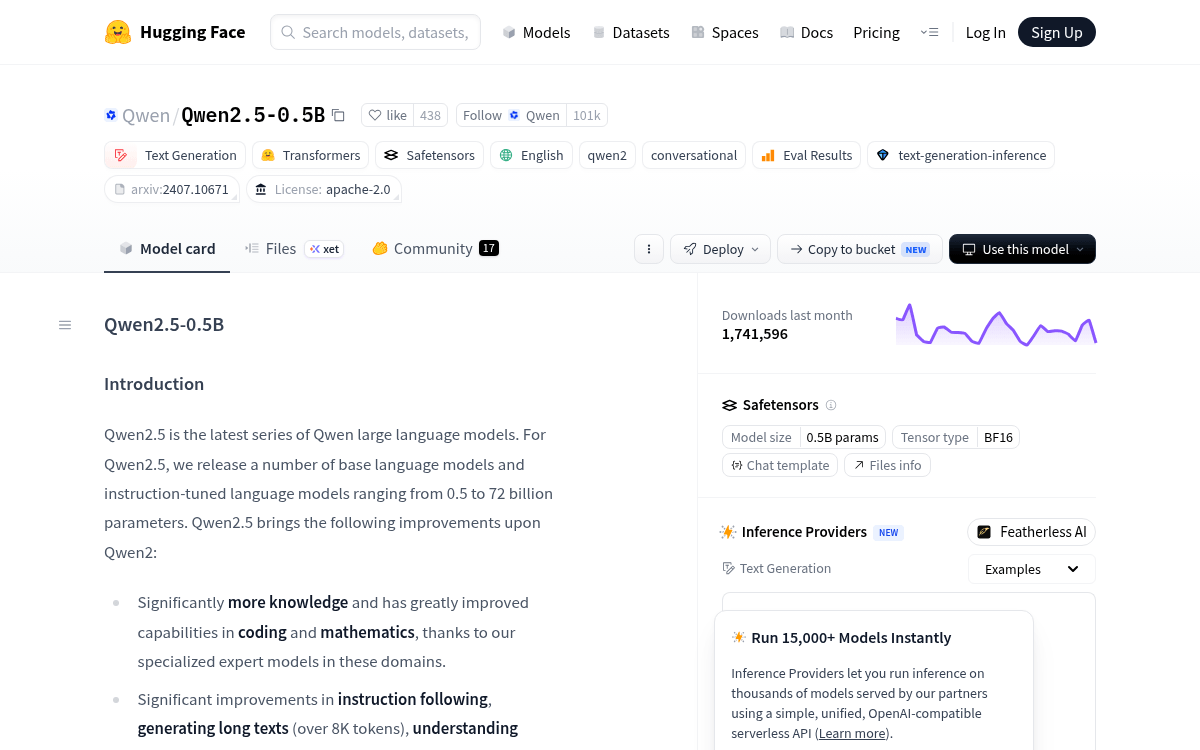
- Qwen2.5-0.5B is a 0.49B parameter base LLM from Alibaba, Apache 2.0 licensed on Hugging Face
- Uses grouped-query attention with 14 Q heads and 2 KV heads, 24 layers, 32K context window
- Outperforms Gemma2-2.6B on several math and coding tasks despite being 5x smaller
- Weak on hard reasoning: only 6.2% on OlympiadBench, 31.4% on MATH500 for the Instruct variant
- Base model is not for chat, meant as a substrate for SFT, RLHF, or continued pretraining
- Deployable via Transformers, vLLM, SGLang, llama.cpp, and Ollama with 693+ community finetunes
The smallest member of Alibaba's Qwen2.5 family keeps quietly climbing the download charts, with more than 1.7 million pulls and over 4,000 likes on Hugging Face. The half-billion parameter base checkpoint has become the default starting point for anyone fine-tuning a tiny language model, and the ecosystem around it now includes hundreds of derivative weights.
What actually shipped
Qwen2.5-0.5B is the base pretrained checkpoint from the broader Qwen2.5 release. The Qwen team shipped pre-trained and instruction-tuned variants at seven sizes (0.5B, 1.5B, 3B, 7B, 14B, 32B, and 72B), providing the originals in bfloat16 alongside quantized builds at several precisions. The 0.5B variant is the entry point, aimed squarely at edge deployment, on-device inference, and research experimentation.
Under the hood, this is a compact but modern decoder. Key architectural details:
- 0.49B total parameters, 0.36B non-embedding
- 24 transformer layers
- Grouped-query attention with 14 query heads and 2 key/value heads
- RoPE positional embeddings, SwiGLU activations, RMSNorm, and tied word embeddings
- Full 32,768 token context length
- BF16 weights, Apache 2.0 license
Grouped-query attention shares key and value projections across multiple query heads, which dramatically shrinks the KV cache during inference. That is what makes a 32K context window actually usable on modest hardware.
Punching above its weight
The interesting story is how competitive the checkpoint is against models several times larger. For edge-side models, Qwen2.5-0.5B, 1.5B, and 3B hold up across nearly all benchmarks, and the 0.5B model outperforms Gemma2-2.6B on various math and coding tasks. Beating a model roughly five times its size on math and code is unusual for this tier.
Generational gains are worth flagging too. Qwen2.5 brings significantly more knowledge and much stronger coding and mathematics ability, thanks to specialized expert models in those domains, along with better instruction following, structured output generation (especially JSON), and multilingual coverage for over 29 languages.
The limitations you should know about
A half-billion parameter model is still a half-billion parameter model. Independent evaluation on reasoning tasks paints a sober picture: Qwen2.5-0.5B-Instruct scores just 6.2% on OlympiadBench and 31.4% on MATH500, well behind the 1.5B and 7B siblings. On MMLU-Pro the base model scores around 14.9.
The Qwen team is explicit about this and does not recommend using the base language model for conversation, suggesting post-training such as SFT, RLHF, or continued pretraining first. Treat this as raw material, not a chatbot.
Getting it running
The model works with any recent Transformers install. A minimal load looks like this:
from transformers import AutoTokenizer, AutoModelForCausalLM
tokenizer = AutoTokenizer.from_pretrained("Qwen/Qwen2.5-0.5B")
model = AutoModelForCausalLM.from_pretrained(
    "Qwen/Qwen2.5-0.5B", device_map="auto"
)
For serving, both vLLM and SGLang expose an OpenAI-compatible API with a single command such as vllm serve "Qwen/Qwen2.5-0.5B". Quantized GGUF builds work with llama.cpp, Ollama, and LM Studio, so you can push this onto laptops and even phones.
Why a 0.5B base model earns its keep
The practical role of a 0.5B base model is to be the cheapest possible substrate for specialized behavior, not to compete with GPT-4 class systems. Browse the Hugging Face model tree and you will find hundreds of finetunes and adapters plus over a hundred community quantizations. That community weight is what makes a small checkpoint actually useful.
Typical use cases where this size fits:
- Draft models for speculative decoding in front of larger Qwen checkpoints
- On-device assistants, classifiers, and routers where latency and RAM matter
- Synthetic data generation pipelines that need cheap high-throughput inference
- Fine-tuning targets for narrow tasks like function calling, NER, or SQL generation
- Teaching and research, where full pretraining or RLHF experiments need to fit on one GPU
The broader shift is that the frontier of small models has moved. A year ago, sub-1B parameter models were widely dismissed as toys. The Qwen2.5 lineup, documented in the release blog, is one of the clearest data points that careful data curation and distillation from larger siblings can make this size genuinely deployable for real workloads.