
Alibaba's Qwen-Image Beats Open Models at Rendering Chinese Text Inside Images
Alibaba's Qwen team open-sourced a 20B MMDiT foundation model that renders complex English and Chinese text directly inside generated images with striking accuracy.
 Pro
Takeaways
- Qwen released Qwen-Image, a 20B MMDiT foundation model under Apache 2.0.
- Excels at complex English and Chinese text rendering inside generated images.
- Uses dual encoding via Qwen2.5-VL plus a VAE to preserve identity during edits.
- Trained with a curriculum going from no-text images up to paragraph-level prompts.
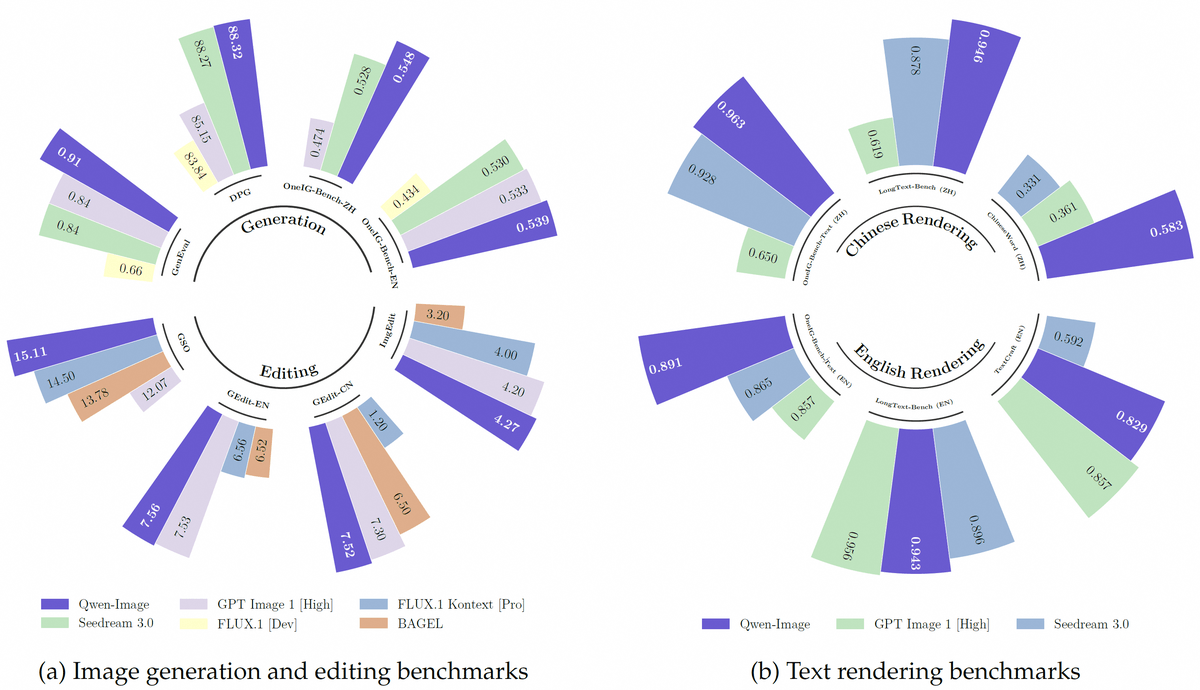
- Reports state-of-the-art results on GenEval, DPG, GEdit, ImgEdit, LongText-Bench.
- Also handles segmentation, depth, edge detection and novel view synthesis. Paper.
Alibaba's Qwen team has released Qwen-Image, a 20B parameter MMDiT image foundation model aimed at two areas where most diffusion systems still stumble: rendering legible text inside pictures, and preserving identity during edits. It ships under Apache 2.0 on Hugging Face and ModelScope, so you can run it locally, fine-tune it, and put it in commercial products without licensing friction.
The headline capability is native text rendering. Qwen-Image handles alphabetic scripts like English well and, more surprisingly for an open model, makes real progress on logographic Chinese. That covers multi-line paragraph layouts, small captions occupying a fraction of the frame, calligraphy-style couplets, and bilingual handwriting on the same surface. Existing open models tend to produce plausible-looking gibberish once text runs beyond a few words; Qwen-Image treats glyphs as first-class visual objects.
Under the hood
Qwen-Image is more than a scaled DiT. The technical report describes several architectural and training choices aimed squarely at the text and editing problems.
- Progressive curriculum for text. The data pipeline covers large-scale collection, filtering, annotation, synthesis, and balancing. Training begins with non-text image generation, moves to simple textual inputs, and gradually scales to paragraph-level descriptions. In plain terms: the model learns to draw first, then short words, then sentences, then whole paragraphs.
- Dual encoding for editing. An improved multi-task paradigm combines text-to-image (T2I), text-image-to-image (TI2I), and image-to-image (I2I) reconstruction, aligning the latent representations between Qwen2.5-VL and MMDiT. During editing, the source image is fed into both
Qwen2.5-VLfor semantic understanding and a VAE encoder for pixel-level reconstruction, so the model keeps the meaning of a scene while preserving fine visual detail. - 20B MMDiT backbone. The multimodal diffusion transformer is large enough to hold layout, typography, and semantic conditioning in one attention stack, which is why long prompts describing infographic layouts or slide compositions produce coherent structure instead of soup.
Benchmarks it clears
Qwen reports state-of-the-art numbers across a broad sweep of public benchmarks: GenEval, DPG, and OneIG-Bench for general generation; GEdit, ImgEdit, and GSO for editing; and LongText-Bench, ChineseWord, and TextCraft for text rendering. The Chinese-text gap over prior open models is the most striking result, which tracks with the training focus.

Getting it running
The Hugging Face pipeline is a drop-in for anyone already using diffusers. Weights are BF16, and the model card lists preset aspect ratios from 1:1 up to 3:2 and 9:16.
from diffusers import DiffusionPipeline
import torch
pipe = DiffusionPipeline.from_pretrained(
    "Qwen/Qwen-Image", torch_dtype=torch.bfloat16
).to("cuda")
prompt = "A bookstore window with a sign reading 'New Arrivals This Week'"
image = pipe(
    prompt=prompt + ", Ultra HD, 4K, cinematic composition.",
    width=1664, height=928,
    num_inference_steps=50,
    true_cfg_scale=4.0,
).images[0]
image.save("out.png")
At 20B parameters in BF16, the weights alone come to roughly 40GB, so a single H100 or A100 80GB is the comfortable path. Quantized community builds are already appearing on the Hub for consumer GPUs, and the model card lists over 500 adapters, 96 finetunes, and 30 quantizations derived from the base checkpoint.
One model, many jobs
One of the more interesting framings from the model card treats generation, editing, and understanding as facets of the same problem. The same weights support object detection, semantic segmentation, depth and edge (Canny) estimation, novel view synthesis, and super-resolution, alongside style transfer, object insertion or removal, and text editing inside an image. You can rewrite the words on a sign in a photo without regenerating the whole scene, or pull a Canny edge map for use as a control signal downstream.
Where it still stumbles
At default settings (50 steps, high resolution) inference is slow, so throughput per GPU is modest compared to distilled or few-step models. Character consistency across multiple edits, hands in unusual poses, and physically implausible compositions remain typical DiT failure modes. The text rendering is strong but can still misspell rare tokens, especially when a prompt asks for many small text elements at once.
Why this release lands
Two shifts stand out. The open-source image model frontier now includes credible Chinese-first systems, which has practical consequences for anyone building product for East Asian markets, where earlier open models were essentially unusable for on-image text. Qwen-Image also folds generation, editing, and dense visual understanding into one weight set, a direction the field has been moving toward but that few open releases have delivered at this scale.
For teams shipping design tools, marketing content pipelines, or multilingual document generation, an Apache 2.0 model that can actually spell is a meaningful unlock. The technical report and GitHub repo go deeper on the data pipeline, curriculum schedule, and evaluation methodology.