
Alibaba's Ovis2.6 Runs 80B Vision AI While Activating Only 3B Parameters
Alibaba's AIDC-AI team ships an 80B mixture-of-experts vision model that runs on 3B active parameters and can crop images mid-reasoning.
Takeaways
- AIDC-AI released Ovis2.6-80B-A3B, an Apache-2.0 multimodal MoE with 80B total, ~3B active parameters.
- 64K context window and 2880x2880 image resolution target long documents and dense charts.
- New Think with Image capability lets the model crop and rotate images inside its chain-of-thought.
- Two-phase generation with a configurable thinking_budget separates reasoning tokens from final answer tokens.
- Built-in grounding returns normalized bounding boxes and points via ref and box tags.
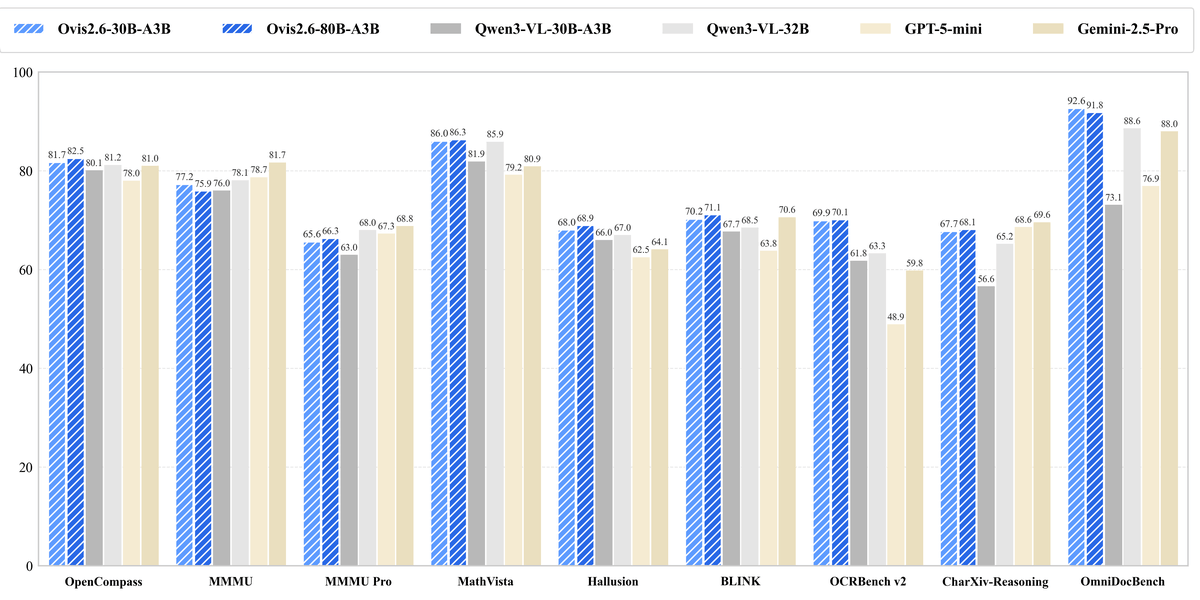
- Scores 66.3 on MMMU_Pro Vision and trades top spots with Qwen3-VL, GLM4.6v, GPT-5 mini, Gemini 2.5 Pro.
Alibaba's AIDC-AI team just released Ovis2.6-80B-A3B, a multimodal model that keeps the knowledge of an 80-billion-parameter network while only lighting up about 3 billion parameters per token. It ships under Apache 2.0, handles images up to 2880x2880, and introduces a reasoning trick where the model can crop and rotate its own inputs mid-thought.
The MoE bet for vision-language
Ovis2.6 builds on the foundation of Ovis2.5, upgrading the LLM backbone to a Mixture-of-Experts (MoE) architecture. The model card describes Ovis2.6-80B-A3B as an Apache-2.0 image-to-text system with 81B listed parameters and roughly 3B active during inference. That captures the economic pitch in one line: carry the knowledge and capacity of a much larger network while activating only a small slice of it per run.
For teams that have been eyeing dense 70B-class vision models but flinching at the serving bill, this is the interesting shape. With 80 billion total weights but only about 3 billion active, the model stays light enough for a single consumer GPU. Professionals and serious hobbyists can run high-end document and visual reasoning locally, keeping sensitive data on their own machines.
Built for dense documents, not dog photos
The context and resolution numbers make the intended workload obvious. Ovis2.6 extends the window to 64K tokens, supports images up to 2880x2880, and puts special emphasis on OCR, document understanding, and chart or diagram analysis. Those specs matter because much of enterprise visual AI has little to do with spotting a dog in a photo. It involves reading dense PDFs, reconciling tables, interpreting forms, extracting evidence from screenshots, and following a thread across many pages.