
Alibaba's gte-large-en-v1.5 Beats Rivals at 16x Smaller Size
Alibaba's compact 434M-parameter embedding model handles 8192-token inputs and tops MTEB in its size class, ideal for RAG and semantic search.
 Pro
Takeaways
- Alibaba's gte-large-en-v1.5 is a 434M-parameter English embedding model with an 8,192-token context window.
- Scores 65.39 on MTEB, topping bge-large, mxbai-embed-large, and multilingual-e5-large-instruct in its size class.
- Built on a transformer++ backbone combining BERT with RoPE positional encoding and gated linear units.
- Trained via staged MLM (512, 2048, 8192 tokens) followed by contrastive pre-training and supervised fine-tuning.
- Apache 2.0 licensed, works with sentence-transformers, ONNX, Transformers.js, and Azure AI.
- Struggles with logical negation, so pair it with a reranker for reasoning-heavy retrieval tasks.
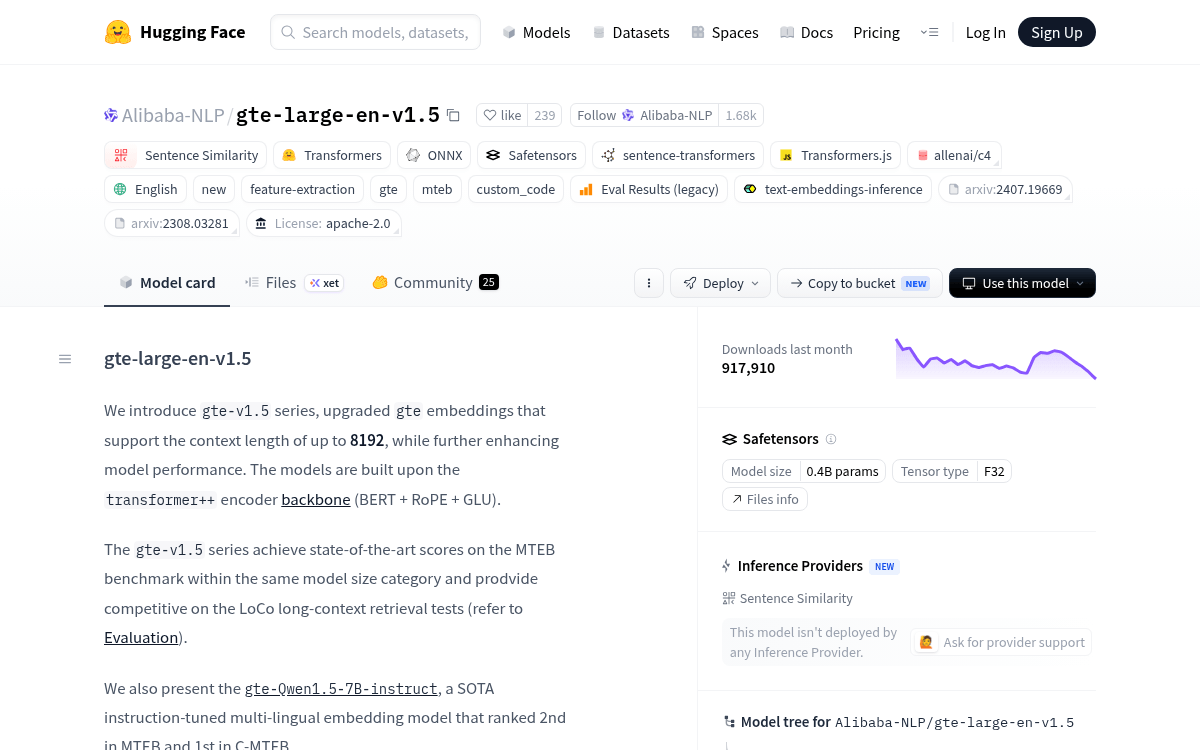
Alibaba's Institute for Intelligent Computing has been quietly building one of the most practical open-source embedding stacks in the ecosystem, and gte-large-en-v1.5 is the workhorse of the family. The model packs 434M parameters, handles English text, and pushes the sequence length to 8,192 tokens without sacrificing quality on shorter inputs. It ships under Apache 2.0.
You get long-context embeddings from an encoder small enough to run on a single GPU, with numbers that hold up against much larger competitors. The gte-v1.5 series posts leading MTEB scores within its parameter class and stays competitive on the LoCo long-context retrieval tests.
Under the hood
The GTE (General Text Embeddings) family is built on a transformer++ encoder backbone: BERT with Rotary Position Embeddings (RoPE) and Gated Linear Units in place of the usual feed-forward layers. RoPE is the same positional trick that lets Llama-family models extend context, and GLUs improve parameter efficiency in the MLP blocks. The model was trained on a large-scale corpus of relevant text pairs.
Output vectors are 1024-dimensional and drawn from an 8,192-token window. Most popular open-source alternatives in this size class, including bge-large-en-v1.5 and mxbai-embed-large-v1, cap out at 512 tokens, which forces aggressive chunking before embedding.
The training recipe
Training ran in three phases: masked language modeling (MLM) on c4-en, weak-supervised contrastive pre-training, and supervised contrastive fine-tuning. The interesting part is how the team stretched the context window. Rather than pre-training on 8k tokens from scratch, they staged the MLM phase:
- MLM at 512 tokens with RoPE base 10,000 for 300k steps at batch size 4,096
- MLM at 2,048 tokens for 30k more steps to adapt positional encodings
- MLM at 8,192 tokens with RoPE base bumped to 160,000, letting the model attend across much longer spans
Weak-supervised contrastive pre-training on text pairs followed, then supervised contrastive fine-tuning on human-labeled pairs. This staged length curriculum is what makes the 8k window genuinely usable rather than a paper trick.
Where it lands on benchmarks
On MTEB, gte-large-en-v1.5 scores 65.39 average across 56 tasks, ahead of mxbai-embed-large-v1 (64.68), multilingual-e5-large-instruct (64.41), and bge-large-en-v1.5 (64.23) in the same weight class. Retrieval (57.91) and classification (77.75) are especially strong, and those are the two categories that matter most for RAG and downstream classifiers.
On the LoCo long-context retrieval suite, it averages 86.71 across five tasks, brushing up against the 7B-parameter gte-Qwen1.5-7B-instruct (87.57) at less than a fifteenth of the size.
Using it
The model works with the standard sentence-transformers API, and there is also an ONNX build and a Transformers.js port for browser inference. Basic usage:
from sentence_transformers import SentenceTransformer
model = SentenceTransformer("Alibaba-NLP/gte-large-en-v1.5", trust_remote_code=True)
embeddings = model.encode(["That is a happy person", "Today is a sunny day"])
similarities = model.similarity(embeddings, embeddings)
You need trust_remote_code=True because the transformer++ backbone is a custom architecture not yet upstreamed into transformers. The maintainers recommend installing xformers and enabling unpadding for a meaningful speedup on batches with variable-length inputs. For production, it is also available as a managed endpoint on Azure AI behind an OpenAI-compatible embeddings API.
Where it shines
The sweet spot is retrieval and semantic search over long documents where chunking into 512-token windows would be painful. Concretely:
- RAG pipelines over PDFs, research papers, transcripts, or codebases
- Document deduplication and clustering
- Zero-shot text classification via nearest-neighbor lookup
- Reranking candidate results from BM25 or a cheaper first-stage retriever
Known weaknesses
Like most contrastively trained encoders, it struggles with logical structure. In a bioinformatics benchmarking study, researchers found that when the reference answer was negated, the similarity between the reference and its inverse was second only to the similarity between the conclusion and the reference. In practice, the encoder does not reliably capture logical relationships between sentences. If your task depends on distinguishing "X causes Y" from "X does not cause Y," you will need a reranker or an LLM verification step downstream.
Coverage is English-only. For multilingual workloads, the same team offers gte-Qwen1.5-7B-instruct, which is heavier but multilingual and instruction-tuned.
Why it matters
The trade-off between context length and model size for embeddings has shifted. Embedding long documents competitively no longer requires a 7B instruction-tuned encoder, and using a small model no longer requires chunking everything to 512 tokens. At 434M parameters with an Apache 2.0 license and nearly a million monthly downloads on Hugging Face, gte-large-en-v1.5 has quietly become one of the default choices when teams need a self-hosted embedding model that just works.