
AEON-7's Ornith-1.0 Shrinks a 66GB Coding Agent to Fit One Blackwell GPU
AEON-7 squeezes DeepReinforce's top coding MoE into 23.7 GB with zero capability loss, unlocking 3× faster inference on Blackwell hardware
Takeaways
- New release: AEON-7 released Ornith-1.0-35B-AEON-Ultimate-Uncensored-NVFP4, a 4-bit quantized, refusal-free build of DeepReinforce's top agentic coding MoE.
- Size: Compressed from 66 GB (BF16) to 23.7 GB with zero coding capability loss — identical pass@1 score of 0.833 on an 18-task agentic probe.
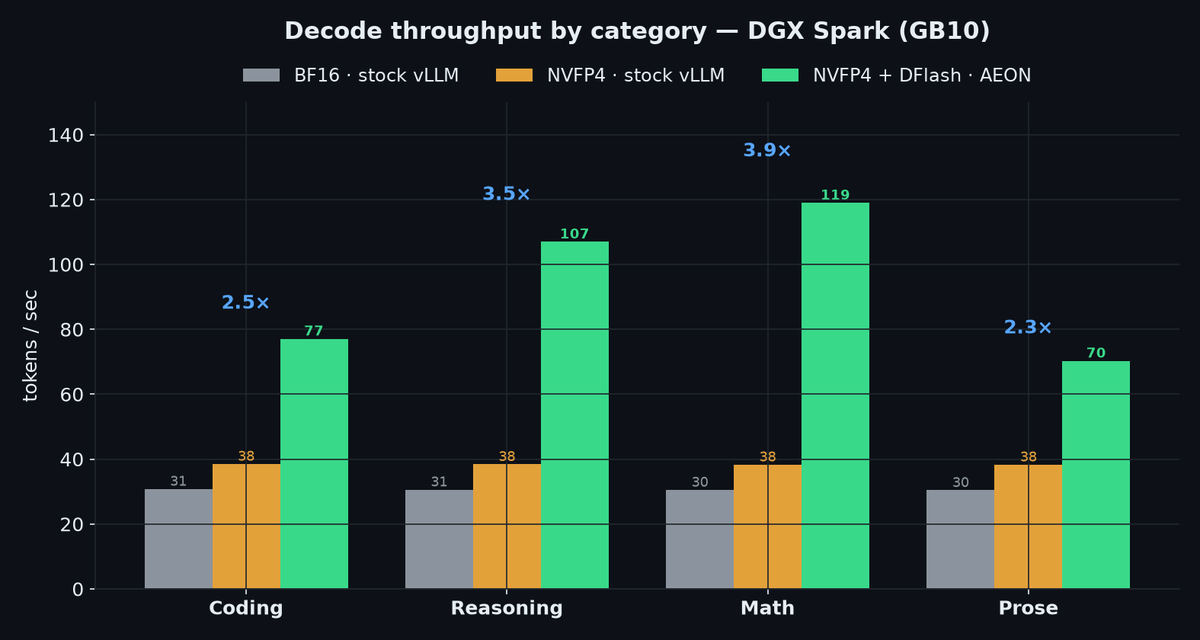
- Speed: Combined NVFP4 + DFlash speculative decoding delivers 3.05× decode throughput and 2.5× faster time-to-first-token vs. a naive BF16 deploy on DGX Spark.
- Benchmarks: Base model scores 75.6 on SWE-bench Verified and 64.2 on Terminal-Bench 2.1 — beating Qwen 3.5-397B despite being 10× smaller.
- Hardware requirement: NVFP4 format requires a Blackwell GPU (B200 or GB10/DGX Spark); the BF16 variant runs on any vLLM setup.
- License: MIT, free to use and modify; model is uncensored — users are solely responsible for outputs and downstream actions.
Ornith-1.0-35B-AEON-Ultimate-Uncensored-NVFP4 is a heavily optimized, refusal-free build of DeepReinforce's state-of-the-art agentic coding model, compressed from 66 GB down to 23.7 GB using NVIDIA's NVFP4 quantization format. The result is a model that fits comfortably on a single Blackwell GPU, runs at over 3× the throughput of the original BF16 baseline, and loses zero coding capability in the process. With over 5,000 downloads in its first few days, it's clearly hitting a nerve.
What Ornith-1.0 actually is
Before getting into the quantization, it helps to understand what's being quantized. Ornith-1.0-35B is DeepReinforce's mid-size agentic coding model, built on a hybrid architecture that mixes two types of attention layers. It has 40 layers total , 30 using GatedDeltaNet linear-attention (a recurrent, Mamba-style mechanism) and 10 using standard full-attention , with 256 routed experts plus one shared expert, a vision tower, and a 256K context window.
The 35B variant is a Mixture-of-Experts model , it has 35B total parameters, but only ~3B are active per token. That's what makes it unusually fast: even though the total parameters are 35B, only a subset of experts is used per token, so the number of parameters computed at each step is actually lower than a dense 9B model.
The training story is also interesting. The key innovation behind Ornith-1.0 is a self-improving training framework , instead of relying on human-designed harnesses to drive solution generation in RL, Ornith-1.0 learns to generate both solution rollouts and the task-specific harnesses that guide those rollouts, jointly optimizing the scaffold and the resulting solution to discover better search trajectories.
On benchmarks, the 35B model punches well above its weight class. It scores 75.6 on SWE-bench Verified and 64.2 on Terminal-Bench 2.1. That Terminal-Bench score beats Qwen 3.5-397B (53.5) , a model eleven times larger.
The uncensoring layer
AEON-7's build adds one more transformation on top of the base model: abliteration. This is a model-editing technique that removes refusal behavior without retraining. Abliteration identifies and neutralizes a latent "refusal direction" in the model's activation space , essentially, a vector in the model's internal representations that encodes the tendency to decline certain requests. Because it changes internal behavior rather than prompt phrasing, it is often more stable than jailbreaks across sessions and prompts.