
Adept's Fuyu-8B Ditches Vision Encoders to Read Screens in 100ms
Adept open-sources a decoder-only vision-language model that drops the image encoder, handles any resolution, and targets UI understanding for AI agents.
 Pro
Takeaways
- Adept open-sourced Fuyu-8B, a multimodal model for AI agents under CC-BY-NC 4.0.
- Vanilla decoder-only transformer with no image encoder; patches are linearly projected into layer one.
- Handles arbitrary image resolutions by streaming patches in raster order with an image-newline token.
- Targets UI QA, chart reading, screen OCR, and bounding-box localization for digital agents.
- Sub-100ms responses on large images; competitive on VQAv2, OKVQA, COCO Captions, AI2D against larger peers.
- Base model without instruction tuning; Adept's blog post recommends fine-tuning for real use.
Adept has released Fuyu-8B, an open-weights multimodal model that takes a noticeably different route from the LLaVA-style stack most of the field settled on. Rather than bolting a pretrained vision encoder like CLIP onto a language model with an adapter, Fuyu strips the whole thing down to a single decoder-only transformer that eats raw image patches. It is the small sibling of the model powering Adept's copilot product, aimed squarely at agents that need to read screens.
One transformer, no vision tower
Most existing multimodal systems lean on a separate visual encoder to process images, followed by an adapter to bridge it to the language model. Fuyu skips that entire pipeline. Architecturally, it is a vanilla decoder-only transformer with no image encoder at all. Image patches are linearly projected directly into the first layer, bypassing the embedding lookup. The decoder is then treated like an image transformer, albeit with no pooling and with causal attention.
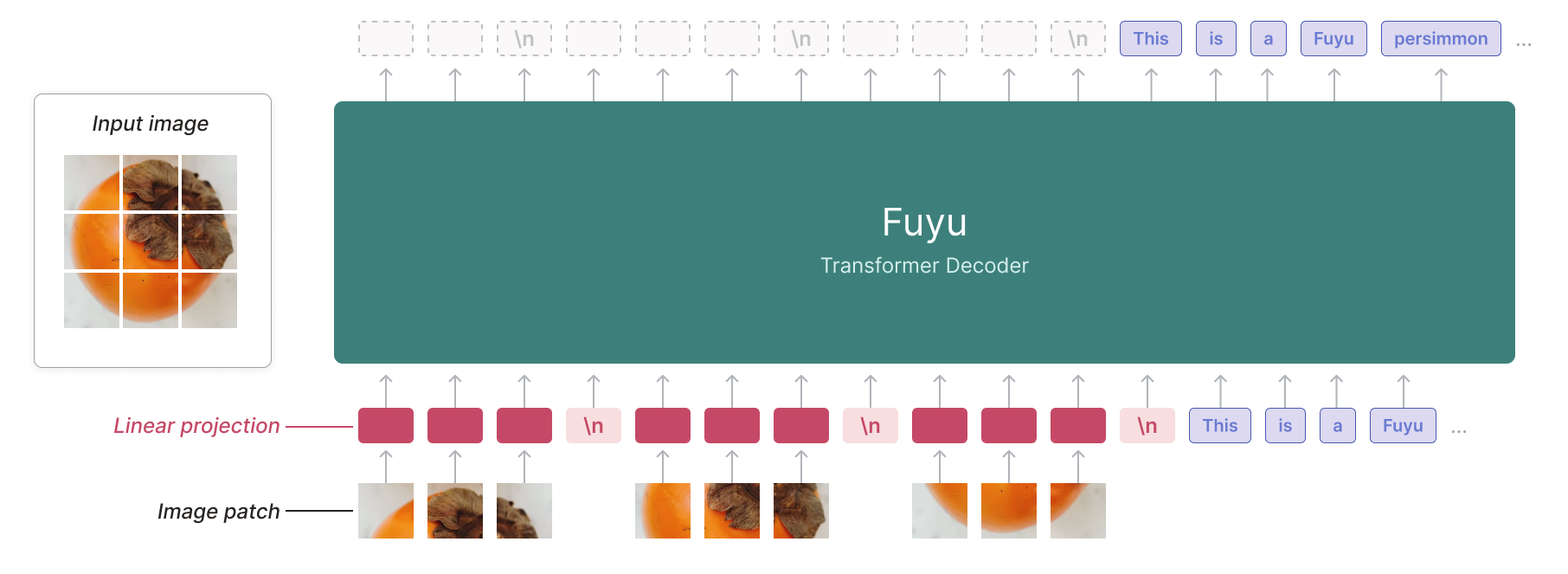
The trick that makes this work at arbitrary resolutions lies in how the image is fed in. Adept removes image-specific position embeddings and streams patches in raster-scan order, using a special image-newline token to mark where a row ends. The model reuses its existing text position embeddings to reason about spatial layout, so training and inference accept images of any size without separate high-res and low-res stages.
Why the simplification matters
Adept lists four reasons the design is worth attention:
- Fuyu-8B has no image encoder, which allows easy interleaving of text and images and handling of arbitrary resolutions.
- It is built for digital agents, so it can answer UI questions and localize elements on screen.
- Latency is low enough for copilot loops, with responses on large images in under 100 milliseconds.
- Despite the narrow product focus, it holds its own on generic image-understanding benchmarks.
The practical upside for anyone building on it: no separate ViT to manage, no adapter to tune, and no resizing images to a fixed 224 or 336 pixel square. You can pass a full 1080p screenshot in and let the causal attention sort it out.
Where it lands on benchmarks
Fuyu-8B is a base model, so the reported numbers are compared against instruction-tuned peers that are often much larger. Adept publishes results against LLaVA 1.5, Qwen-VL, PALI-X, and PaLM-E:
| Task | Fuyu-8B | LLaVA 1.5 (13.5B) | Qwen-VL (10B) | PALI-X (55B) |
|---|---|---|---|---|
| VQAv2 | 74.2 | 80.0 | 79.5 | 86.1 |
| OKVQA | 60.6 | n/a | 58.6 | 66.1 |
| COCO Captions | 141 | n/a | n/a | 149 |
| AI2D | 64.5 | n/a | 62.3 | 81.2 |
It trails the giants on general VQA, which is expected. Adept cares more about the agent-shaped capabilities these benchmarks do not really measure: chart reading, document layout, and clicking the right button in a UI.
The agent angle
Adept framed the release around a specific product bet. Fuyu-8B has capabilities in understanding diagrams, charts, and graphs, doing OCR on screens, outputting bounding boxes for objects on screens, and answering UI-based questions. That is a very different capability list from a model tuned for natural-image captioning, and it is why the arbitrary-resolution property matters so much. A screenshot of a spreadsheet is not a 336x336 square, and downsampling it destroys the small text you actually need to read.

The model card demonstrates this with a chart-reading example where the model correctly reads the highest male life expectancy off a line graph as 80.7 in 2018, without any specialized chart parsing head.
Getting it running
The weights are on Hugging Face under a CC-BY-NC 4.0 license, which restricts them to research use. Total parameter count is around 9B in bfloat16. Basic inference looks like this:
from transformers import FuyuProcessor, FuyuForCausalLM
from PIL import Image
processor = FuyuProcessor.from_pretrained("adept/fuyu-8b")
model = FuyuForCausalLM.from_pretrained("adept/fuyu-8b", device_map="cuda:0")
image = Image.open("screenshot.png")
inputs = processor(text="What color is the bus?\n", images=image, return_tensors="pt").to("cuda:0")
out = model.generate(**inputs, max_new_tokens=16)
print(processor.batch_decode(out[:, -16:], skip_special_tokens=True))
A couple of implementation details worth knowing: |SPEAKER| is the placeholder token for image patch embeddings, |NEWLINE| marks the end of a raster row, and Adept recommends ending prompts with a newline for best results. Fuyu also runs on vLLM and SGLang out of the box for anyone who wants an OpenAI-compatible endpoint.
What it is not
Adept is explicit that this raw base model will need fine-tuning for anything real. The release ships with no RLHF, no safety filtering, and no chat template. The company notes limitations around generating faces and the usual caveats about social bias in a web-scale image dataset. Between that and the non-commercial license, this is a research artifact, not a drop-in for a production copilot.
The bigger bet
Fuyu-8B is interesting less as a benchmark leader and more as an architectural argument. The dominant recipe in open multimodal work has been to take a strong vision encoder, freeze or partially train it, and glue it to an LLM via a projection layer. Adept is arguing that a single decoder trained end-to-end on patches is simpler, scales more cleanly, and inherits every transformer optimization the community has already built.
They followed up by scaling the recipe. Adept describes Fuyu-Heavy as the world's third-most-capable multimodal model, behind only GPT4-V and Gemini Ultra, which are 10 to 20 times larger. That result suggests the Fuyu architecture can be scaled up while keeping arbitrary image sizes and reusing existing transformer optimizations. Fuyu-Heavy is closed, but the 8B release gives the open community a working reference implementation of the same idea.
For anyone building screen-reading agents, document parsers, or chart-QA tooling, this is worth pulling down and probing. The interesting question is whether a single-tower design ends up being easier to fine-tune on the messy, high-resolution, text-heavy images that real agent work actually involves.