
A Tiny Open-Source Model Quietly Nails Nepali Speech at 6% Error Rate
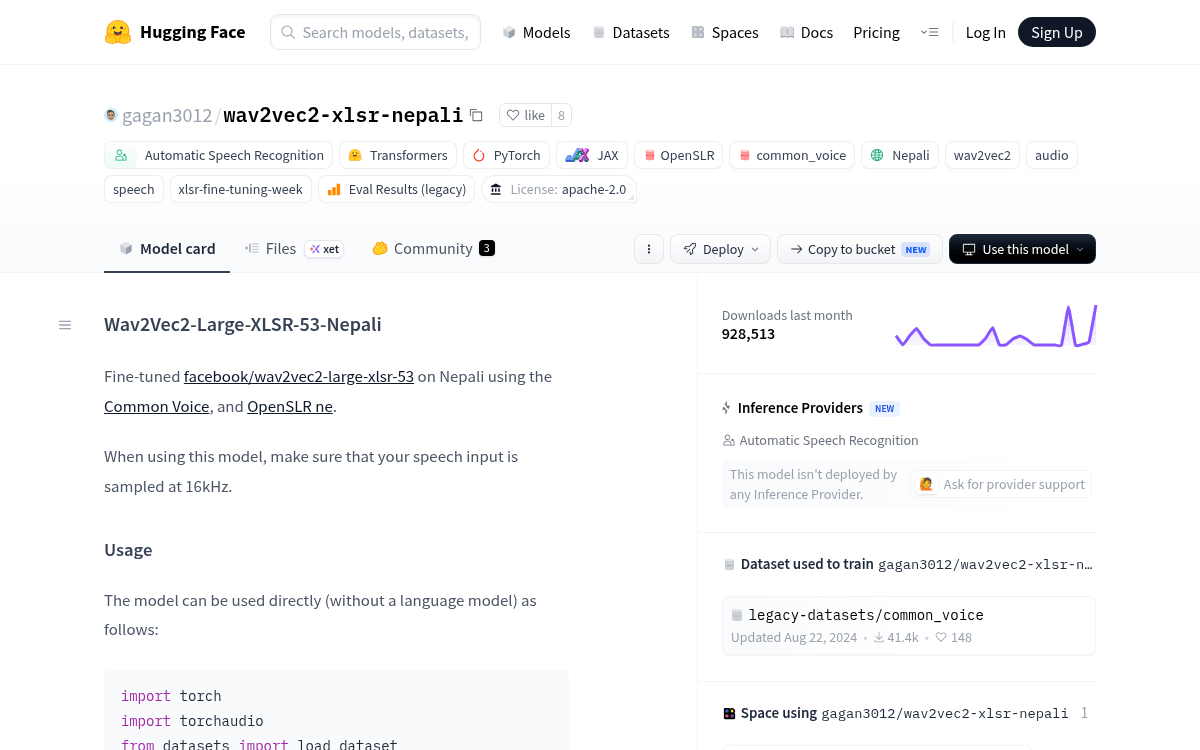
A Nepali speech recognition model fine-tuned from Facebook's XLSR-53 is quietly racking up nearly a million downloads with a 5.97% word error rate.
 Pro
Takeaways
- Nepali ASR model wav2vec2-xlsr-nepali hits 5.97% WER on OpenSLR test set.
- Fine-tuned from facebook/wav2vec2-large-xlsr-53 using Common Voice and OpenSLR data.
- Apache 2.0 license, nearly a million cumulative downloads on Hugging Face.
- Outputs Devanagari script directly via CTC; requires 16 kHz audio input.
- Best on clean read speech; noisy or accented audio degrades performance significantly.
- Illustrates broader XLSR-53 recipe powering community ASR for low-resource languages.
Nepali rarely shows up in mainstream speech recognition benchmarks, yet a small open-source model on Hugging Face has quietly served nearly a million downloads for it. The wav2vec2-xlsr-nepali checkpoint, released under Apache 2.0, fine-tunes Facebook AI's XLSR-53 backbone for Nepali automatic speech recognition and reports a test word error rate just under 6% on OpenSLR.
What you're actually downloading
The checkpoint adapts facebook/wav2vec2-large-xlsr-53 to Nepali using two data sources: Mozilla's Common Voice corpus and the OpenSLR Nepali set (resource 43). It expects raw audio sampled at 16 kHz and emits Devanagari-script transcriptions directly through a CTC head. On the OpenSLR Nepali test split, the author reports a WER of 5.97%, competitive for a low-resource language fine-tune.
Why XLSR-53 keeps showing up under the hood
The base model matters here. XLSR-53 is a self-supervised speech representation system designed for robust transfer across more than 50 languages. It extends wav2vec 2.0 to the multilingual domain by integrating a product quantizer and scaling to 53 languages and roughly 56,000 hours of unlabeled audio. Pretraining is contrastive: the model jointly solves a contrastive task over masked latent speech representations and learns a quantization of those latents shared across languages. A convolutional feature encoder maps raw audio to latent representations, which flow into a Transformer that outputs context vectors.
That shared multilingual pretraining is what makes a Nepali fine-tune viable at all. Experiments show cross-lingual pretraining significantly outperforms monolingual pretraining, and on the CommonVoice benchmark XLSR reports a relative phoneme error rate reduction of 72% over the best known prior results. Meta released XLSR-53 explicitly to catalyze research in low-resource speech understanding, and Nepali fits that description precisely.
Using it
The simplest path is the Transformers pipeline abstraction. Two lines get you a working transcriber:
from transformers import pipeline
pipe = pipeline("automatic-speech-recognition",
                model="gagan3012/wav2vec2-xlsr-nepali")
print(pipe("my_nepali_audio.wav"))
For lower-level control, load the processor and CTC model directly and feed tensors yourself. One gotcha worth flagging: the model was trained on 16 kHz audio, so anything from a 48 kHz source (like Common Voice recordings) needs resampling before inference. The model card shows a torchaudio resampler applied in exactly that pattern.
Strengths and sharp edges
Where it delivers:
- Strong reported accuracy on clean, read-speech Nepali (5.97% WER on OpenSLR).
- Direct Devanagari output, with no romanization or transliteration layer.
- Apache 2.0 license, so commercial use is unrestricted.
- Small enough to run on a single GPU and cheap to fine-tune further.
Where it falls short:
- The reported WER comes from OpenSLR, which is clean studio-quality read speech. Noisy audio, phone calls, or heavily accented speech will degrade results significantly.
- No built-in language model. Pairing it with a KenLM n-gram over Nepali text typically shaves several points off WER.
- The CTC head operates over characters, so output has no punctuation, no casing, and no speaker segmentation.
- It is a 2021-era checkpoint. Newer options like Whisper and Meta's MMS also cover Nepali, sometimes with better robustness on noisy data.
Where it fits in practice
Obvious use cases include transcription tooling for Nepali media, voice interfaces for apps targeting users in Nepal and the diaspora, dataset labeling pipelines for building larger corpora, and accessibility features like captioning. The checkpoint also serves as a strong warm start if you want to fine-tune further on domain data, which is often cheaper than starting from XLSR-53 directly since the weights have already absorbed Nepali phonotactics and orthography.
The bigger pattern
The reason this model keeps trending long after release is structural. Meta open-sourced a genuinely multilingual foundation, and community fine-tunes have filled in the languages that commercial vendors deprioritize. XLSR-53 and its successor XLS-R build on wav2vec 2.0 and exploit similarities between languages during pretraining, improving recognition across them. For any low-resource language, the recipe of grabbing XLSR-53, fine-tuning on a few hundred hours of Common Voice plus OpenSLR data, and publishing the result is now well-worn, and the download counts show real demand on the other end.