
A Tiny 14M Korean Sentiment Model Quietly Hit 2.5M Downloads
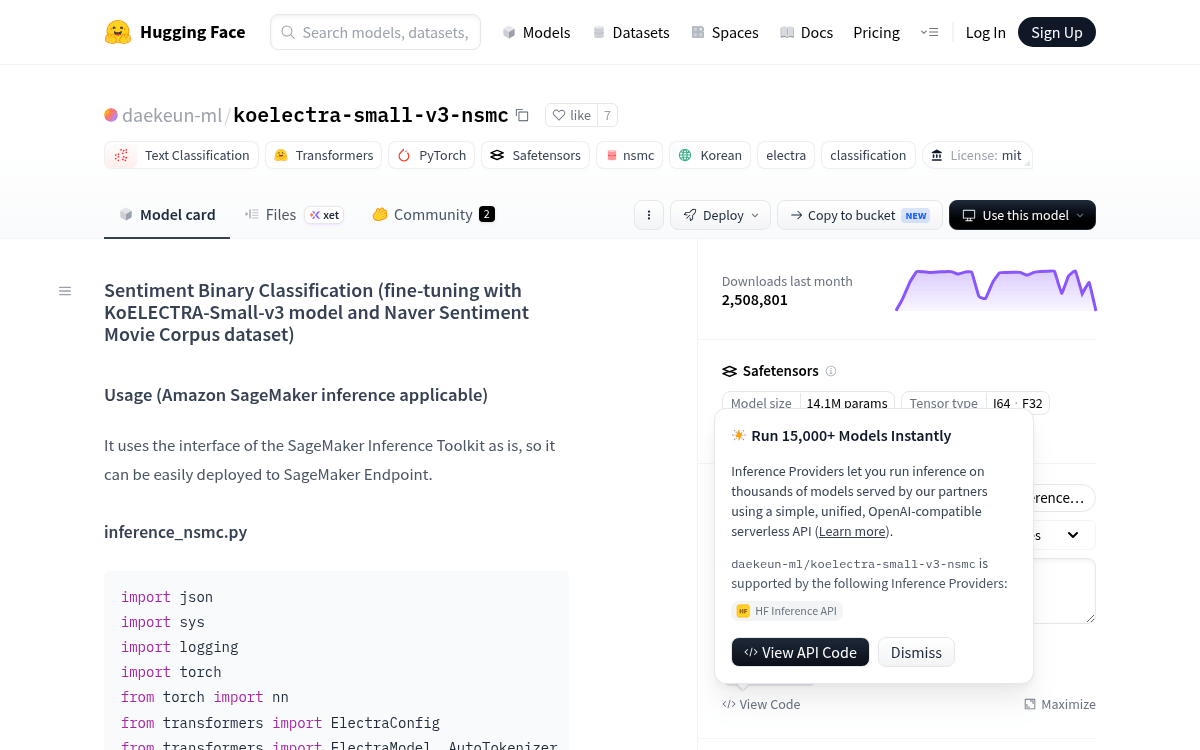
A 14M parameter Korean sentiment classifier fine-tuned on movie reviews has crossed 2.5M downloads, quietly powering production text pipelines.
 Pro
Takeaways
- Korean sentiment classifier koelectra-small-v3-nsmc has crossed 2.5M downloads on Hugging Face.
- Built on KoELECTRA-Small-v3, 14.1M parameters, MIT licensed, binary Pos/Neg output.
- Fine-tuned on the Naver Sentiment Movie Corpus, 128 token max input length.
- Hits 89.36 accuracy on NSMC, close to the much larger Base-v3 variant at 90.63.
- Ships a SageMaker Inference Toolkit handler for one-step endpoint deployment.
- Struggles with sarcasm, idioms, and out-of-domain text beyond movie reviews.
A small Korean text classifier has quietly become one of the busier models on the Hugging Face Hub, racking up more than 2.5 million downloads without any of the fanfare that usually surrounds trending checkpoints. The checkpoint is daekeun-ml/koelectra-small-v3-nsmc, a binary sentiment classifier built on KoELECTRA-Small-v3 and fine-tuned on the Naver Sentiment Movie Corpus. It weighs in at 14.1M parameters, ships under an MIT license, and does exactly one thing well: decide whether a Korean sentence is positive or negative.
There is no new architecture here and no benchmark-shattering result. What there is instead is a cheap, deployable, permissively licensed Korean NLP building block that keeps showing up in production pipelines long after larger general-purpose LLMs have taken the spotlight.
What it actually does
The classifier fine-tunes KoELECTRA-Small-v3 on the Naver Sentiment Movie Corpus (NSMC) to label Korean text as positive or negative. It accepts up to 128 tokens per input and returns a probability for each class.
Usage is a two-line affair with Hugging Face Transformers:
from transformers import pipeline
pipe = pipeline("text-classification", model="daekeun-ml/koelectra-small-v3-nsmc")
pipe("이 영화는 최고의 영화입니다")
# [{'label': 'Pos', 'score': 0.9619}]
The repository also ships a full inference_nsmc.py handler that conforms to the SageMaker Inference Toolkit interface, so the same weights can be dropped straight into a SageMaker Endpoint without writing custom serving code.
Why ELECTRA, and why small
ELECTRA swaps BERT's masked-language objective for a discriminator that learns to spot tokens replaced by a small generator network. In practice that means it reaches BERT-tier accuracy with far fewer parameters and less compute, which is what makes the small variant attractive for cheap inference. On NSMC, KoELECTRA-Small-v3 hits 89.36 accuracy, against 90.63 for the much larger KoELECTRA-Base-v3. Giving up roughly 1.3 points to shrink the model to a fraction of the size is a trade most production teams will happily take.
The training data is straightforward: NSMC contains about 150,000 training and 50,000 test movie reviews, each labeled 0 for negative and 1 for positive.
Where it fits
Korean sentiment analysis at scale is the obvious use case, but the model has quietly become a default in a few adjacent scenarios:
- Real-time comment moderation and review scoring on Korean-language platforms where LLM latency and cost are prohibitive.
- Batch labeling of Korean text corpora before training larger downstream models.
- Feature extraction for recommender systems that need a cheap sentiment signal per document.
- Educational and demo use, since the checkpoint is small enough to run on CPU or a free Colab.
- A drop-in baseline for teams comparing a fine-tuned encoder against a prompted multilingual LLM.
Where it breaks
The limits are what you would expect from a small, domain-specific classifier. Sarcasm, idioms, and other figurative language trip it up, as they do for most compact sentiment models. Training on movie reviews means out-of-domain text like financial news, medical notes, or code-switched Korean-English chatter will degrade quality. Output is strictly binary, with no neutral class, no aspect-level sentiment, and no multi-label support.
What 2.5M downloads say about applied NLP
The interesting story is what the download count reveals about the current state of applied NLP. Even in a landscape dominated by general-purpose LLMs, a lot of production work still runs on task-specific encoders that are small, fast, cheap, and deterministic. A 14M parameter classifier that can be served for fractions of a cent per thousand requests, with a known accuracy number on a public benchmark, is a very different tool from an API call to a frontier model.
For teams building Korean-language products, the fine-tuned-encoder path is still very much alive. Small footprint, fast inference, an MIT license, and a documented SageMaker deployment story explain why this particular checkpoint keeps getting pulled long after flashier models have come and gone.