
A Tiny 135M BERTweet Classifier Just Crossed 1 Million Downloads on Hugging Face
A compact BERTweet fine-tune keeps racking up downloads because it nails a task large language models still overthink: three-way tweet polarity.
 Pro
Takeaways
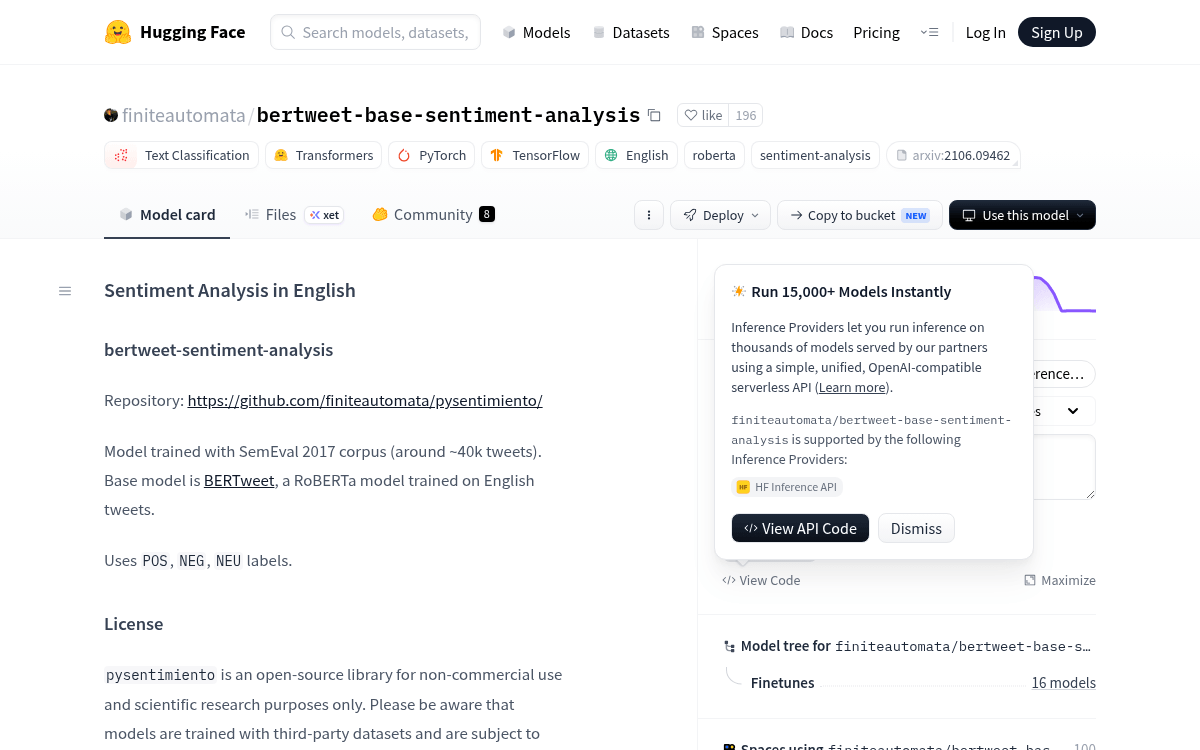
- bertweet-base-sentiment-analysis has crossed 1.03M lifetime downloads on Hugging Face.
- Fine-tuned on SemEval 2017 (~40k tweets) with POS, NEG, NEU labels.
- Base model is BERTweet, a RoBERTa pretrained on ~850M English tweets.
- Part of pysentimiento, a toolkit covering multiple SocialNLP tasks and languages.
- Licensed for non-commercial and research use; inherits third-party dataset licenses.
- Details in the pysentimiento paper by Pérez, Giudici, and Luque.
While the industry chases trillion-parameter frontier models, a tiny sentiment classifier fine-tuned from BERTweet has quietly crossed 1,033,753 lifetime downloads on Hugging Face. The finiteautomata/bertweet-base-sentiment-analysis checkpoint is the default workhorse many teams reach for when they need to score social media text as positive, negative, or neutral without paying per-token API costs.
The model ships as part of pysentimiento, a Python toolkit for opinion mining introduced in a 2021 paper by Juan Manuel Pérez, Juan Carlos Giudici, and Franco Luque. The library bundles pretrained models for sentiment and emotion analysis in Spanish and English behind a single interface. The authors benchmarked several transformer backbones and landed on BETO for Spanish and BERTweet for English.
What's actually inside the checkpoint
Training used the SemEval 2017 corpus, roughly 40k tweets, with three labels: POS, NEG, NEU. The base model is BERTweet, a RoBERTa variant pretrained on approximately 850 million English tweets. That backbone matters. BERTweet already understands hashtags, @-mentions, emoji, and the mangled grammar of social posts before any fine-tuning happens, whereas generic BERT tokenizers famously choke on that kind of input.
Why it keeps getting pulled
A million downloads on a four-year-old classifier is not an accident. A few things explain the stickiness:
- It runs anywhere. A base-size RoBERTa is roughly 135M parameters, fits on a single consumer GPU, and inferences in milliseconds on CPU with ONNX. No API bill.
- It is domain-matched. Fine-tuning on SemEval 2017 tweets on top of 850M-tweet pretraining means the model handles informal text without prompt engineering.
- Three labels, not five. POS/NEG/NEU maps directly onto most product dashboards, brand-monitoring pipelines, and academic annotation schemes.
- Two lines to deploy. The Hugging Face
pipelineabstraction hides everything.
from transformers import pipeline
pipe = pipeline("text-classification",
                model="finiteautomata/bertweet-base-sentiment-analysis")
print(pipe("i cannot believe how good this update is 🔥"))
# [{'label': 'POS', 'score': 0.98...}]
Where it wins, where it loses
The paper's benchmarks are candid about tradeoffs. On English tasks, BERTweet edges out RoBERTa by a slim margin, and both outperform vanilla BERT. The pattern repeats across languages: domain-specialised backbones lead, with BERTweet-br and BERTabaporu on top for Portuguese and RoBERTuito for Spanish.
The failure modes are equally well-defined:
- Long-form text. It was trained on tweets. Feed it a customer support email and accuracy drops.
- Sarcasm and irony. The pysentimiento authors ship a separate irony classifier precisely because polarity models miss it.
- Non-English text. This checkpoint is English only. Spanish, Portuguese, and Italian have their own siblings in the pysentimiento family.
- Aspect-based sentiment. It returns a single label for the whole input, so it will not tell you the user loved the camera but hated the battery.
The licensing catch
One detail teams frequently miss: pysentimiento is released for non-commercial use and scientific research only, and the weights themselves inherit the licenses of the SemEval 2017 and TASS datasets they were trained on. If you are building a commercial product, check the source dataset terms rather than assume the Hugging Face download implies a permissive license.
Small models still eat the streaming workload
The download counter is a useful data point in the current LLM-first climate. Zero-shot sentiment via GPT-class models works, but for high-volume streaming workloads, a 135M-parameter classifier that runs locally at thousands of tweets per second per GPU still beats calling a hosted API on both latency and cost per prediction. For a narrow classification job on in-domain text, a specialised small model remains the practical answer, and this checkpoint is the clearest evidence of that pattern in the wild.