
A Hobbyist Strips Qwen3.5-9B of All Refusals and Gets 488K Downloads
A community rebuild of Qwen3.5-9B strips out every refusal in a 465-prompt test set, keeping vision, thinking mode, and a 262K context intact.
 Pro
Takeaways
- HauhauCS released an uncensored Qwen3.5-9B claiming 0/465 refusals with zero capability loss.
- Q4_K_M quant is 5.3 GB and runs on 8 GB VRAM GPUs including an AMD RX 570.
- Keeps native multimodal input, thinking mode, and 262K context (1M with YaRN).
- Architecture uses Gated DeltaNet linear attention plus full softmax in a 3:1 ratio.
- Ships GGUF for llama.cpp, LM Studio, Jan, koboldcpp, and Ollama.
- May still append disclaimers like "not legal advice" but generates full content anyway.
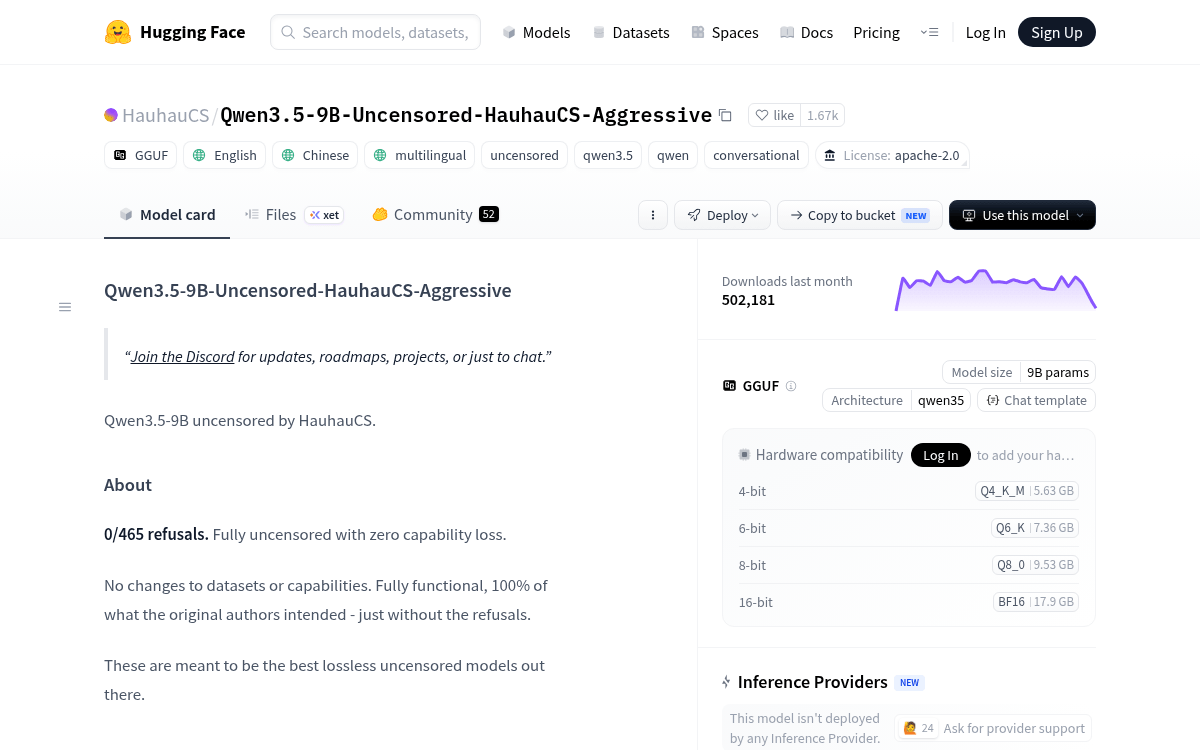
A community modder going by HauhauCS has published an uncensored Qwen3.5-9B variant that reportedly returns zero refusals on a 465-prompt evaluation suite while preserving the base model's full capability stack. The release has picked up roughly 488K downloads and 1.9K likes on Hugging Face, making it one of the more visible refusal-removal projects targeting the new Qwen3.5 generation.
HauhauCS claims 0/465 refusals with no changes to datasets or capabilities, framing the result as "100% of what the original authors intended, just without the refusals." Unlike jailbreak prompts or LoRA patches, this ships as standalone GGUF weights you can drop into any llama.cpp-compatible runtime.
What is actually under the hood
The model inherits everything from the Qwen3.5-9B base. Key specs from the model card:
- 9B dense parameters across 32 layers
- Hybrid attention: Gated DeltaNet linear attention combined with full softmax attention in a 3:1 ratio, trading some quadratic attention for a much cheaper linear variant on most layers
- 262K native context, extendable to 1M with YaRN position scaling
- Native multimodal input for text, image, and video via a separate
mmprojvision encoder - Multi-token prediction support, a 248K vocabulary, and 201 languages
- Native thinking mode (chain-of-thought traces exposed to the runtime)
Four quantizations ship with the release. BF16 weights weigh in at 17 GB, Q8_0 at 8.9 GB, Q6_K at 6.9 GB, and the popular Q4_K_M at 5.3 GB, plus an 880 MB vision encoder file that has to be loaded alongside the main GGUF for image or video inputs. That Q4 footprint is the headline detail: it fits inside the 8 GB VRAM budget of a $80 used AMD RX 570 running Vulkan, which is why the release blew up on X.
Aggressive versus balanced
HauhauCS ships this as the aggressive variant with stronger uncensoring and more thorough refusal removal, and notes that a balanced variant may follow if this one runs too loose. One quirk matters for anyone wiring this into an agent pipeline: the model is fully unlocked and will not refuse prompts, but it occasionally appends a short disclaimer at the end of a response like "This is general information, not legal advice." That boilerplate is baked into the base model's training rather than a refusal, and the actual content is still generated in full. Post-processing should strip trailing disclaimer text rather than retry on refusal tokens.
Running it locally
The GGUF format means it works with essentially every mainstream local runtime: llama.cpp, LM Studio, Jan, koboldcpp, Ollama, and Unsloth Studio. The fastest path is a single command:
ollama run hf.co/HauhauCS/Qwen3.5-9B-Uncensored-HauhauCS-Aggressive:Q4_K_MOr via llama.cpp's OpenAI-compatible server:
llama serve -hf HauhauCS/Qwen3.5-9B-Uncensored-HauhauCS-Aggressive:Q4_K_MThe authors flag one gotcha: this is a brand new architecture and llama.cpp support landed very recently, so make sure you are on a recent build. Recommended sampling from the Qwen team is temperature=0.6, top_p=0.95, top_k=20 in thinking mode, and they advise keeping at least 128K context loaded to preserve reasoning behavior.
Who is picking this up
The stated audience is red teamers and security researchers, and the tweet driving traffic frames it as a tool for offensive-security notes and pentesting. Beyond that, the model suits research projects exploring model behavior without safety constraints, content generation systems that require unrestricted output, and applications needing multimodal understanding of text, images, and video. Other builders have already forked it. LEONW24's fork repackages the weights to fix the base model's Ollama deployment failure by converting and merging them into a single GGUF file that Ollama can load natively, and MLX ports for Apple Silicon have also appeared.
What the release signals
Refusal ablation on frontier open-weights has a long history, and the Qwen3.5 lineage is what makes this release notable. The base model brings a 262K context, native vision, and a hybrid linear-attention design in a 9B envelope, and until now those capabilities were only usable through the safety-tuned instruct release. HauhauCS's work shows a single hobbyist can strip alignment from a state-of-the-art multimodal reasoning model and distribute it globally within days of launch. That is now the default assumption for any open-weights release. If your product's safety story depends on the base model refusing, you are one weekend project away from that assumption being obsolete, and the mitigation has to live at your application layer rather than the weights.