
A Community-Built Wav2Vec2 Hindi Model Hit 1.4M Downloads Despite 72% Error Rate
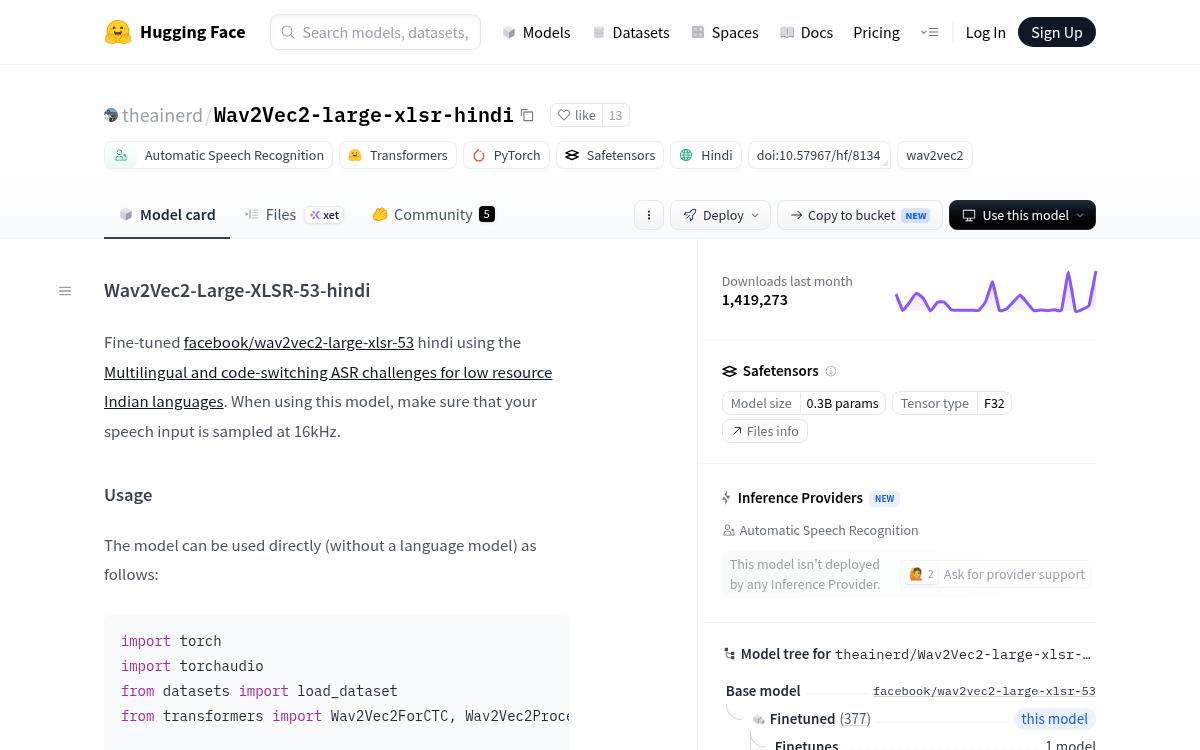
A community fine-tune of Meta's XLSR-53 for Hindi speech recognition has quietly racked up 1.4M downloads, becoming a default choice for Hindi ASR prototypes.
 Pro
Takeaways
- Hindi ASR fine-tune of Meta's XLSR-53 hits 1.4M downloads on Hugging Face.
- Reports 72.62% WER on Common Voice Hindi test split, useful as a baseline not production.
- 0.3B parameters, CTC head, encoder-only, runs on a single consumer GPU.
- Requires 16kHz audio input and plugs into the standard
transformerspipeline. - Trained on the Multilingual and code-switching ASR challenge data for low-resource Indian languages.
- Embedded in 12+ downstream Hugging Face Spaces for Hindi speech-to-text and translation.
A community-built Hindi speech recognition model has crossed 1.4 million downloads on Hugging Face, making it one of the most-used open ASR checkpoints for any Indian language. The model, theainerd/Wav2Vec2-large-xlsr-hindi, adapts Meta's cross-lingual speech encoder to transcribe Hindi audio into Devanagari text. It is free, permissively hosted, and pluggable into the standard transformers pipeline.
The 30-second version
The checkpoint takes facebook/wav2vec2-large-xlsr-53 and adapts it to Hindi. XLSR-53 is a multilingual extension of Wav2Vec2 with 24 Transformer layers and a hidden size of 1024, pretrained on roughly 56,000 hours of unlabeled speech across 53 languages. The Hindi fine-tune weighs in at about 0.3B parameters and produces character-level output via a CTC head, so no separate language model is required to get transcriptions out of it.
To run it, you need audio at a 16kHz sample rate and about ten lines of Python:
from transformers import pipeline
pipe = pipeline(
    "automatic-speech-recognition",
    model="theainerd/Wav2Vec2-large-xlsr-hindi"
)
result = pipe("my_hindi_audio.wav")
print(result["text"])
Training used the Multilingual and Code-Switching ASR Challenges for Low Resource Indian Languages dataset. The 16kHz input requirement matters in practice: feed it a typical 48kHz recording without resampling and quality collapses.
The uncomfortable number
The author reports a Word Error Rate of 72.62% on the Common Voice Hindi test split. That figure deserves unpacking before you build anything serious on it.
WER on Indic languages is unusually harsh because Hindi is morphologically rich and Common Voice contains a lot of loanwords, code-switched English, and speaker variance. For comparison, a recent benchmark on the same language found Google Speech-to-Text at 16.2%, Vaani at 16.6%, and Gemini 2.5 Pro at 18.5%, with the top five models all below 30%. A 70%+ WER means roughly seven out of every ten words are off in some way, though character error rates are typically much lower and the transcript is often readable to a native speaker.
Treat this as a solid starting-point checkpoint rather than a production ASR service. It works well as a base for further fine-tuning on your own domain data, or as a fast baseline when you need something that runs offline.
So why 1.4M downloads?
Several practical reasons keep this checkpoint at the top of Hindi ASR search results:
- Encoder-only and CTC-based. No autoregressive decoding, so inference is fast and streaming-friendly, unlike Whisper.
- Permissive base model. XLSR-53 is Apache-licensed, and this fine-tune inherits an easy path to commercial use.
- Small enough to self-host. At 0.3B parameters in FP32, it fits on a single consumer GPU, and quantized variants exist.
- Drop-in with Transformers. Works with
AutoProcessorandAutoModelForCTCwithout custom code. - Reference implementation. The author published the training script as a Colab notebook, so downstream teams can reproduce or extend it.
The checkpoint is also embedded in a surprising number of downstream apps on the Hub, from Hindi speech-to-text demos to a farmers' helper bot and a video translation pipeline. In each case, the model handles the front-end acoustic work while another model handles translation or dialog.
What it actually is under the hood
XLSR builds on wav2vec 2.0, trained by solving a contrastive task over masked latent speech representations while jointly learning a quantization of those latents shared across languages. The base model learned universal acoustic units by listening to 53 languages without labels. This fine-tune then added a character classifier for Devanagari on top and trained end-to-end on Hindi audio-text pairs. Cross-lingual pretraining consistently beats monolingual pretraining on low-resource languages, which is why the recipe works at all.
Once pretrained, the encoder needs only a few minutes of labeled data to reach strong performance on downstream speech tasks, from recognition to translation. That property is the entire reason a hobbyist checkpoint like this exists, and why more accurate variants keep appearing.
When to use it, when to skip it
Reach for this model if you are:
- Prototyping a Hindi voice interface and need something running today.
- Building an offline transcription tool where sending audio to Google or OpenAI is not an option.
- Looking for a warm-start checkpoint to fine-tune on your own labeled Hindi corpus.
- Doing research on CTC-based Indic ASR and need a public baseline.
Skip it if you need production-grade accuracy on clean Hindi. Managed APIs from Google, Sarvam, or AI4Bharat's newer models will do far better out of the box. Skip it too for heavy code-switched Hindi-English content, where large multilingual models like Whisper or Gemini currently dominate.
The broader signal is worth noting. Indic ASR remains a fragmented space where a two-year-old community fine-tune can stay the default download simply because nothing more accessible has taken its slot. That gap is closing fast, but for now, a 0.3B-parameter XLSR fine-tune is doing an outsized share of the world's Hindi transcription work.