
A Community-Built Filipino Speech Model Quietly Hit 1.7M Downloads
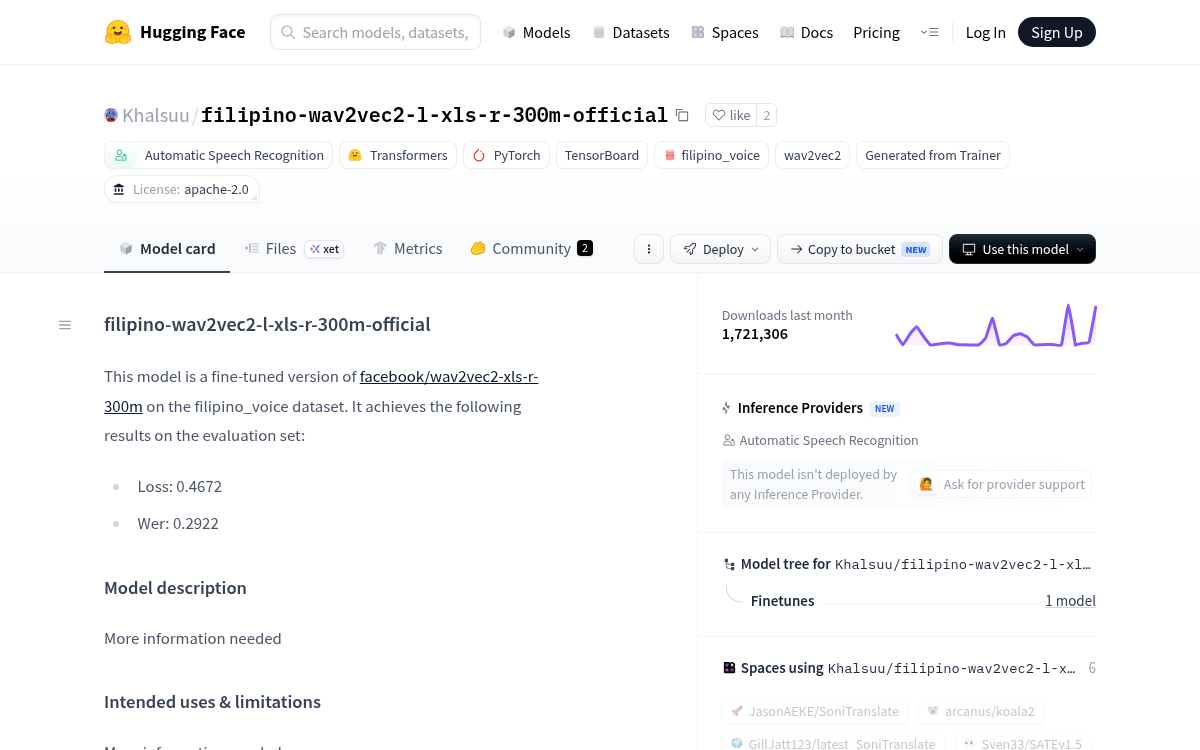
A community fine-tune of Meta's XLS-R 300M has crossed 1.7 million downloads, becoming a go-to speech recognition model for Filipino audio.
 Pro
Takeaways
- Filipino wav2vec2 XLS-R 300M fine-tune passes 1.7M downloads on Hugging Face
- Reports 29.22% WER and 0.4672 loss on filipino_voice evaluation set
- Apache 2.0 licensed, so free for commercial use with no restrictions
- Built on Meta's XLS-R 300M, pretrained on 436K hours across 128 languages
- Trained 30 epochs at lr 3e-4, batch 16, with mixed precision AMP
- Useful for Tagalog voice search, dataset bootstrapping, and domain fine-tuning
A community-built speech recognition model for Filipino has quietly become one of the most downloaded automatic speech recognition (ASR) checkpoints on Hugging Face, with over 1.7 million downloads and more than 3,200 likes. The model, Khalsuu/filipino-wav2vec2-l-xls-r-300m-official, is a fine-tune of Meta's XLS-R 300M on a Filipino voice dataset, and it fills a real gap for a language that mainstream commercial ASR APIs still handle unevenly.
According to the model card, this checkpoint is a fine-tuned version of facebook/wav2vec2-xls-r-300m on the filipino_voice dataset. It ships under Apache 2.0, so you can drop it straight into commercial products with no licensing fees or usage limits.
The numbers behind the checkpoint
On its evaluation set, the model reports a loss of 0.4672 and a word error rate (WER) of 0.2922. A WER of roughly 29 percent means about 3 in 10 words are mis-recognized on the held-out set. For a low-resource language fine-tune that is competitive, and it is a strong starting point for further domain adaptation.
The training recipe is straightforward and easy to reproduce. Key hyperparameters:
- Learning rate: 3e-4 with a linear scheduler and 500 warmup steps
- Batch size: 8 per device with gradient accumulation of 2 (effective batch 16)
- Optimizer: Adam, betas (0.9, 0.999), epsilon 1e-8
- Epochs: 30, with mixed precision (native AMP)
The training log shows WER dropping from 0.5987 at step 400 down to 0.2922 by step 5600, with most of the gains happening in the first 2,000 steps before a long tail of slow improvement.
What XLS-R 300M actually is
XLS-R is a family of large-scale models for self-supervised cross-lingual speech representation learning based on wav2vec 2.0, pretrained on 128 languages and roughly 436K hours of unlabeled audio. The 300M variant is the smallest of the family, but with fine-tuning these models achieve state-of-the-art performance on speech translation, recognition, and language identification.
Cross-lingual pretraining transfers acoustic knowledge across languages. Even if Filipino has a small labeled dataset, the encoder has already learned to model human speech in general from hundreds of thousands of hours of audio. Fine-tuning then only has to teach the model the phoneme inventory and orthography of the target language, which is why a modest dataset can produce a usable model.
Dropping it into your code
Usage is a one-liner through the Transformers pipeline API:
from transformers import pipeline
pipe = pipeline(
    "automatic-speech-recognition",
    model="Khalsuu/filipino-wav2vec2-l-xls-r-300m-official",
)
result = pipe("sample_filipino.wav")
print(result["text"])
For more control (custom decoding, chunking long audio, adding a KenLM language model on top), load the processor and CTC model directly with AutoProcessor and AutoModelForCTC. Audio should be 16 kHz mono, the standard for wav2vec2 checkpoints.
Where it fits, and where it does not
A 29 percent WER rules out plug-and-play production transcription, but the checkpoint is genuinely useful for:
- Bootstrapping Filipino voice datasets with weak-supervision transcripts you clean up later
- Voice search, command recognition, or intent classification where you only care about a few keywords
- Further fine-tuning on domain audio (call centers, education, healthcare) where labeled data is scarce
- Academic work on Tagalog or Filipino NLP where a reproducible open baseline beats a closed API
Some limitations are worth flagging. The model card leaves intended use, training data details, and evaluation data underdocumented, which makes it hard to know exactly which dialects, accents, or code-switched Taglish inputs it will handle well. The Spark NLP port curated for scalability and production-readiness exists in separate CPU and GPU variants, a hint that inference tuning matters if you deploy at scale.
Why a three-year-old checkpoint keeps trending
The download count says something about the current ASR landscape. Whisper and newer multilingual models cover Filipino to varying degrees, but a small, Apache-licensed, CTC-based wav2vec2 model still wins on latency, cost, and hackability. It runs on a single GPU, fine-tunes on a laptop-scale dataset, and integrates cleanly into existing Transformers pipelines. For Tagalog-focused apps that do not need Whisper-scale multilingual coverage, that combination is hard to beat, which is why the model keeps showing up in Spaces like SoniTranslate and other translation and dubbing tools built around it.