
A 3-Year-Old ResNet-18 Quietly Hit 1.7M Downloads on Hugging Face
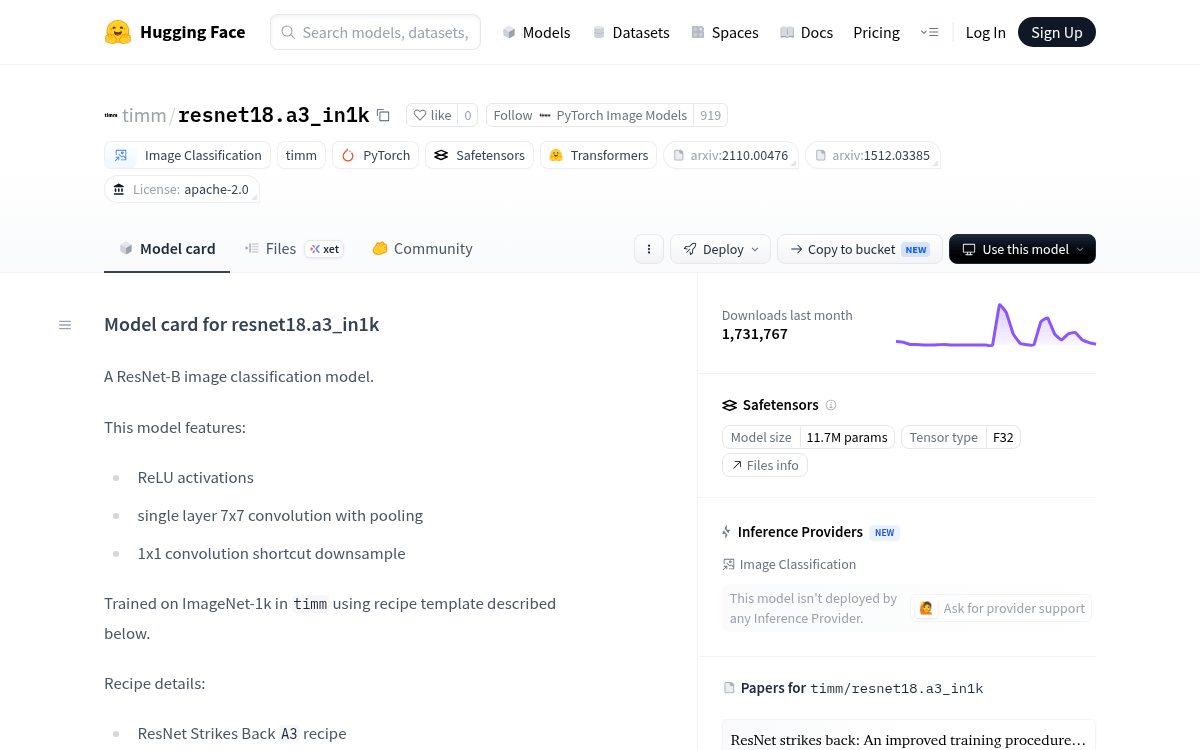
A tiny ResNet-18 checkpoint from the ResNet Strikes Back A3 recipe keeps racking up downloads as a lightweight image backbone default.
 Pro
Takeaways
- timm's resnet18.a3_in1k has crossed 1.7M downloads as a default lightweight vision backbone.
- Weights come from the ResNet Strikes Back A3 recipe: 100 epochs, batch 2048, ~15h on 4 V100s.
- Training uses LAMB optimizer, BCE loss, cosine LR, mixup, CutMix and RandAugment.
- 11.7M params, 0.9 GMACs, 68.25% ImageNet top-1 at 224x224, ~10k img/sec on V100.
- Trained at 160x160 and evaluated at 224x224 to cut compute cost.
- Apache-2.0, works as classifier, feature extractor or embedder via one timm call.
A ResNet-18 checkpoint that most engineers grabbed years ago is quietly one of the most downloaded image models on Hugging Face, pulling more than 1.7 million downloads and 3,000+ likes on the timm hub. The architecture is old and the recipe is public, yet resnet18.a3_in1k has become the go-to sanity-check backbone for anyone who needs a small CNN that trains fast, runs anywhere, and behaves predictably.
Old bones, modern training
The weights come from the ResNet Strikes Back paper by Ross Wightman, Hugo Touvron, and Hervé Jégou, which set out to answer a simple question: how much of the gap between old ResNets and modern vision transformers comes from architecture, and how much comes from training tricks? The authors re-evaluated a vanilla ResNet-50 under a procedure that folds in modern advances, then shipped the recipes and pre-trained checkpoints through timm so future work has stronger baselines. Under their most demanding setting, a vanilla ResNet-50 hits 80.4% top-1 accuracy at 224x224 on ImageNet-val without extra data or distillation.
What the A3 recipe actually is
The paper ships three recipes named A1, A2, and A3, each targeting a different compute budget. A3 is the smallest one and the one that produced this checkpoint. It aims to beat the original ResNet-50 procedure with a short schedule of 100 epochs at batch size 2048, trainable in about 15 hours on 4 V100 16GB GPUs, which makes it a workable setting for exploratory research or ablation studies.
The specific ingredients used to train this ResNet-18 are documented on the model card and in the paper:
- LAMB optimizer with binary cross-entropy loss instead of the usual cross-entropy
- Cosine learning rate schedule with warmup
- Standard Random Resized Crop and horizontal flip, plus timm variants of RandAugment, mixup and CutMix, along with label smoothing, Repeated Augmentation and Stochastic Depth for regularization
- Trained at 160x160 to save compute, evaluated at 224x224
The BCE choice follows from mixup and CutMix, which synthesize an image from several sources with different labels. That turns the objective into a multi-label problem where BCE slightly outperforms CE.
The numbers
The checkpoint itself is deliberately small: 11.7M parameters, 0.9 GMACs, and roughly 10,000 images per second on a single V100 at 224x224. Here is how it stacks against its A1 and A2 siblings, all sharing the exact same ResNet-18 architecture:
| Model | Recipe length | Top-1 @ 224 | Params | Img/sec |
|---|---|---|---|---|
| resnet18.a1_in1k | 600 epochs | 71.49% | 11.7M | 10,187 |
| resnet18.a2_in1k | 300 epochs | 70.64% | 11.7M | 10,194 |
| resnet18.a3_in1k | 100 epochs | 68.25% | 11.7M | 10,167 |
A3 gives up about three points of top-1 versus A1 in exchange for roughly 6x less training time. For most downstream uses, that gap disappears after a few epochs of fine-tuning on your own data.
Using it
The model is Apache-2.0 licensed and loads through timm or the transformers pipeline with a single line. Because timm exposes the same object as a classifier, a feature extractor, or an embedding model, the same weights cover most vision workflows:
import timm
# classifier
model = timm.create_model('resnet18.a3_in1k', pretrained=True)
# multi-scale feature maps for detection or segmentation heads
backbone = timm.create_model('resnet18.a3_in1k', pretrained=True, features_only=True)
# 512-dim embeddings for retrieval or metric learning
embedder = timm.create_model('resnet18.a3_in1k', pretrained=True, num_classes=0)
The feature extractor returns five feature maps at strides 2, 4, 8, 16 and 32, which plug directly into standard FPN or U-Net decoders.
When to actually reach for it
Nobody is winning a Kaggle leaderboard with this checkpoint. Reach for it when:
- You need a CPU-friendly or edge-friendly vision backbone under 12M parameters
- You want a fast baseline to compare a new architecture or training method against, which is exactly what the paper was built for
- You are fine-tuning on a small custom dataset where a huge pretrained model would overfit or be overkill
- You want deterministic, well-behaved features to bolt onto a detection, segmentation, or retrieval head
A three-year-old ResNet-18 checkpoint keeps trending because the ecosystem around it never went away. Detection frameworks, medical imaging pipelines, and student projects still default to ResNet backbones, and A3 is the cheapest set of weights that captures modern training practice without a transformer-scale compute bill.