
01.AI's Yi-34B Beats Meta's 70B Llama 2 Running on Four Consumer GPUs
01.AI releases a 34B bilingual open-source LLM trained from scratch on 3T tokens, matching GPT-3.5 performance while running on consumer GPUs.
 Pro
Takeaways
- 01.AI released Yi-34B, a bilingual base LLM matching GPT-3.5 on MMLU and LMSys ELO
- Outperforms Llama 2-70B and Falcon-180B on Hugging Face Open LLM Leaderboard and C-Eval
- Trained from scratch on 3.1T tokens using Llama-compatible architecture under Apache 2.0
- 4-bit AWQ variant runs on a single RTX 3090/4090 with 20 GB VRAM
- 200K context variant hits 99.8% on needle-in-a-haystack after long-context pretraining
- Family expanded to Yi-9B, Yi-VL-34B multimodal, and Yi-1.5 series with improved code/math
A 34-billion parameter open weight model that trades blows with GPT-3.5 and topples much larger open competitors has landed on Hugging Face. Yi-34B, built from scratch by Chinese startup 01.AI, is a bilingual English/Chinese base model released under Apache 2.0. It fits on four RTX 4090s and matches GPT-3.5 on standard benchmarks.
01.AI was founded by veteran AI researcher and investor Kai-Fu Lee, who pulled in engineers from Google, Huawei, and Microsoft Research Asia and stockpiled the chips needed to train the Yi series. Initial funding came from Sinovation Ventures and Alibaba's cloud unit. The 34B model outperforms Meta's 70B Llama 2 and TII's 180B Falcon on most public leaderboards.
Punching above its weight
The headline claim is that a 34B model can go toe to toe with proprietary systems and embarrass open weights three to five times its size. On MMLU for the base model and LMSys ELO for the chat variant, Yi-34B posts scores in the neighborhood of GPT-3.5.
Against open competition, the results are similarly aggressive. Yi-34B ranked first among all open models (including Falcon-180B, Llama-70B, and Claude) in both English and Chinese on the Hugging Face Open LLM Leaderboard (pre-trained) and C-Eval. Yi-34B-Chat took second place behind GPT-4 Turbo on AlpacaEval, ahead of GPT-4, Mixtral, and Claude, and leads the open pack on MMLU, CMMLU, BBH, and GSM8k.
What went into the training run
The recipe leans on data quality rather than architectural novelty. The Yi series comprises 6B and 34B language models pretrained from scratch on 3.1T tokens of heavily filtered data, then finetuned on a small but meticulously polished alignment set. 01.AI credits the near GPT-3.5 benchmark scores and human preference wins to that data engineering effort.
On architecture, Yi reuses what already works. The models adopt the same Transformer/Llama structure with weights trained from scratch, meaning you can load them with LlamaForCausalLM and slot them into any Llama-compatible tooling. A quick sanity check:
from transformers import AutoTokenizer, AutoModelForCausalLM
tokenizer = AutoTokenizer.from_pretrained("01-ai/Yi-34B", use_fast=False)
model = AutoModelForCausalLM.from_pretrained("01-ai/Yi-34B", device_map="auto")
Context windows, from 4K to 200K
The first public release introduced two bilingual base models at 6B and 34B parameters, both trained with a 4K sequence length and extensible to 32K at inference time. A follow-up release stretched context to 200K tokens. For long-document workloads, the team later reported pushing needle-in-a-haystack accuracy on Yi-34B-200K from 89.3% to 99.8% after additional long-context pretraining on 5B tokens.
The family has since expanded to include a 9B variant tuned for code and math, plus Yi-VL-34B for vision-language tasks. Yi-VL-34B was the first open-source 34B vision-language model and topped the MMMU and CMMMU multimodal leaderboards on release.
Getting it running on your hardware
Yi-34B is not small, but the surrounding ecosystem pushes it aggressively toward consumer boxes. The base FP16 model needs roughly 72 GB of VRAM (four RTX 4090s or a single A800 80GB), while quantized chat variants drop that requirement sharply:
| Model | Minimum VRAM | Example GPU |
|---|---|---|
| Yi-34B-Chat (FP16) | 72 GB | 4x RTX 4090 or 1x A800 |
| Yi-34B-Chat-8bits (GPTQ) | 38 GB | 2x RTX 3090/4090 |
| Yi-34B-Chat-4bits (AWQ) | 20 GB | 1x RTX 3090/4090 |
| Yi-6B-Chat-4bits | 4 GB | 1x RTX 3060 |
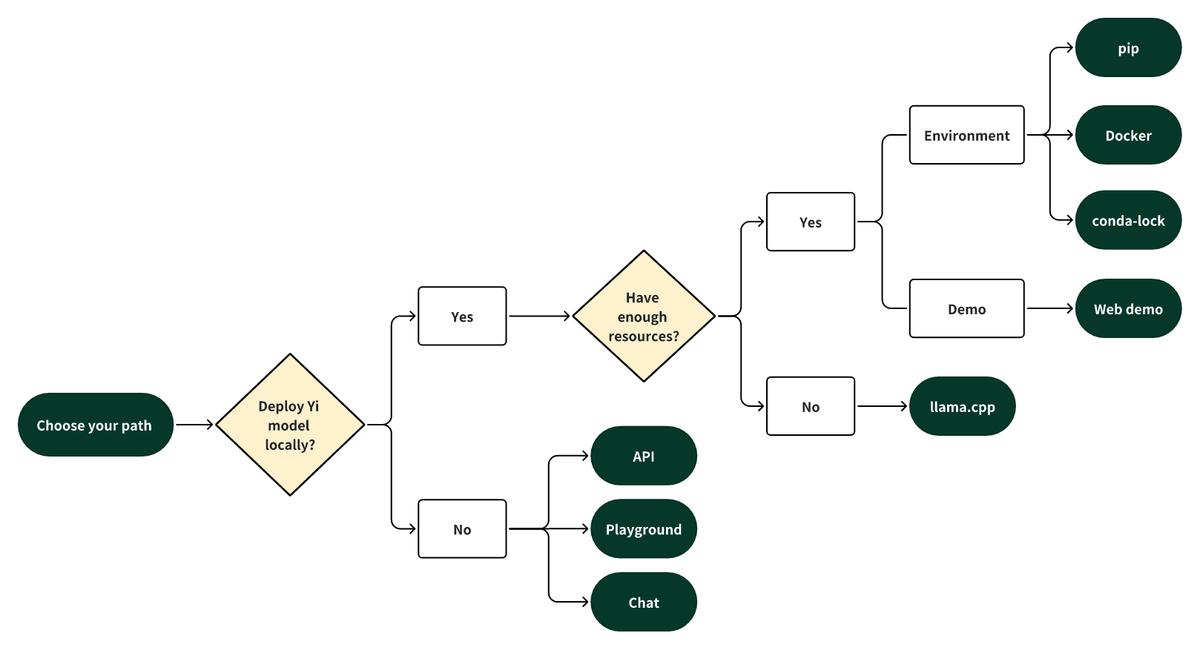
Deployment paths cover the usual suspects. You can serve it with vllm serve 01-ai/Yi-34B, SGLang, or Docker Model Runner. Community quantizations from TheBloke (GPTQ, GGUF, AWQ) drop into llama.cpp, Ollama, or LM Studio. On a MacBook Pro with 16 GB of RAM, the 2-bit quantized 6B chat model runs interactively through llama.cpp.

Base or Chat, and where each shines
The two flavors serve different needs. The chat model was trained purely with supervised fine-tuning, which the team says intentionally sacrifices some determinism for response diversity. That comes with trade-offs worth knowing about:
- Hallucination: more varied responses raise the chance of factually wrong output.
- Regeneration non-determinism: resampling the same prompt can produce noticeably different answers.
- Cumulative error: in extended reasoning or multi-step math, small mistakes compound.
- Mitigation: tune
temperature,top_p, ortop_kto trade creativity for coherence.
For fine-tuning, the maintainers offer some practical guidance. Yi-34B-Chat uses a Special Fine-Tuning method that produces replies closer to human conversation style, while the Base model is more versatile with higher performance ceiling. If you trust your dataset, fine-tuning the Base model tends to pay off. If your data is thin or you want output that mimics conversational style out of the box, start from the Chat model.
Why this release moves the needle
Two things make Yi-34B interesting beyond leaderboard bragging rights. It collapses the assumption that Chinese-language open models trail their English counterparts, delivering strong performance in both languages from the same base weights. It also shows how far careful data engineering can carry a mid-sized model. After parameter and KV cache quantization, inference costs drop enough that a broad slice of the community can run it on cost-effective devices.
The Yi repository ships with fine-tuning scripts, quantization tooling for GPT-Q and AWQ, and LLaMA-Factory integration for LoRA training on a single card. Between the Apache 2.0 license (free for commercial use), the Llama-compatible architecture, and a dense ecosystem of derivatives like Nous-Capybara-34B and Dolphin-2.2-Yi-34B, Yi-34B is one of the more practical drop-in options for teams eyeing a 70B-class model without 70B-class hardware.