The theme today is doing more with less. Tencent's DFly2 borrows the big model's own memory instead of allocating new storage, squeezing out 4.2x speed gains. Qwen3.5-9B fits in 6GB and outscores a 120B model on graduate reasoning.
The edge is eating the cloud, one clever trick at a time.
Harvard is cutting inference costs 34% during pretraining and llm.asm runs 35% faster than llama.cpp in pure assembly. Efficiency is the new arms race.
|
|
In Partnership with
|
·
|

|
|
|
| |
|
|
Summary 6 min 18 sec read
|
|
|
|
|
|
|
|
|
|
|
| SIGNALS |
|
|
|
|
|
|
|
|
|
|
|
|
|
|
PRO can be expensed
|
|
A personalized newsletter, the whole website live, and $500+ in perks. Most companies pay from their learning budget.
|
| | | | Open the email We wrote it for you. | Send it to your manager From your own email. | Start PRO Pay with your work card, or file the receipt. |
|
|
|
|
Sent from your own email. We never contact your manager.
|
|
|
Top Model
|
|
|
|
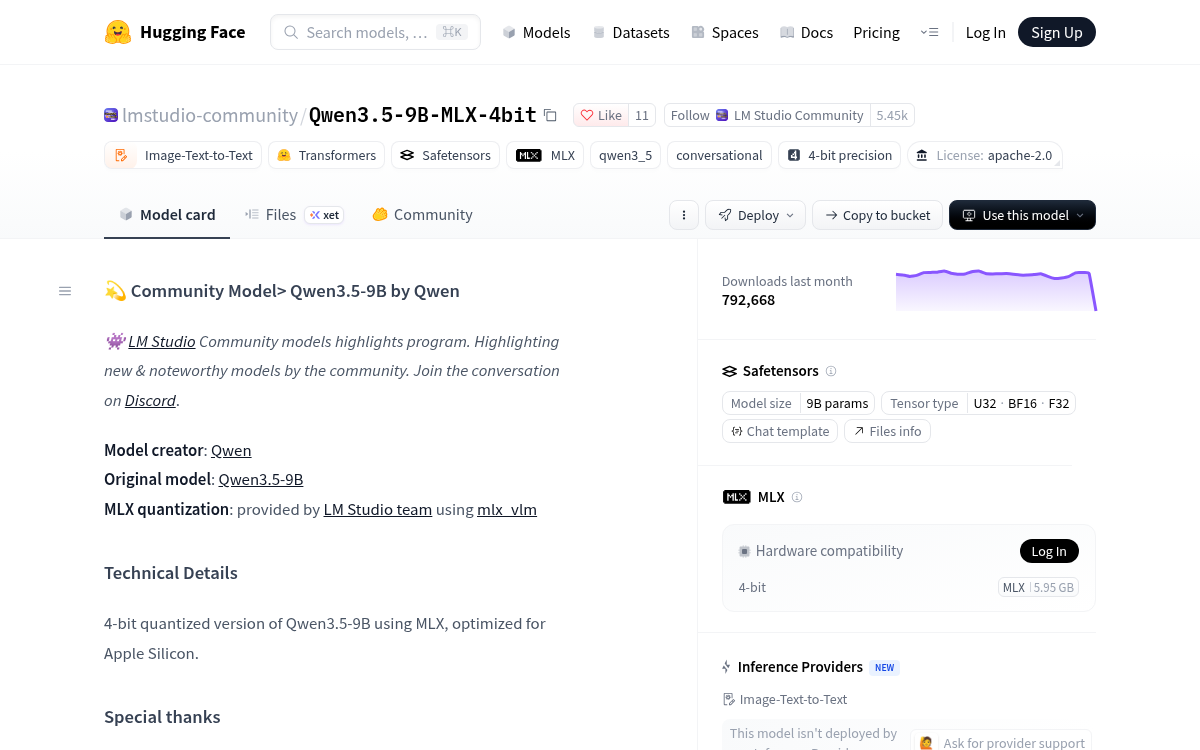
LM Studio Brings Alibaba's Qwen3.5-9B to Apple Silicon for 6 GB
|
|
▲ 3,327 Likes
|
|
Alibaba's Qwen3.5-9B just landed on Apple Silicon, packaged by LM Studio to run in under 6 GB of storage. That's a 9-billion-parameter model sitting on your MacBook. Here's the exciting part: it scores 81.7 on GPQA Diamond, a tough graduate-level science test, beating OpenAI's gpt-oss-120b at 71.5. Smaller model, better score on that benchmark. Key specs worth knowing: - 4-bit compressed weights, roughly 6 GB on disk, but you need 16 GB RAM minimum to actually use it comfortably
- 262,144 token context window, though real usable length depends on your available memory
- Supports text, images, and video inputs
- Apache 2.0 license, so commercial use is fine
To run it, install mlx-lm and start the server. It exposes an OpenAI-compatible API at localhost, so your existing code just works. You can also disable reasoning mode with enable_thinking=False to get faster, shorter responses for tasks like classification. Apple Silicon only. For Windows or Linux, grab the GGUF build instead.
|
|
|
|
Presented by Adobe
|
|
Adobe previews local MCP for creative tools
|
|
Firefly AI Assistant (beta), powered by Adobe Creative Agent, adds Plan Mode and Model Selector. Local MCP integrations (preview) let third-party agents edit Photoshop, Illustrator, Premiere and After Effects project files while keeping layers, sequences and compositions editable. Direct complex, multi-step creative tasks through conversation, with customization to guide the agent. Firefly Graph (beta) lets you build and iterate on custom, repeatable creative workflows.
|
|
|
|
Top Paper
|
|
|
|
Samsung's CCNN Fixes 3D Gaussian Splatting's Blurry Detail Problem
|
|
▲ 2,708 Likes
|
|
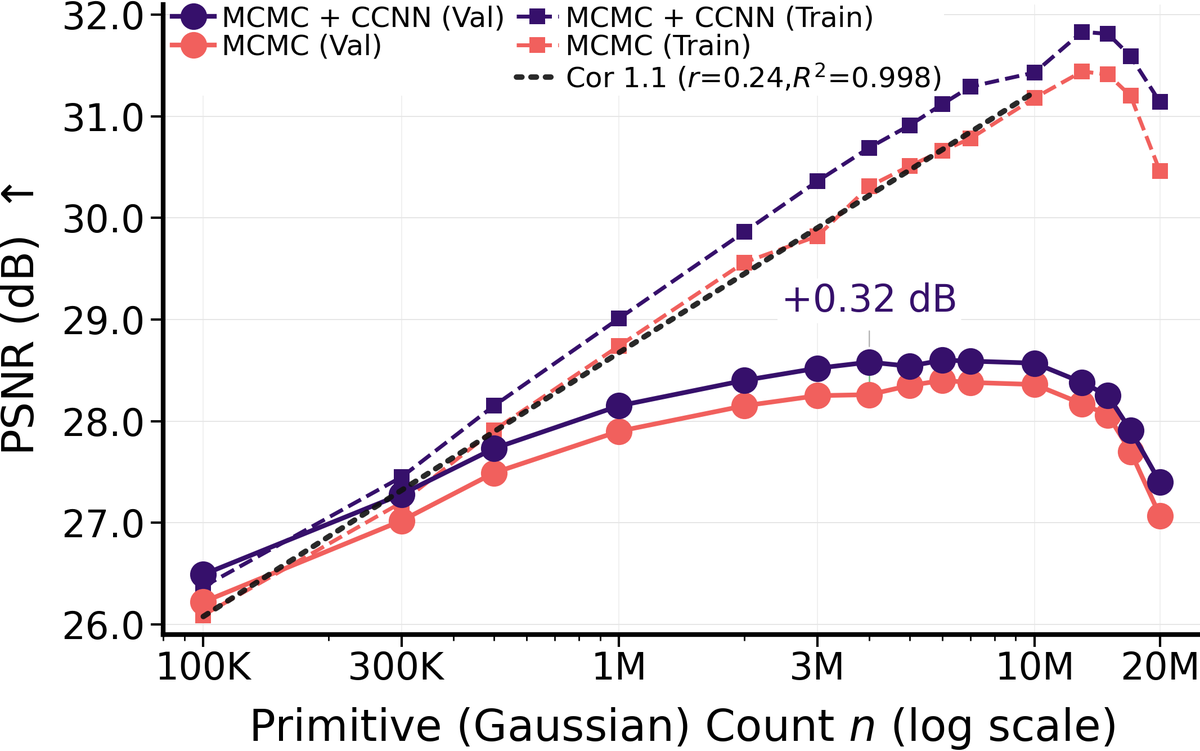
You know how 3D scenes rendered from photos can look blurry around fences, leaves, or thin wires? That's the problem Samsung's new CCNN module is solving for Gaussian Splatting. Gaussian Splatting works by placing thousands of tiny colored blobs in 3D space to recreate a scene. The obvious fix for blurriness is adding more blobs. But here's the catch: past 4 million blobs, quality actually drops. The model starts memorizing the training photos instead of learning the real scene. CCNN plugs in after your existing renderer and cleans up the image using three things: - The rough render your Gaussian Splatting already produced
- The exact pixel coordinates being reconstructed
- Nearby pixel patterns to recover edges and fine textures
It predicts what's wrong and adds the fix on top. No rebuilding your pipeline. The gains are modest, around +0.32 dB PSNR, but consistent across six benchmarks. Biggest wins show up in foliage, text, and wires. Flat surfaces? Not much difference. Code is live under the Samsung Labs GitHub.
|
|
|
|
Presented by Buoyant.io
|
|
Make inference count on your GPUs: no token bills
|
|
Every agent and app you ship sends more tokens to a frontier model, and the bill grows with them. Kinference serves that traffic from your own vLLM pods, routing each request to the pod predicted to meet its SLO, with frontier models only by policy. Open-source inference serving for platform teams.
|
|
|
|
Top Paper
|
|
|
|
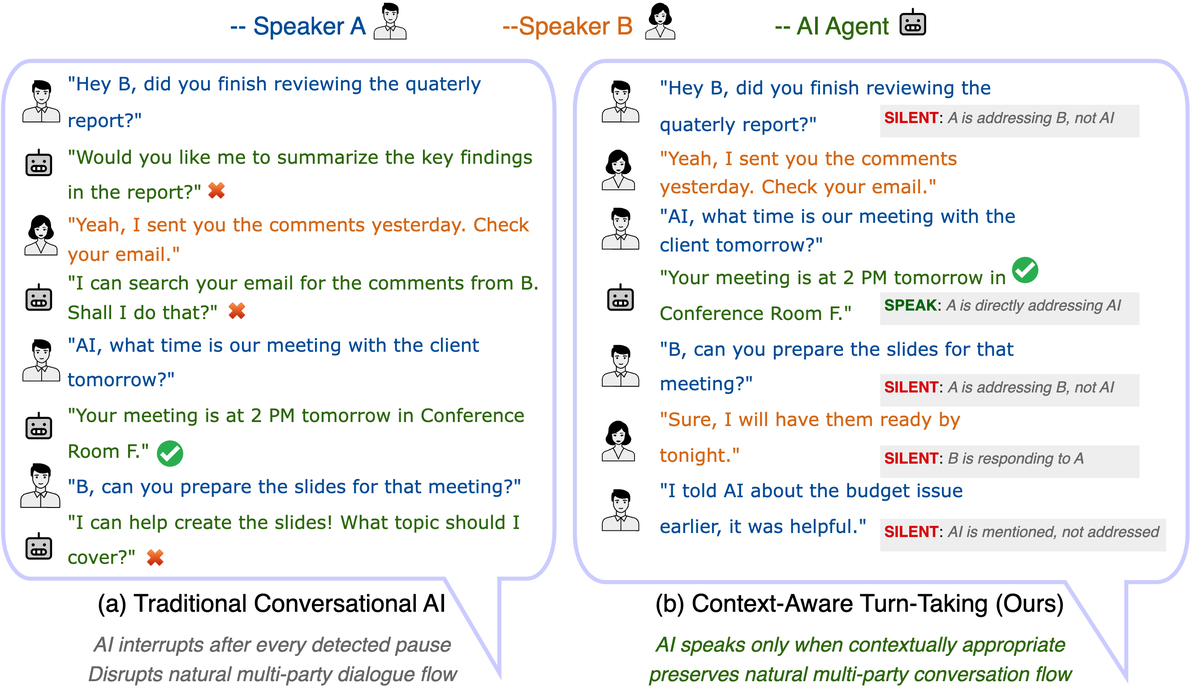
Voice AI Assistants Fail Group Meetings Without Explicit Turn-Taking Training
|
|
▲ 2,267 Likes
|
|
Your voice AI works fine in a one-on-one call. Put it in a group meeting, and it starts interrupting people or going completely silent. Why? It has no idea whose turn it is to speak. A new paper drops a 120,000-decision benchmark to test exactly this. The task is simple: at every pause, should the AI speak or stay quiet? Turns out, that's really hard. Here's the core problem. In a group chat, a pause doesn't mean "your turn." Someone might be thinking mid-sentence. Or the question was aimed at someone else. The AI needs to read social context, not just silence. Results from testing eight top AI models were rough: - Random guessing scores 50%. Most open-source models stayed right there.
- Best zero-shot result (Gemini 3.1 Pro): only 64.45%
- Fine-tuning with reasoning examples pushed accuracy up 23 percentage points
- Fine-tuned models hit 71.73%, beating human annotators at 60-66%
The fix: train your model on labeled examples that explain why to speak or stay silent. The dataset is on Hugging Face under Apache 2.0, ready to use.
|
|
|
|
AlphaSignal PRO
|
|
You are not getting all of AlphaSignal.
|
|
Upgrade to PRO for an edition built around the topics, subtopics and companies you follow,
with personal picks across news, models, papers and repos.
|
|
|
|
|
