| Hey, | Welcome to AlphaSignal – the most read newsletter by AI developers.
We bring you the top 1% of news, papers, models, and repos, all summarized to keep you updated on the latest in AI. |
|
|
|
IN TODAY'S SIGNAL
| Read time: 6 min 17 sec | 🎖️ Top News
📌 Inference
⚡️ Trending Signals
📌 AskUI
💻 Top Tutorials
🧠 How To |
|
|
|
If you're enjoying AlphaSignal please forward this email to a colleague.
It helps us keep this content free. |
|
|
|
TOP NEWS
| Deep Learning Techniques | Yann LeCun unveils DyT, a tanh-based alternative to normalization layers with lower compute costs
| ⇧ 21,937 Likes |
| What's New |
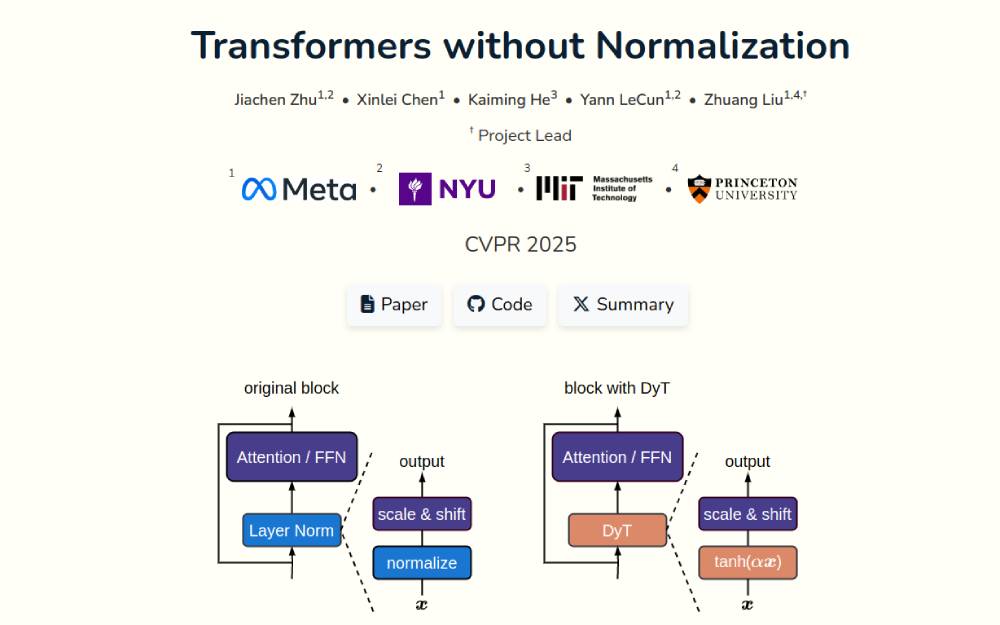
Yann LeCun and his team have introduced Dynamic Tanh (DyT) as a replacement for traditional normalization layers in deep learning models. This new approach, based on the scaled tanh function, shows performance comparable to or better than methods like LayerNorm and RMSNorm. The most exciting aspect is its potential to reduce computational costs while maintaining model efficiency.
Key Insights - DyT offers a simpler, more efficient alternative to normalization layers in transformers.
- The tanh-based approach maintains model performance while reducing computational overhead.
- DyT's simplicity allows for easy integration without major changes to existing architectures.
- The α (alpha) parameter is essential to adjusting performance, requiring careful tuning.
How DyT Works
DyT replaces normalization layers with a scaled tanh function, (tanh(αx)). - The α (alpha) parameter controls the scaling factor of the tanh function.
- DyT mimics the behavior of normalization layers, squashing extreme values while keeping a linear center.
- The approach is simple to implement by swapping out normalization layers.
Performance Benchmarks
DyT has been tested across several model types with promising results. - Vision models: ViT, ConvNeXt, MAE, DINO, DiT.
- LLMs: LLaMA.
- Speech models: wav2vec 2.0.
- DNA models: HyenaDNA, Caduceus.
In all cases, DyT performs similarly or better than traditional normalization layers.
Efficiency and Speed DyT improves computational speed compared to LayerNorm and RMSNorm.
- DyT reduces training and inference costs.
- Requires only one learnable scaling parameter (α).
- Runs faster than RMSNorm on H100 GPUs.
The computational efficiency is a key advantage for models that require substantial resources.
Easy Integration Implementing DyT is simple: swap out normalization layers with DyT in your model.
- No major architectural changes are required.
- Adjust the alpha parameter based on your model’s needs.
Community Feedback
David Matta
"Interesting! So, the activation function tanh() is doing double duty—not just introducing non-linearity but also adjusting within a good range for learning, reducing the need for normalization layers."
Yann LeCun
"I have been using tanh() in neural networks since 1986. This is not new. This paper does not present any new concepts but empirical results that may be surprising."
jc_stack
"Have you seen performance comparisons with batch norm networks on edge devices? The computational savings could be significant if parameterized tanh() holds up at scale" | |
| Learn more
|
|
|
|

| Run Powerful Models like DeepSeek R1 Faster and Cheaper | Integrate DeepSeek R1, the leading open-source model for math, code generation, and complex reasoning, seamlessly into your applications with Inference.net's flexible APIs:
Easy Setup: OpenAI-compatible endpoints enable deployment in minutes.
Flexible Inference: Supports both high-speed real-time serverless inference and large-scale batch processing.
Cost-Effective: Achieve over 90% cost savings compared to closed-source alternatives without compromising performance. Start today with API credits at no cost. |
| Try now
| partner with us → |
|
|
|
TRENDING SIGNALS
| AI Models |
|
⇧ 12,738 Likes | |
AI Tool |
|
⇧ 3,468 Likes | |
Agents |
|
⇧ 1,593 Likes | |
Reasoning Models |
|
⇧ 878 Likes | |
AI Tool |
|
⇧ 2,593 Like | | |
|
|
|
|
Effortlessly Build AI Vision Agents with AskUI.
| At the Berlin hackathon, AskUI built AI Vision Agents for native desktop apps—automating testing, PDF data extraction, and form filling. The framework makes automation simple and flexible.
Try it now with a no-cost trial and build AI-driven workflows today. | Start Building Now ↗️ |
|
|
|
TOP TUTORIALS
| MCP Server |
|
⇧ 1,483 Likes |
Anthropic's Model Context Protocol (MCP) helps you connect data sources to AI tools securely. This tutorial covers MCP setup, configuring connections to Google Drive, Slack, GitHub, and Brave Search, and automating tasks with Claude’s MCP tools. Learn how to integrate APIs, manage files, and execute workflows using structured prompts. |
| Agents |
|
⇧ 2,748 Likes |
Nicholas Renotte demonstrates how to build a multi-agent system with Watsonx.ai in 15 minutes. Using CrewAI and LangChain, he configures LLMs, sets up AI agents, and automates tasks like researching AI topics and writing keynote speeches. The tutorial covers API setup, function calling, delegation, and multi-agent collaboration. |
| Generative AI |
| ⇧ 248 Likes |
Learn to create high-quality video datasets for fine-tuning video generation models using a three-stage pipeline. Acquire videos with yt-dlp, preprocess them with watermark, aesthetic, and motion filters, and process using Florence-2 for object recognition and captions. This tutorial helps streamline video dataset preparation for custom AI applications. |
| |
| |
|
|
HOW TO
| Code Assistance |
Use Claude Code Effectively |
Project Initialization When starting a new project, always use the “/init” command. This command creates a “Claude.md” document containing your project documentation for easy reference.
Working Effectively After initializing your project, always ask Claude Code to explain the project thoroughly. Request details about each component, their functionalities, and how they interconnect with other parts of your project.
Administering Complex Changes
If you’re planning a major change, such as large-scale refactoring or adding complex new functionality, always instruct Claude Code to outline a plan before implementing any changes. Encourage deeper thinking by using phrases such as: Think hard Think deep Think longer
After reviewing Claude’s proposed plan, if you agree, proceed directly with the changes. If not, request revisions to the plan.
Minor Changes For minor updates, specify the exact file:
- Claude, add error handling to data_processing.py.
- Claude, refactor calculate_totals in invoice.py.
Best Practices
|
| Learn more
|
|
|
|
At Alpha Signal, our mission is to build a sharp, engaged community focused on AI, machine learning, and cutting-edge language models, helping over 200,000 developers stay informed and ahead. We’re passionate about curating the best in AI, from top research and trending technical blogs to expert insights and tailored job opportunities. We keep you connected to the breakthroughs and discussions that matter, so you can stay in the loop without endless searching. We also work closely with partners who value the future of AI, including employers and advertisers who want to reach an audience as passionate about AI as we are.
Our partnerships are based on shared values of ethics, responsibility, and a commitment to building a better world through technology.Privacy is a priority at Alpha Signal. Our Privacy Policy clearly explains how we collect, store, and use your personal and non-personal information. By using our website, you accept these terms, which you can review on our website. This policy applies across all Alpha Signal pages, outlining your rights and how to contact us if you want to adjust the use of your information. We’re based in the United States. By using our site, you agree to be governed by U.S. laws. |
|
|
|
Looking to promote your company, product, service, or event to 200,000+ AI developers? Let's work together.
|
| Work with us
|
|
|
|
|
