| Hey, | Welcome to today's edition of AlphaSignal, a newsletter for developers by developers.
We identify and summarize the top 1% news, papers, models, and repos in the AI industry. |
|
|
|
IN TODAY'S SIGNAL
| Read time: 6 min 8 sec | 🎖️ Top News
📌 Ori
⚡️ Trending Signals
📌 AssemblyAI
⚙️ Top Lectures
🧠 Deep Dive
|
|
|
|
If you're enjoying AlphaSignal please forward this email to a colleague.
It helps us keep this content free. |
|
|
|
TOP NEWS
| LLM | Google releases 2 new production-ready and updated Gemini models with substantially reduced pricing |
⇧ 5,822 Likes |
 |
What's New |
Google has unveiled Gemini-1.5-Pro-002 and Gemini-1.5-Flash-002, updated versions of their Gemini 1.5 series LLMs. These releases build upon the models introduced at Google I/O in May 2024, offering enhanced capabilities across text, code, and multimodal tasks.
Key highlights 7% increase in MMLU-Pro scores 20% improvement in MATH and HiddenMath benchmarks 2-7% enhancement in vision and Python code generation 64% reduction in input token pricing for Gemini-1.5-Pro 2x faster output and 3x lower latency for Gemini-1.5-Flash Performance Improvements and Capabilities
The new models demonstrate significant advancements in math-related tasks, with a 20% boost in MATH and HiddenMath benchmarks.
Gemini-1.5-Pro-002 retains its 2 million token context window, enabling the processing of extensive documents and codebases.
Gemini-1.5-Flash-002 focuses on speed optimization, delivering twice the output speed and three times lower latency compared to its predecessor. Pricing and Accessibility
Google has reduced pricing for Gemini-1.5-Pro by 64% for input tokens, 52% for output tokens, and 64% for incremental cached tokens on prompts under 128K tokens, effective October 1, 2024.
Rate limits have increased to 2,000 RPM for 1.5 Flash and 1,000 RPM for 1.5 Pro.
Developers can access these models through Google AI Studio and the Gemini API, with Vertex AI availability for larger organizations. Model Output and Efficiency
Both models now produce more concise responses, with output lengths 5-20% shorter than previous versions.
The updates enable new applications in video understanding, document processing, and code analysis while potentially lowering implementation costs. Multimodal Capabilities
The upgraded models show improvements in vision-related tasks, with performance gains ranging from 2% to 7%.
This enhancement extends to video understanding capabilities, allowing for more effective processing and analysis of visual content alongside text and code. Integration and Practical Applications
The Gemini 1.5 series models are designed for general performance across a wide range of tasks.
They can synthesize information from 1000-page PDFs, answer questions about repositories containing over 10,000 lines of code, and create useful content from hour-long videos. |
|
|
Read more
|
|
|
|
| Accelerate your AI training and inference with $1,000 in matched GPU credit. | Build, train, and deploy AI models faster. Ori's platform supports open source fine-tuning, foundational model training, and inference tasks.
On-demand NVIDIA GPUs: Accelerate training and inference. Multiple options available. Reserved instances: Lock in resources for critical workloads. 35% savings, 1-month minimum. Serverless Kubernetes: Deploy models globally without cold starts. We handle cluster management. Key features
Pay-per-use pricing Multi-region support Automated load balancing Ori now offers $1000 credit for new users. Spend $1000 on any public cloud, get $1000 back. See terms. |
|
Get started
| partner with us |
|
|
|
TRENDING SIGNALS
| OpenAI |
|
⇧ 29,400 Likes | |
AI Agent |
|
⇧ 1,300 Likes | |
Text to Audio |
|
⇧ 2,100 Likes | |
Open source LLM |
|
⇧ 1,400 Likes | |
Intel |
|
⇧ 801 Likes | | |
|
|
|
|
|
Build Smarter Multilingual Apps with Automatic Language Detection
| AssemblyAI just released enhanced language detection and speech-to-text accuracy for multilingual apps. Real-time captions and LLM features now extract key insights from audio data. 200,000+ developers already use AssemblyAI. Try it now with $50 in free API credits, no credit card required. |
Start Building Today |
|
|
|
|
TOP LECTURES
| Finetuning |
| ⇧ 438 Likes |
This tutorial teaches you three techniques to improve Flux fine-tunes using synthetic data: generating images from a single input, reusing high-quality model outputs, and combining LoRAs. You'll learn to expand limited datasets, refine model performance, and diversify output styles. These methods help create more accurate and versatile image generation models. |
| PDF Parsing |
|
⇧ 1,300 Likes |
Learn to use pdfplumber, a Python library for extracting data from PDFs. You'll learn to extract tables, text, and form data with precise positioning. You can also the explore the library for visual debugging, page manipulation, and customization options. You'll see how to integrate extracted data with pandas for analysis. This tool helps you automate PDF data extraction efficiently. |
| Machine Learning |
|
⇧ 354 Likes |
Learn about PDLP, a new first-order method solver for large-scale linear programming. Understand its advantages over traditional methods, core algorithm based on restarted primal-dual hybrid gradient, and key improvements. Explore real-world applications in network traffic engineering, container shipping, and traveling salesman problems. Discover how PDLP scales to billions of constraints, outperforming commercial solvers. |
| |
| |
|
|
DEEP DIVE
| Llama | Running inference of Llama3 70B on 4GB GPU and Llama3.1 405B on 8GB GPU with AirLLM library |
⇧ 117 Likes |
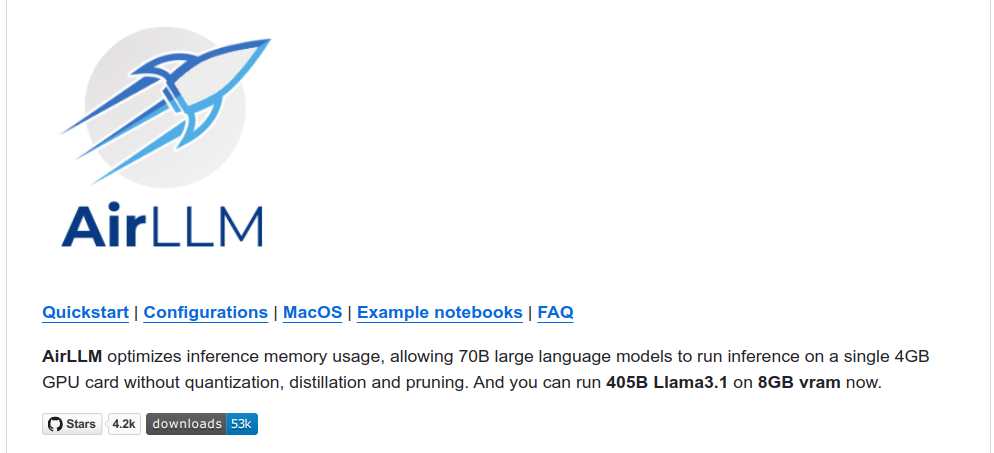 |
AirLLM helps you run large LLMs on GPUs with limited VRAM.
The core of AirLLM is layer-wise inference. It loads only one layer at a time into GPU memory, freeing up space after each layer's computation. This approach stores model layers on disk, loading them as needed.
To optimize performance, AirLLM uses flash attention. This technique enhances CUDA memory access for faster processing.
The library also offers compression options
4-bit quantization 8-bit quantization
These further reduce memory usage, AirLLM implements prefetching to overlap model loading and computation, improving speed. It supports various model types, including Llama, ChatGLM, and QWen.
By combining these techniques, AirLLM lets you run Llama3 70B on a 4GB GPU and Llama3.1 405B on an 8GB GPU.
|
|
Read more
|
|
|
|
Looking to promote your company, product, service, or event to 200,000+ AI developers? Let's work together.
|
|
Advertise
|
|
|
|
|
