| Hey, | Welcome to AlphaSignal – the most read newsletter by AI developers.
We bring you the top 1% of news, papers, models, and repos, all summarized to keep you updated on the latest in AI. |
|
|
|
IN TODAY'S SIGNAL
| Read time: 6 min 02 sec | 🎖️ Top News
📌 Inference
⚡️ Trending Signals
📄 Top Papers
🧠 Pytorch Tip |
|
|
|
If you're enjoying AlphaSignal please forward this email to a colleague.
It helps us keep this content free. |
|
|
|
TOP NEWS
| AI Interpretability | Anthopic details a method to trace computations inside Claude 3.5 Haiku, revealing internal reasoning paths
| ⇧ 7,356 Likes |
| What's New |
Anthropic published two technical papers detailing a method to trace computations inside Claude 3.5 Haiku. The method identifies and links interpretable features across layers into circuits that represent computation paths. Claude plans multiple words ahead during generation, confirmed through direct intervention in its internal state.
Key features of the interpretability method
The system supports targeted inspection and manipulation of internal computations. Tracks feature activations and their influence across transformer layers
Identifies causal dependencies between inputs, internal states, and outputs
Supports controlled interventions to test feature contributions
Enables mapping of abstract concepts across language, math, and reasoning task
Forward planning in word generation Claude selects future words before generating them, even when producing text one token at a time.
In a rhyme task, Claude pre-selects a word like rabbit before generating the full line
Removing rabbit from the internal state causes Claude to switch to habit
Injecting an unrelated concept like green forces the model to rewrite the line accordingly
This planning behavior contradicts naive next-token-only assumptions
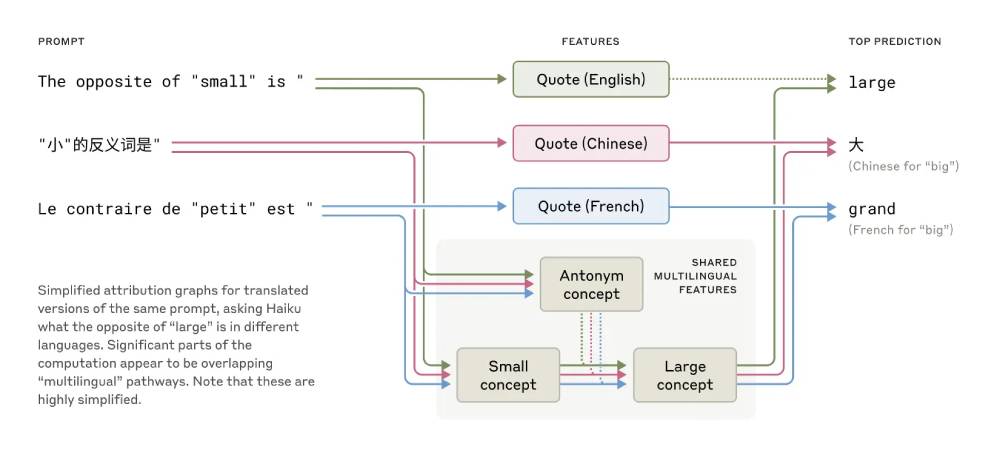
Multilingual conceptual representations Claude uses shared internal concepts across multiple languages before mapping them to words.
Asking for “opposite of small” in different languages activates the same abstract features
The final token selection depends on the question’s language, not the internal concept
Larger models like Claude 3.5 Haiku share over twice the features across languages as smaller ones
The method traces cross-lingual processing paths at the feature level
Arithmetic through parallel computation paths
Claude computes sums using distinct internal strategies without showing them in its explanations.
One path estimates the total, another calculates specific digits
Claude combines these paths to get the final answer
When asked how it added numbers, it describes the human school-taught algorithm
These internal strategies are not reflected in the model’s output
Tracing multi-step reasoning
The method confirms Claude uses intermediate concepts when answering compositional questions.
For “Capital of state where Dallas is located,” it first activates Dallas → Texas
Then it activates Texas → Austin before producing the final answer
Swapping Texas features with California changes the output to Sacramento
Internal state manipulations confirm multi-step reasoning mechanisms
Implementation
Anthropic has not released tools or code but describes implementation in two papers.
Community Feedback
Koji
"This research that “visualises” the inner workings of AI is truly groundbreaking. Being able to see how language models craft poetry or make medical decisions brings discussions about AI understanding and safety from abstract theory to a more tangible analysis of mechanisms. I reckon this is a big step towards strengthening the collaborative relationship between AI and humans."
Chris Cheung
"Game changer, being able to more accurately pinpoint where hallucination happens will drastically improve foundation models"
Sam Coward
"Great read. Fascinating how pressure for grammatical correctness is a forcing factor for jailbreaks!"
| |
| Learn more
|
|
|
|

| Switch to Open-Source AI Without the Hassle | Open-source AI models now beat proprietary models like OpenAI’s and Anthropic’s on key benchmarks. Inference.net provides API access to top open models, including DeepSeek V3 and DeepSeek R1.
DeepSeek V3 0324: The top non-reasoning model, scoring higher than Gemini 2.0 Pro and Claude 3.7 Sonnet.
DeepSeek R1: Matches or exceeds GPT-4’s reasoning at lower cost.
Why use Inference.net? |
| Get access now
| partner with us → |
|
|
|
TRENDING SIGNALS
| AI Model |
|
⇧ 30,728 Likes | |
AI Model |
|
⇧ 1,538 Likes | |
Multimodal Model |
|
⇧ 583 Likes | |
Chatbot Feature |
|
⇧ 2,846 Likes | |
AI & Social Media |
|
⇧ 1,148 Like | | |
|
|
|
|
TOP PAPERS
| AI in Labor Markets |
|
⇧ 1,045 Likes | Problem
The paper investigates how Claude 3.7 Sonnet from Anthropic affects labor markets, particularly in coding, education, and science.
Solution
Claude 3.7 Sonnet’s “extended thinking” mode is used in technical fields like coding and research. The model is employed for both augmenting tasks (e.g., learning) and automating them (e.g., task completion). Anthropic provides data on its use in over 630 categories.
Results
Usage of Claude 3.7 Sonnet has increased in coding, education, and science. The model shows more iteration in tasks like copywriting and relies more on directives for translation. A new taxonomy categorizes previously overlooked tasks.
| |
3D Generative Models |
| ⇧ 2,954 Likes |
Problem Generating large, coherent 3D worlds from textual descriptions is time-consuming and challenging, with existing methods often limited to object-centric or small-scale scene generation.
Solution SynCity combines pre-trained 3D generative models and 2D image generators, using a tile-based approach to create expansive 3D scenes. It ensures consistency by blending neighboring tiles and drawing context from previously generated ones.
Results
SynCity generates large, immersive 3D worlds with high-quality details, offering fine control over layout and appearance, and enabling seamless expansion of scenes.
|
| 3D Human Reconstruction |
|
⇧ 1,873 Likes | Problem
Generating animatable 3D human avatars from a single image is difficult due to challenges in geometry, appearance, and deformation.
Solution
LHM uses a multimodal transformer and 3D Gaussian splatting to create animatable 3D avatars, preserving detailed clothing and face features.
Results
LHM outperforms existing methods in accuracy, animation consistency, and generalization, generating avatars in seconds without post-processing.
| | |
|
|
|
|
PYTORCH TIP
| Boost Your Jupyter Workflow for Automatic Module Reloading |
When working with a Python module in a Jupyter notebook, you typically need to reload the module after making changes. Instead of manually reimporting it, you can use the %autoreload magic command to automatically reload your modules.
Use %autoreload 2 during development to keep your notebook in sync with code changes, improving workflow efficiency and reducing errors in long-running experiments.
Here's how it to use it: |
%load_ext autoreload
%autoreload 2
|
|
|
|
At Alpha Signal, our mission is to build a sharp, engaged community focused on AI, machine learning, and cutting-edge language models, helping over 200,000 developers stay informed and ahead. We’re passionate about curating the best in AI, from top research and trending technical blogs to expert insights and tailored job opportunities. We keep you connected to the breakthroughs and discussions that matter, so you can stay in the loop without endless searching. We also work closely with partners who value the future of AI, including employers and advertisers who want to reach an audience as passionate about AI as we are.
Our partnerships are based on shared values of ethics, responsibility, and a commitment to building a better world through technology.Privacy is a priority at Alpha Signal. Our Privacy Policy clearly explains how we collect, store, and use your personal and non-personal information. By using our website, you accept these terms, which you can review on our website. This policy applies across all Alpha Signal pages, outlining your rights and how to contact us if you want to adjust the use of your information. We’re based in the United States. By using our site, you agree to be governed by U.S. laws. |
|
|
|
Looking to promote your company, product, service, or event to 200,000+ AI developers? Let's work together.
|
| Work with us
|
|
|
|
|
