Hey, | Welcome to today's edition of AlphaSignal.
Whether you are a researcher, engineer, developer, or data scientist, our summaries are there to keep you up-to-date with the latest breakthroughs in AI.
Let's get into it!
Lior | . |
|
|
|
IN TODAY'S SIGNAL
| Top News
Lambda
Trending Signals
Top Repos
PyTorch Tip |
Read Time: 5 min 41 sec |
|
|
|
Enjoying this newsletter?
Please forward it to a friend or colleague. It helps us keep this content free.
|
|
|
|
TOP NEWS
| Industry | Microsoft unveils new Phi-3 models, GitHub Copilot updates, AI PCs, and more |
⇧ 5821 Likes |
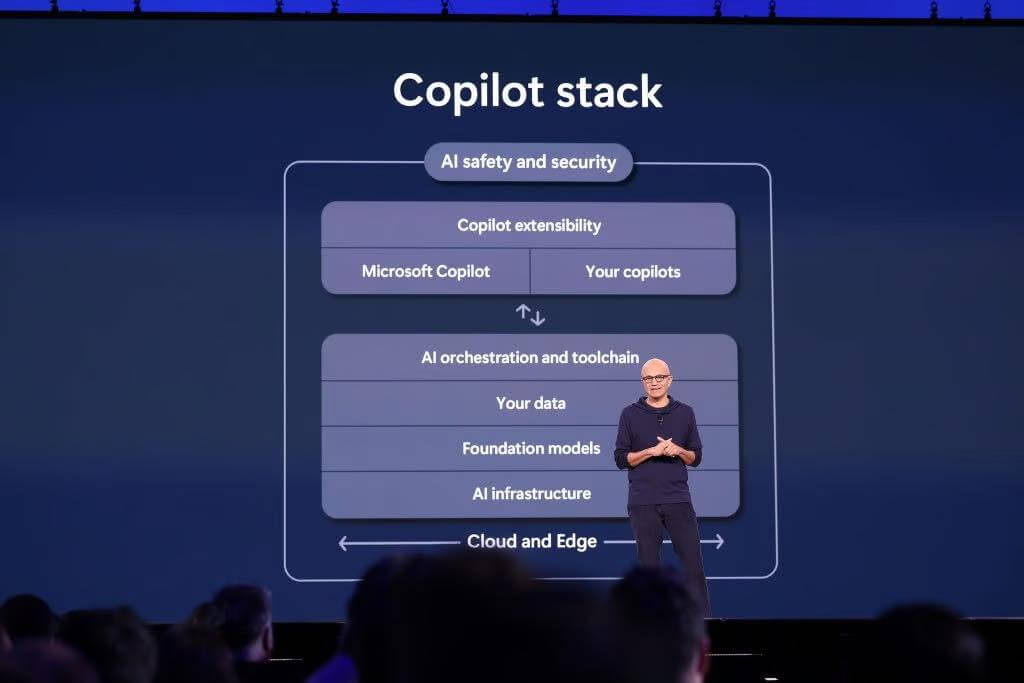 |
What's New | The AlphaSignal team was invited to the Microsoft Build conference where new AI tools and breakthroughs were released at every layer of the tech stack.
Let's go through each of the releases!
Small Language Models Microsoft wants to take the lead on the Small Language Model race. After their tiny but mighty Phi-3 released a few months ago, they just added new models to the Phi-3 family:
- Phi-3-vision: the first 4.2B multimodal model of the Phi family
- Phi-3-small: a new 7B parameters language model that rivals with models twice it size.
- New Phi-3 model: 14B parameter trained on 4.8T tokens achieving MMLU of 78 (comparable with Llama3 70B)
- Phi-Sliica: included in every Copilot+PC designed for NPUs with 650 tokens/sec prompt processing.
Microsoft Copilots and GitHub Copilot
Many updates and new features were added to the Copilots family.
- GitHub Copilot Extensions: Microsoft is empowering any developer to customize the Copilot experience with services like Azure, Docker, or Sentry directly within GitHub Copilot Chat.
- Team Copilot: An expansion of Copilot from a personal AI assistant to a collaborative team member. Team Copilot can act as a meeting facilitator, note-taker, project manager, and collaborator across Microsoft 365 apps like Teams, Loop, and Planner. This moves Copilot capabilities from just assisting individuals to also assisting teams.
- Copilot Studio Agents: New agent capabilities were added in Copilot Studio to allow developers to build proactive Copilots that can independently manage complex business processes. These Copilots can leverage memory, learn from feedback, and ask for help when needed.
New Copilot+ PCs Microsoft introduced the world to a new category of Windows PCs designed for AI: Copilot+ PCs. Copilot+ PCs are the fastest, most intelligent Windows PCs ever built.
Windows Copilot library and new Phi-Silica, a SOTA Small Language Model, included in every Copilot+PC.
PyTorch and a new Web Neural Network - a web native machine learning framework - now native on Windows
Powerful new silicon capable of 40+ TOPS
AI tools like Recall (to easily find and remember what you have seen in your PC), Cocreator (for AI image generation), Live Captions (for real-time audio translation), and more
20x more powerful and up to 100x as efficient for running AI workloads and deliver industry-leading AI acceleration
Other announcements
Microsoft also announced Real Time intelligence within their Fabric app the Azure AI-powered analytics platform, now in preview, as well as a long list of partnerships from AMD to Khan Academy or Cognition AI. | Access |
You can try Phi-3-vision now on the Azure AI platform. Phi-3 is also available on HuggingFace GitHub Copilot Extensions are supported in GitHub Copilot Chat on GitHub.com, Visual Studio, as well as VS Code. | |
Community Response |
Bindu Reddy
The new Phi-3 14B model scores phenomenally on all benchmarks. On key numbers, it seems to be pretty close to Llama-3-Instruct 🤯🤯 As small models become more and more powerful, we will see 7b-sized GPT-4 class models, which will be instantly useful for simple tasks Open-source will not only catch up but will do better in both cost and efficiency. |
Tom Warren
Microsoft is making a big bet on building a new type of AI computer. AI chips are at the core of Microsoft’s new Copilot Plus PCs, and Microsoft thinks they could change the way we use computers. |
|
Read announcements
|
|
|
|
| Get On-demand Instances in Seconds | Accelerate your training and inference workloads with dedicated GPU instances powered by NVIDIA’s H100 Tensor Core available at Latitude.sh's platform.
With pre-installed AI software, high-performance networking, and enterprise-grade hardware, you get from zero to training your LLMs with just a few clicks. |
|
GET MY GPUs
| partner with us |
|
|
|
TRENDING SIGNALS
| Google |
|
⇧ 1942 Likes | |
Object Detection |
| ⇧ 981 Likes |
| ChatGPT |
|
⇧ 357 Likes | |
Industry |
| ⇧ 2381 Likes
| | Theory |
| ⇧ 621 Likes |
| |
| |
|
|
TOP REPOS
| Crowd-Sourcing | |
☆ 10,701 | fabric is an open-source framework for augmenting humans using AI. It provides a modular framework for solving specific problems using a crowdsourced set of AI prompts that can be used anywhere. |
| Multimodal Models |
| ☆ 1170 |
Lumina-T2X is a series of text-conditioned Diffusion Transformers (DiT) capable of transforming textual descriptions into images, videos, detailed multi-view 3D images, and synthesized speech.
This family of models allow generation of output in any modalities, resolution, and duration within one framework, and requires low training resources. | |
RAG | |
☆ 3715 | Verba is Weaviate's open-source application designed to offer an end-to-end, streamlined, and user-friendly interface for Retrieval-Augmented Generation (RAG) out of the box.
You can run Verba either locally with HuggingFace and Ollama or through LLM providers such as OpenAI, Cohere, and Google. You can also choose between different RAG frameworks, data types, chunking & retrieving techniques in a very customizable way. | |
|
| |
|
|
PYTORCH TIP
| Model Architecture | Using Lambda Layers for Dynamic Adjustments in Network Behavior |
Lambda Layers in PyTorch can be used to incorporate function-based modifications within a model dynamically, which can adjust to varying inputs or conditions without restructuring the entire network.
Here’s a practical example demonstrating how to use a Lambda Layer to conditionally apply different operations based on input characteristics: |
import torch
import torch.nn as nn

class DynamicLambdaLayer(nn.Module):
    def __init__(self):
        super(DynamicLambdaLayer, self).__init__()

    def forward(self, x):
        # Apply a different function based on input
        if x.mean() > 0.5:
            return x * 2  # Scale up feature values if mean > 0.5
        else:
            return x * 0.5  # Scale down otherwise

# Example usage in a model
model = nn.Sequential(
    nn.Linear(10, 20),
    DynamicLambdaLayer(), # Inserting the dynamic lambda layer
    nn.ReLU(),
    nn.Linear(20, 5)
)

# Test input
input = torch.randn(1, 10)
output = model(input)
print(output)
|
|
|
|
Ghita is an editor at AlphaSignal and AI Engineer at Clear Ventures. Experienced in Computer Vision and Language models, she holds 2 masters in Applied Mathematics.
| | | |
Want to promote your company, product, job, or event to 180,000+ AI researchers and engineers?
|
|
Sponsor
|
|
|
|
|