| Hey, | Welcome to AlphaSignal – the most read newsletter by AI developers.
We bring you the top 1% of news, papers, models, and repos, all summarized to keep you updated on the latest in AI. |
|
|
|
IN TODAY'S SIGNAL
| Read time: 6 min 05 sec | 🎖️ Top News
📌 ElevenLabs
⚡️ Trending Signals
🗞️ Top Substacks
🧠 Top Lecture |
|
|
|
If you're enjoying AlphaSignal please forward this email to a colleague.
It helps us keep this content free. |
|
|
|
TOP NEWS
| LLMs | OpenAI releases GPT-4.1 series with 1M-token context outperforming GPT 4.5 by 16.6% on SWE-bench
| ⇧ 31,385 Likes |
| What's New |
OpenAI has released GPT‑4.1, GPT‑4.1 mini, and GPT‑4.1 nano via the API. All three models outperform GPT‑4o and GPT‑4.5 on key benchmarks. GPT‑4.1 reaches 54.6% on SWE-bench Verified and supports 1 million token context.
Key Features The models include new behaviors and tool support for production use.
All models support up to 1 million token context window
GPT‑4.1 trained to follow diff format for efficient patching workflows
Predicted Outputs API improves full file rewrite latency
Improved multi-hop reasoning using Graphwalks and MRCR datasets
GPT‑4.1 family only available via API; not in ChatGPT UI
Coding performance improves across all evals
GPT‑4.1 leads SWE-bench, Aider polyglot, and real-world frontend code generation. Scores 54.6% on SWE-bench Verified vs 38.0% (GPT‑4.5) and 33.2% (GPT‑4o)
Achieves 52.9% on Aider diff format, up from 18.2% with GPT‑4o
Makes extraneous edits in 2% of completions vs 9% in GPT‑4o
Preferred by human graders 80% of the time for frontend app generation
Supports 32K output tokens for full file rewrites
Instruction Following
The models handle structured prompts and multi-turn requests more reliably. Maintains coherence and follows complex formatting across turns Handles content requirements and negative instructions more accurately
Offers detailed step-level logs for observability and debugging
Scores 49% on OpenAI’s internal instruction eval (hard subset)
Reaches 38.3% on MultiChallenge, up from 27.8% in GPT‑4o
Achieves 87.4% on IFEval vs 81.0% for GPT‑4o
Long Context All models retrieve, track, and reason over large inputs.
Needle-retrieval accuracy stays consistent across 1M-token inputs
Scores 46.3% on OpenAI-MRCR (2-needle, 1M tokens)
Reaches 61.7% on Graphwalks BFS and 58.0% on Graphwalks Parents
GPT‑4.1 mini and nano also support 1M-token contexts
Improves disambiguation in multi-turn, multi-needle tasks
Latency
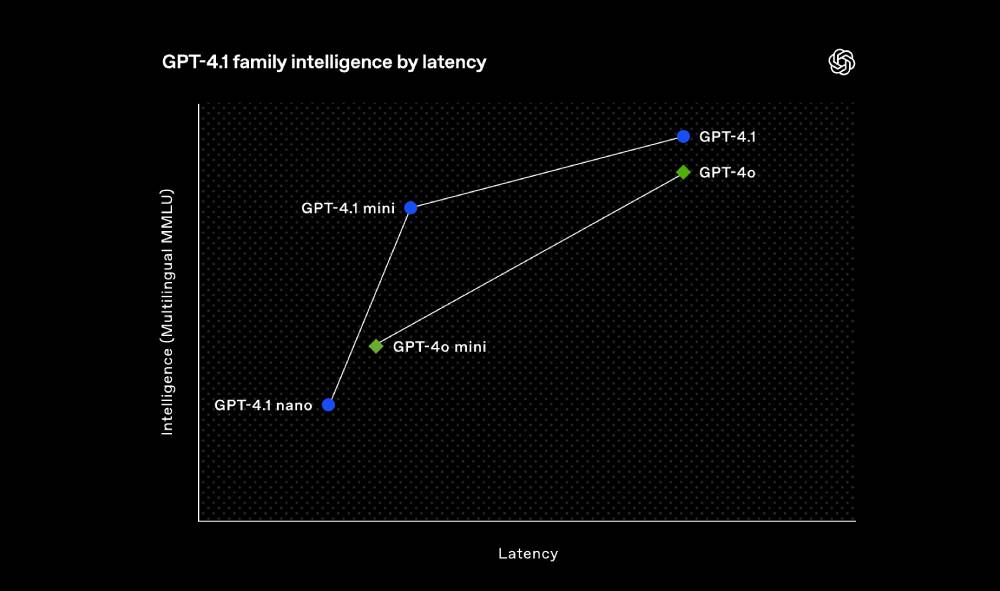
You can choose based on speed, cost, and accuracy tradeoffs. GPT‑4.1 nano returns first token in under 5 seconds at 128K input
GPT‑4.1 mini cuts latency by 50% vs GPT‑4o
Prompt caching now discounts input tokens by 75% on repeated queries
Transition from GPT‑4.5 by July 14
OpenAI will deprecate GPT‑4.5 Preview in the API in three months. Replace gpt-4.5-preview with gpt-4.1 in API calls
Adjust prompts for improved instruction following behavior
Support for GPT‑4.1-only features like 1M context and diff mode
No additional cost for long-context beyond standard per-token rates
Availability and access
You can use GPT‑4.1 models via the OpenAI API starting today.
Accessible through standard OpenAI endpoints and Playground
GPT‑4.1 not available in ChatGPT; GPT‑4o powers ChatGPT
Batch API supports GPT‑4.1 models with additional 50% pricing discount No local or downloadable version; hosted API use only
Community Feedback
Alex Salcido
"GPT-4.1 is very good with Cursor. It one-shot adding a web search to my local LLM assistant with long-term memory."
Get Nugget
"The 1M token context is game-changing, but the real power move? GPT-4.1-nano costs just $0.50/million tokens total ($0.10 input, $0.40 output). That's 25x cheaper than GPT-4o."
Prometheus Waluig
"That’s cool, but “API-only” is a double-edged sword. If the model’s that powerful, great at coding, instruction following, and can handle a million tokens, why gate it off from direct user access? Real-world utility includes accessibility. Not every dev wants to juggle tokens and endpoints just to explore new ideas. Sometimes you want to talk to the thing, not build scaffolding around it. Let’s not confuse “developer happiness” with broader usefulness." |
|
| Try now
|
|
|
|
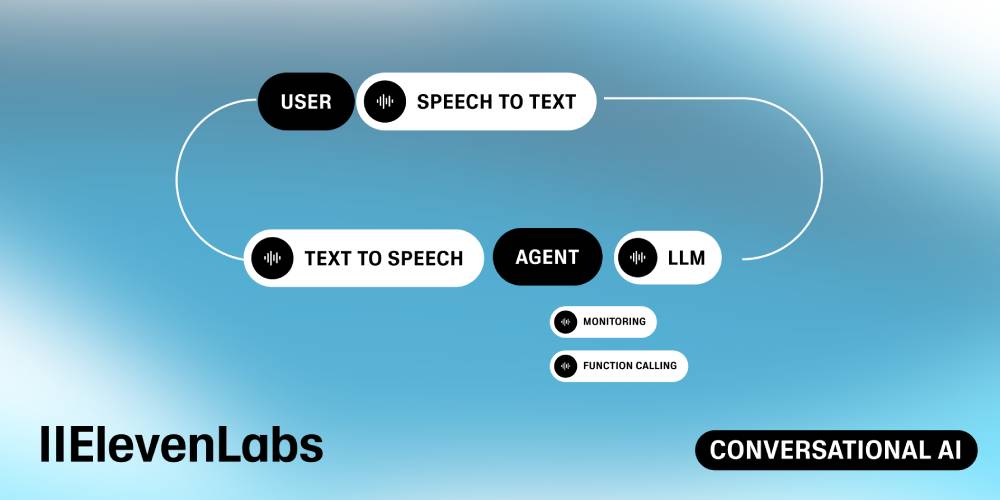
| Deploy Human-Like Voice Agents in Minutes | Over 500,000 voice agents have been built with ElevenLabs, handling support calls, booking appointments, and tutoring users 1-on-1. Developers are shipping real products with real results.
Pick from 5,000+ human-like voices, write a system prompt, upload your knowledge base, integrate third-party tools, and connect a phone number.
That’s it and you’re live.
Join thousands of developers building production-ready agents in days, not months. |
| Build voice agents
| partner with us → |
|
|
|
TRENDING SIGNALS
| AI Assistants |
|
⇧ 12,438 Likes | |
AI Tool |
|
⇧ 5,035 Likes | |
LLMs |
|
⇧ 2,249 Likes | |
AI Evaluation |
|
⇧ 865 Likes | |
Embodied AI |
|
⇧ 887 Like | | |
|
|
|
|
TOP SUBSTACK READS
| AI Industry |
|
Breaks down why Google is now ahead of OpenAI, Anthropic, and Meta across every AI front—LLMs, agents, video, cloud, hardware, and more. Covers Gemini 2.5’s benchmark dominance, Google's ecosystem advantage, and why DeepMind’s quiet momentum has turned into full-spectrum market leadership. |
⇧ 208 Likes | |
Multi Agent Collaboration |
|
Explains why Google’s A2A protocol complements MCP, addressing cross-agent collaboration, security, and state management. Breaks down the key differences between MCP’s LLM context integration and A2A’s agent communication. Helps you understand potential future shifts in Agentic systems and their impact on multi-agent architectures.
|
⇧ 72 Likes | |
AI Agents | |
| Covers how to build production-ready AI agents using LangGraph for interactive game environments. Learn to create character impersonation agents, architect an agentic RAG system, and implement multiple personas for NPCs, leveraging Groq API's LLM and advanced prompt engineering techniques for dynamic gameplay.
|
⇧ 34 Likes | | |
|
|
|
|
TOP LECTURE
| LLM |
How to Use o1 for High-Context, High-Precision Tasks |
⇧ 3,015 Likes |
| This podcast breaks down how to use the o1 model effectively for software engineering, reasoning tasks, and high-context workflows.
The speakers explain how o1 differs from chat models, why prompt design matters more, and how to structure inputs and outputs for optimal results. They also cover common mistakes, model quirks, and real-world use cases.
You will learn: How o1 differs from chat-first models like Claude and GPT-4
Why prompt briefs outperform standard prompt formats in o1
Techniques to inject high-volume, domain-specific context effectively
How to guide o1 by output goals instead of process instructions
Evaluation methods for assessing o1’s reasoning accuracy
What o1 excels at: one-shot code generation, domain-specific language use, and architecture planning
Limitations in style generation, multi-step app creation, and latency handling
UI and product design considerations when building on top of o1 |
| Watch now
|
|
|
|
At Alpha Signal, our mission is to build a sharp, engaged community focused on AI, machine learning, and cutting-edge language models, helping over 200,000 developers stay informed and ahead. We’re passionate about curating the best in AI, from top research and trending technical blogs to expert insights and tailored job opportunities. We keep you connected to the breakthroughs and discussions that matter, so you can stay in the loop without endless searching. We also work closely with partners who value the future of AI, including employers and advertisers who want to reach an audience as passionate about AI as we are.
Our partnerships are based on shared values of ethics, responsibility, and a commitment to building a better world through technology.Privacy is a priority at Alpha Signal. Our Privacy Policy clearly explains how we collect, store, and use your personal and non-personal information. By using our website, you accept these terms, which you can review on our website. This policy applies across all Alpha Signal pages, outlining your rights and how to contact us if you want to adjust the use of your information. We’re based in the United States. By using our site, you agree to be governed by U.S. laws. |
|
|
|
Looking to promote your company, product, service, or event to 200,000+ AI developers? Let's work together.
|
| Work with us
|
|
|
|
|
