| Hey, | Welcome to today's edition of AlphaSignal, a newsletter for developers by developers.
We identify and summarize the top 1% news, papers, models, and repos in the AI industry. |
|
|
|
IN TODAY'S SIGNAL
| Read time: 4 min 21 sec | 🎖️ Top News
📌 Ori
⚡️ Trending Signals
🛠️ Top Repos
RAGFlow, an open-source RAG engine based on deep document understanding.
MindSearch: an LLM-based Multi-agent Framework of Web Search Engine (like Perplexity).
Composio equips agents with 100+ well-crafted tools to tackle complex tasks.
📌 Encord
🧠 Lecture |
|
|
|
If you're enjoying AlphaSignal please forward this email to a colleague.
It helps us keep this content free. |
|
|
|
TOP NEWS
| OpenAI | OpenAI Launches JSON Structured Outputs and a New Model with 50% Cheaper Inputs, 100% Reliability |
⇧ 11,193 Likes |
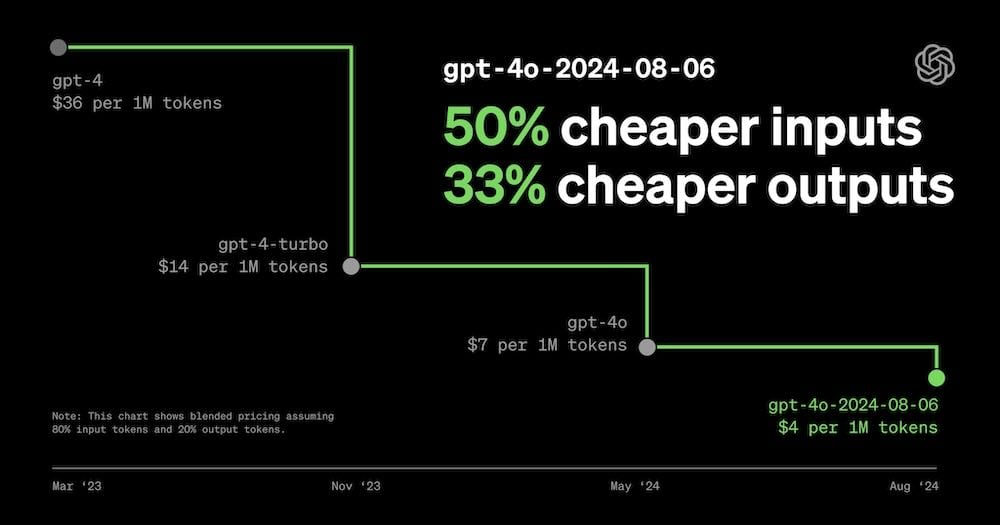 |
What's New | OpenAI released the new GPT-4o-2024-08-06 model, which supports Structured Outputs. This model achieves perfect scores in JSON schema adherence, ensuring reliable and consistent output formats.
It offers significant cost reductions and improved performance. The model features an increased context window of 16,384 output tokens, up from 4,096 tokens.
Structured Outputs for Reliable JSON Schema Adherence
Structured Outputs make sure model outputs strictly follow developer-supplied JSON Schemas. This feature guarantees outputs match the provided schema by using constrained sampling techniques, converting JSON Schemas into context-free grammars.
Enhanced Consistency and Usability with Structured Outputs
Structured Outputs provide 100% reliability in JSON schema adherence. This reduces the need for developers to manually validate and retry outputs.
Developers enforce strict schema adherence using the "strict": true option in function definitions or the "type": "json_schema" option for response formats. This feature is valuable for tasks requiring precise data formats, like dynamically generating user interfaces and extracting structured data.
Availability and Implementation Across OpenAI Models
Structured Outputs are available as function calling and response formats. Function calling supports models from GPT-3.5-turbo-0613 and GPT-4-0613, allowing strict schema enforcement within tool definitions.
The response format option works with the latest GPT-4o models. OpenAI's Python and Node SDKs now have native support for Structured Outputs, simplifying implementation.
Cost Efficiency and Key Features
The GPT-4o-2024-08-06 model offers significant cost reductions and improved performance: - 50% lower input costs: $2.50 per million tokens
- 33% lower output costs: $10.00 per million tokens
- Increased context window: 16,384 output tokens
Structured Outputs maintain consistent output formats, improving the reliability and performance of AI applications by dynamically generating user interfaces and extracting structured data. The feature is available for GPT-4o-2024-08-06 but not for all OpenAI models. | |
|
Try structured outputs
|
|
|
|
| Kickstart your AI training with $1000 in credit |
Meet the specialized demands of your AI/ML workloads with our scalable, efficient, and robust cloud infrastructure. Enjoy on-demand access to GPU-accelerated virtual machines, reserve a dedicated instance or request a private bare metal cluster – the choice is yours.
AI-Optimized Infrastructure: Customize your hardware, storage, and networking to fit your unique workload needs.
Flexible Scalability: Configure compute, storage, and networking to scale as your demand increases.
Transparent Costs: Benefit from personalized pricing and configurations that the hyper-scalers can't match. |
|
Get started
| partner with us |
|
|
|
TRENDING SIGNALS
| Compression |
|
⇧ 1830 Likes | |
Grants |
| ⇧ 834 Likes
| | Language Models |
|
⇧ 242 Likes | |
Deployment |
|
⇧ 1029 Likes | |
Tokens |
| ⇧ 212 Likes |
| |
| |
|
|
SAM 2 is out now - but does it work on YOUR data?
| Last week, Meta unveiled SAM 2 which promises to significantly increase data labeling speed for AI teams. But is SAM 2 effective for YOUR domain-specific data? Join the Encord ML team, who first implemented and fine-tuned the model, for a webinar to learn how you can do the same. |
Apply to attend ↗️ |
|
|
|
TRENDING REPOS
| RAG | |
☆ 13,640 Stars |
RAGFlow helps you implement a streamlined Retrieval-Augmented Generation (RAG) workflow for question-answering using LLMs. It supports multiple data formats and complex sources, offering accurate, cited responses with minimal hallucinations. It integrates models like OpenAI GPT-4o and supports platforms like Docker for seamless deployment. |
| Search |
MindSearch | ☆ 3010 Stars |
MindSearch helps you deploy an AI search engine with LLMs like GPT and InternLM2.5-7b-chat. It answers complex queries by analyzing hundreds of web pages, improving factuality with a dynamic graph construction process. It supports interfaces like React, Gradio, and Streamlit. |
| Agents |
| ☆ 4544 Stars |
Composio helps you integrate AI agents with over 100 tools for tasks across GitHub, Notion, Slack, and more, using one line of code. It boosts tool accuracy by 40% and manages six auth protocols. Use with OpenAI, Langchain, and others. Extend easily with new tools and frameworks. |
| |
| |
|
|
TOP LECTURE
| Language Models |
Direct Preference Optimization (DPO) from Scratch |
⇧ 1592 Likes |
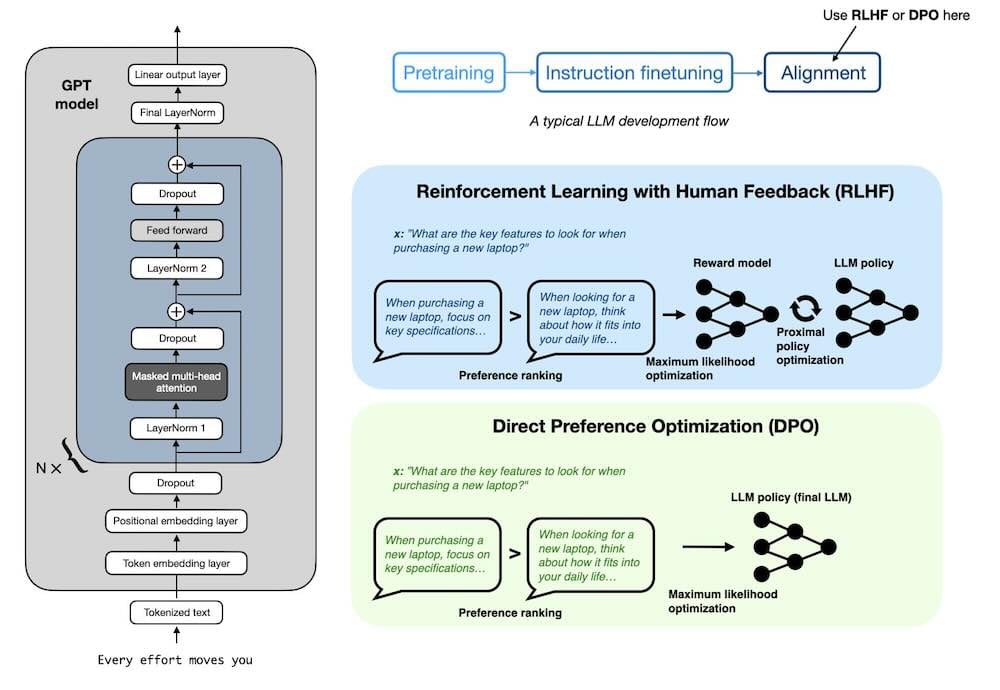 |
The "Direct Preference Optimization (DPO) for LLM Alignment" lecture by Sebastian Raschka provides a comprehensive walkthrough of aligning LLMs with user preferences using Direct Preference Optimization.
This approach simplifies alignment compared to reinforcement learning from human feedback (RLHF) by directly optimizing model outputs to align with user expectations.
The lecture includes a complete notebook that guides you through:
- Understanding DPO: Learn the fundamentals of DPO and its advantages over RLHF methods.
- Implementing DPO: Follow step-by-step instructions to code DPO from scratch.
- Data Preparation: Create and utilize a preference dataset for training.
- Optimizing Outputs: Adjust model outputs to improve alignment with user preferences.
- Comparative Analysis: Compare DPO with RLHF to understand their strengths and limitations.
|
|
Read more
|
|
|
|
Want to promote your company, product, service, or event to 200,000+ AI researchers and engineers?
|
|
Sponsor
|
|
|
|
|
