Hey, | Welcome to today's edition of AlphaSignal.
Whether you are a researcher, engineer, developer, or data scientist, our summaries ensure you're always up-to-date with the latest breakthroughs in AI.
Let's get into it!
Lior |
|
|
|
IN TODAY'S SIGNAL |
Read Time: 4 min 49 sec |
|
|
|
Enjoying this newsletter? Please forward it to a friend or colleague. It will help us keep this content free. |
|
|
|
TOP NEWS | Agents | Open-Source Software Engineer Agents | ☆ 3212 | 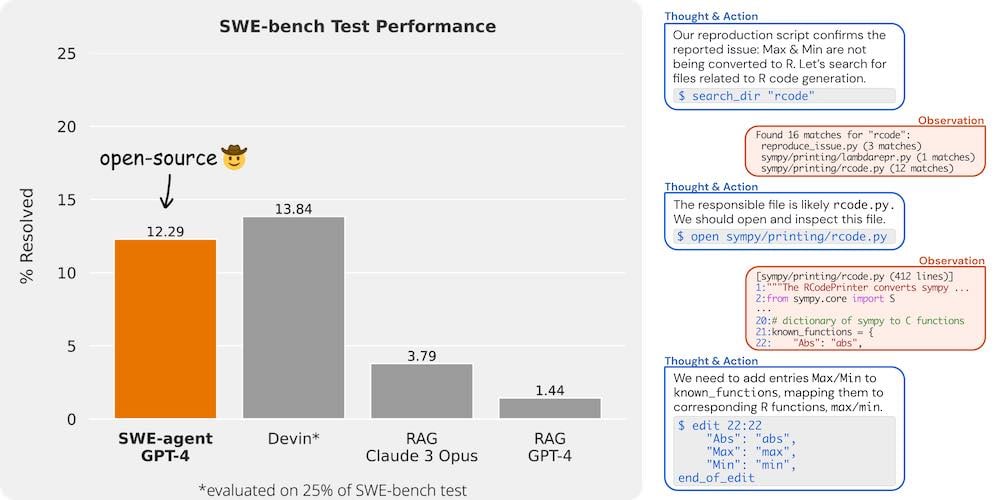 | What's New | Princeton NLP introduces SWE-agent, a system deploying GPT-4 to autonomously address issues in GitHub repositories.
It achieves accuracy comparable to the AI agent Devin on the SWE-bench and resolves issues in an average of 93 seconds. SWE-agent is available as open-source.
Features: - File Navigation: Facilitates opening, scrolling, and searching within files.
- Code Editing: Provides line editing with syntax feedback.
- Testing: Enables writing and executing tests directly.
Design Insights: - Linking language models directly to standard bash terminals has proven ineffective. SWE-agent addresses this by implementing a design that mirrors intuitive user interfaces, automatically correcting indentation errors and offering feedback.
Performance: Setup: - Users need Docker and Miniconda for setup, and a GitHub token is required for operation.
| Why This Matters | Autonomous software engineer agents can completely disrupt the industry and open up a new world of possibilities. The fact an open-source project was able to achieve similar results than Devin less than 30 days after its announcement shows how fast and efficient the open-source community is. | Community Feedback | Yifei Hu: "I sense a new research domain: agent computer interaction (ACI). It's similar to human computer interaction (HCI) but focuses more on LLMs and LVMs"
Noctre: "While the achievement is really impressive, it's a bit misleading to label it as "open source" if it uses GPT-4 to do a part of the heavy lifting"
jtor: "I'm really curious why Devin didn't eval on the full test set. What's the max possible score for swe-agent if we're just looking at 25%?" | | Try swe-agent |
|
|
|
 | Fine-Tune LLMs on Your Own Data | LLM fine-tuning tools have two major flaws that put fine-tuning out of reach of most companies: They assume that you have a dataset ready to go that perfectly captures how the model should behave;
They lack tools for evaluating the models in a way that builds the trust needed for an enterprise to deploy them.
SuperAnnotate makes dataset preparation and LLM fine-tuning a breeze. It is a powerful platform for collaboratively creating, managing, and refining datasets with colleagues or external partners.
Excited to announce that SuperAnnotate has partnered with Databricks to make this set of tools available for your data!
Read more about how to connect your Databricks cluster to SuperAnnotate and get started with fine-tuning. | | Learn how | partner with us |
|
|
|
TOP ANNOUNCEMENTS | Jailbreaking | | Anthropic researchers have released a method named "many-shot jailbreaking" that can bypass LLM safety measures by using large context windows filled with hundreds of fake dialogues between a human and an AI assistant. Including many such dialogues before a final question, like how to pick a lock, forced the LLM to answer the malicious question. | ⇧ 1512 ⇆ 412 | | Music Generation | | Stable Audio 2.0 introduces a latent diffusion model for generating high-quality, structured audio tracks up to 3 minutes at 44.1kHz. It features audio-to-audio transformation, leveraging a compressed autoencoder and a diffusion transformer (DiT) for processing long sequences. Trained on AudioSparx’s licensed dataset, it also incorporates content recognition technology to avoid copyright infringement. | ⇧ 1028 ⇆ 339 | | Code Assistants | | Replit has developed a native 7B parameter LLM specifically for code repair, surpassing GPT-4 and Claude 3 Opus in benchmarks. This model integrates directly with Replit's IDE, using LSP diagnostics and synthesized diffs from a dataset of 100k examples to efficiently address code errors. | ⇧ 800 ⇆ 105 | | |
| |
|
|
PYTHON TIP | Generators | When dealing with large datasets or complex computations, efficiently managing memory can greatly improve your code's performance.
A useful but lesser-known Python technique involves the use of generators for lazy evaluation, which can be especially beneficial in machine learning tasks that require the handling of big data or the execution of intensive computations.
Generators allow you to declare a function that behaves like an iterator, i.e., it can be used in a for loop. The main advantage of generators is that they do not store their contents in memory. Instead, they generate each value on the fly, which means they are much more memory-efficient when dealing with large datasets.
Here's how you can use a generator to process large datasets: |
def process_large_list(data_list):
    for item in data_list:
        yield item

def process_item(item):
    # This is a simple example function
    print(item)


# Assume this is a large list for demonstration
large_data_list = [1, 2, 3, 4, 5]
for item in process_large_list(large_data_list):
    process_item(item)
|
|
|
|
TOP TWEET | This recent tweet shares a tip about how to avoid overfitting by looking at the distribution of the training and testing datasets, before even applying any regularization technique. This method is called Adversarial Validation.
The idea is to train a simple binary classification model on a new binary dataset based on whether or not each sample belongs to the training or testing dataset.
Analyzing the performance of this classifier shows whether or not the training and testing data have the same distribution and whether or not they are separable.
If the splits come from different distribution, the model will necessarily perform poorly.
To get a deeper understanding, you can read the whole tweet below. |  | Santiago @svpino |
| I want to show you a clever trick you didn't know before. Imagine you have six months' worth of data. You want to build a model, so you take the first five months to train it. Then, you use the last month to test it. This is a common approach... | | | | | | 2157 Likes 314 Retweets 50 Replies |
|
| | Read tweet |
|
|
|
Ghita is an editor at AlphaSignal and AI Engineer at Clear Ventures. Experienced in Computer Vision and Language models, she holds 2 masters in Applied Mathematics. |
|
|
|
Want to promote your company, product, job, or event to 175,000+ AI researchers and engineers? | | Sponsor |
|
|
|
|
