
Pro
Tsinghua's SynCred-Bench Reveals AI Fakes Fool Humans 37% of the Time
A new benchmark reveals that AI-generated fake official documents fool humans 37% of the time and defeat nearly every automated detector on the market
20 stories
A new benchmark reveals that AI-generated fake official documents fool humans 37% of the time and defeat nearly every automated detector on the market
FLIPS fingerprints how an LLM is configured, not just which model it is, enabling regulators to audit deployed AI behavior for the first time
MuHL learns adaptive multi-scale hyperedges from brain scans, beating 19 baselines on Alzheimer's and Parkinson's classification while pinpointing disease-linked brain regions.
AugMask lets any diffusion-based tabular generator train on incomplete data without architectural changes, beating specialized missing-aware models
GTAD fuses graph diffusion kernels with transformers to catch Alzheimer's before symptoms appear, pinpointing the exact brain regions that matter most
EqGINO brings rotation-equivariance to 3D Fourier Neural Operators via isotropic spectral convolution, enabling robust PDE solving on complex geometries without the prohibitive cost of spectral group convolutions.
A new paper proves that no single calibration dataset can preserve all LLM capabilities after pruning, and proposes a mixing protocol that beats the C4 default by +18.8 points
A new mathematical framework proves that injecting learnable messages inside GNN layers beats input-level graph prompting, eliminating negative transfer entirely in one-shot classification.
A new theoretical framework from Li Sun and collaborators reframes graph substructure transferability through Riemannian geometry, introducing GAUGE — a pretrainable architecture that learns intrinsic graph structure without relying on node features or fixed geometric spaces.
A Google DeepMind ICML 2026 paper argues that optimizing AI against static benchmarks makes it structurally unable to cooperate once deployed among adaptive humans and institutions
AirDreamer combines world-model imagination with sparse-reward RL to navigate drones through cluttered, unseen environments — and transfers directly to real hardware with zero tuning.

VistaHop exposes a critical gap in multimodal AI: even the best models solve fewer than 1 in 4 multi-hop visual reasoning tasks
Researchers from NYU Abu Dhabi's eBRAIN Lab introduce PSViT, a structured pruning method that cuts Spiking Vision Transformer memory by 22.4% without specialized hardware or retraining.
A new study maps how sex and age imbalances in training data degrade skin cancer AI, and finds the two biases need completely different fixes

WebRISE exposes a critical blind spot in web code generation benchmarks: even the best models fail to reliably produce pages that actually work as intended
Researchers from Xiaomi's HyperAI team and partner universities propose a two-stage framework that cuts mobile agent false triggers nearly in half while slashing inference compute by 69%
A new benchmark tests AI agents on real clinical software -- and the results reveal a dangerous gap between lab performance and hospital-ready reliability
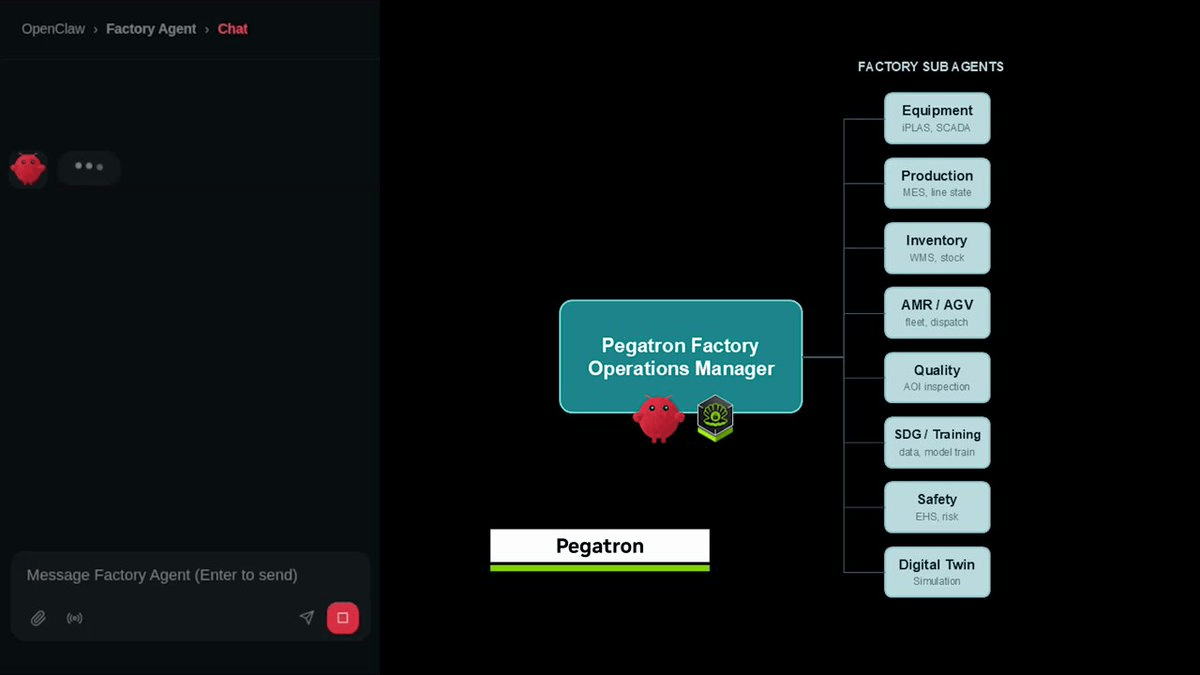
NVIDIA's FOX blueprint lets manufacturers build a single AI brain that orchestrates hundreds of specialized agents across the factory floor, with Foxconn already projecting 80% faster root-cause analysis
Nous Research's Hermes agent can now install NVIDIA's verified CUDA-X, NeMo, and Omniverse skills directly from the Skills Hub, bridging open-source agents with the full NVIDIA platform stack.
GPT-5.5, GPT-5.4, and Codex hit Amazon Bedrock GA, giving AWS-native enterprises a direct path to OpenAI's best models without leaving their cloud