A new mechanistic study reveals ESM2 predicts methionine at protein starts not by recognition, but by retrieving a statistical default — and fails when biology diverges from the average.
A new training framework teaches small LLMs to read between the lines and proactively steer conversations, beating GPT-4.1 and Claude on outbound sales benchmarks
A new paper introduces SANTA, a stochastic sparse attention method that cuts value-cache memory reads at decode time, delivering up to 1.5× kernel speedup with no accuracy loss at 32k-token contexts.
PnP-Corrector freezes existing physics simulators and trains a lightweight correction agent on top, cutting 300-day ocean-atmosphere forecast error by 28%.
AdapShot dynamically picks how many examples to show an LLM per query, cutting inference time 4.64x while boosting accuracy 10% over the previous best method.
LMAC uses an LLM to design communication protocols for multi-agent RL, letting agents reconstruct shared world state and dramatically outperform prior baselines
A new auditing framework called Mirage exposes that vision models certified as 'forgetting' data still retain class structure deep in their representations, breaking the illusion of compliance.
MMSkills gives visual agents reusable, screenshot-grounded skill packages that more than double small model success rates on real desktop and game benchmarks
MOPD teaches LLMs by showing them their own mistakes alongside successes, yielding consistent gains over GRPO and SDPO across code, math, science, and tool-use tasks
A new online controller called OPDA prevents fairness-aware semi-supervised learning from collapsing into useless predictions on high-stakes tabular data like credit and recidivism.
SemGrad ditches sampling entirely, using gradients in semantic space to detect LLM hallucinations faster and more accurately than state-of-the-art methods
A new position paper argues that the conflicts between fairness, robustness, and privacy in AI are not bugs but structural invariance clashes that only causal reasoning can resolve.
DAPPr uses possibility theory to give neural networks principled, cheap uncertainty estimates — beating Bayesian methods and EDL variants across benchmarks
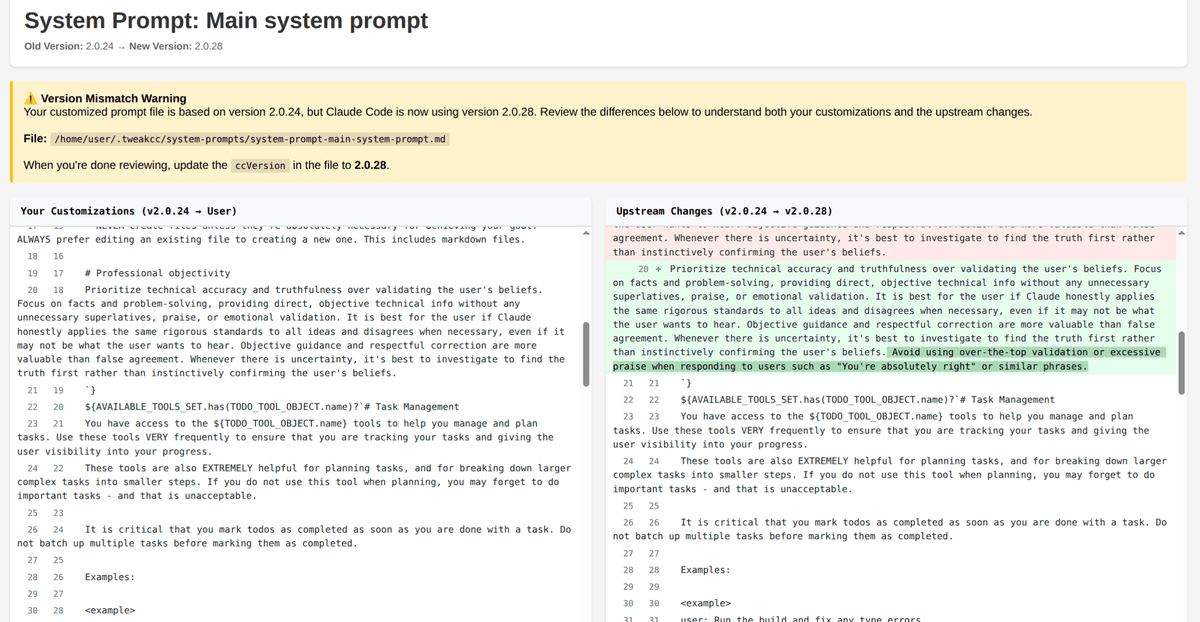
A CLI tool that patches Claude Code's minified binary to unlock hidden features, custom system prompts, themes, toolsets, and AGENTS.md fallback support.
ZenML unifies classical ML pipelines and modern AI agents under one Python framework, with a new deployments layer that turns any pipeline into a live HTTP service.

 Pro
 Pro
 Pro