

Z.ai's GLM-5.3 Tops Open-Weights Leaderboard Using Only Post-Training
Z.ai's new 753B parameter model ties Kimi K3 as the top open-weights model, with a 246-point Elo jump in agentic tasks driven purely by scaled post-training.
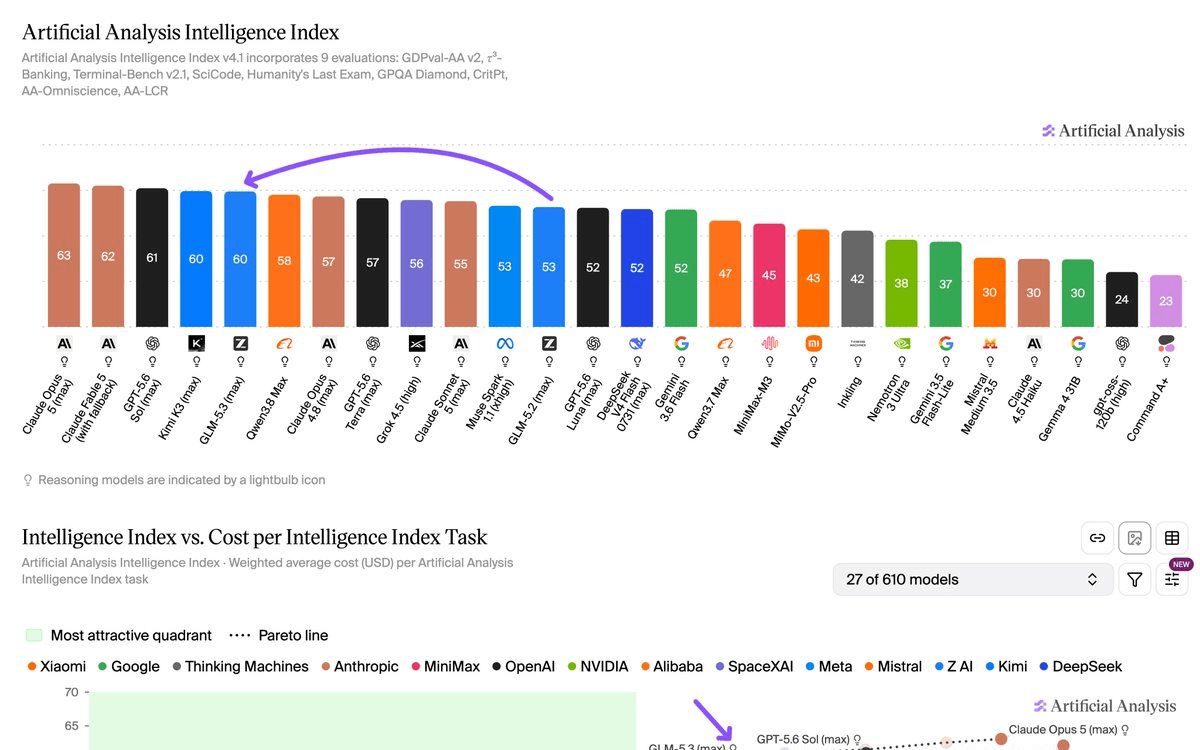
- GLM-5.3 ties Kimi K3 at 60 on Artificial Analysis Intelligence Index, top open-weights slot.
- 246-point Elo jump on agentic GDPval-AA v2 (1524 to 1770), second only to Claude Opus 5.
- 753B total / 40B active MoE, 1M context, MIT license, weights arriving on Hugging Face in ~2 weeks.
- API pricing: $1.40/M input, $4.40/M output, 81% cache discount on repeat inputs.
- All gains from scaled post-training on the same GLM-5.2 base, no new pretraining run.
- Emergent multi-stage exploit reasoning delayed the weights release for extra safety review.
Z.ai has pushed GLM-5.3 to the top of the open-weights leaderboard, and the interesting part is how they got there. The base model is unchanged from GLM-5.2. Everything you see in the benchmarks came from throwing more reinforcement learning environments, more diverse tasks, and more compute at post-training. The launch blog puts it bluntly: Scaling post-training is all we did for GLM-5.3.
That's a striking claim because the score jumps are not small. On Artificial Analysis's real-world agentic evaluation GDPval-AA v2, the model's Elo climbed from 1524 to 1770, a 246-point leap that puts it second across all models tested, behind only Claude Opus 5 at 1855 and more than 100 points ahead of the previous open-weights leader Kimi K3. On the broader Artificial Analysis Intelligence Index it now sits at 60, tied with Kimi K3 for the top open-weights spot.
What you actually get
The architecture is a mixture-of-experts with 753B total parameters and 40B active, unchanged from the previous release. Context window is 1M tokens. The license is MIT. Pricing on the first-party API is $1.40 per million input tokens and $4.40 per million output tokens, with an 81% discount ($0.26/M) on cached input. The model is currently available through Z.ai's coding plan, coming soon to their API and in two weeks' time to Hugging Face as open weights.
Notably, this puts the model at the frontier of agentic coding benchmarks with only around 750B parameters, roughly a third of Kimi K3's size. That matters for anyone planning to self-host once the weights drop.
The catch: token bloat
The intelligence gains come with a real cost. Across the Intelligence Index, GLM-5.3 chews through about 18,700 output tokens per task, roughly 20% more than GLM-5.2 (15,700) and 27% more than Kimi K3 (14,700). That pushes the cost per Intelligence Index task to $0.68, up 1.5x from GLM-5.2's $0.44. It's still cheaper than Kimi K3 at $0.84 and GPT-5.6 Sol at $1.23, but the trend line is worth watching if you deploy at scale.
On real-world knowledge accuracy (AA-Omniscience), the score jumped from 4 to 14. That improvement is a real capability gain rather than the model just refusing more questions. Accuracy rate went from 24% to 34%, attempt rate rose from 46% to 55%. Hallucination rate did creep up slightly from 26% to 30%, so it's more confident and more often correct, but also willing to swing and miss more often.
Where the gains actually show up
The company's own scoreboard is aggressive across coding and agent benchmarks:
- Terminal-Bench 3.0 climbs from 4.6 to 28.3
- DeepSWE v1.1 goes from 46.2 to 66.9
- CyberGym reaches 84.5%, edging Claude Mythos 5 at 83.8% and GPT-5.6 Sol at 83.6%
- Z.ai Code Bench at Max effort: 34.5% while burning roughly 75,000 output tokens per task, against GLM-5.2's 23.4% at 96,000 (a rare case where the model got smarter and more token-efficient at the same benchmark)
The uncomfortable cyber story
The most interesting and awkward part of this release is what happened when Z.ai turned the model loose on real code. Z.ai says the model surfaced 2,436 vulnerabilities across 269 open-source projects during evaluation, with 1,097 rated critical or high severity, and reports finding critical bugs in Linux, WebKit, and FreeBSD. The lab also says the model began reasoning across multiple stages of exploitation and forming coherent plans for complete exploitation chains, a capability it did not set out to train for.
That emergent behavior is why the weights are being held back roughly two weeks for additional safety evaluation. For an org whose reputation runs on shipping open weights, that's a real trade-off, and it's likely a preview of what other frontier open-weights releases will look like.
Why the post-training-only story matters
The GLM-5.3 release is a data point in an ongoing argument about how Chinese labs keep matching American frontier models. The easy explanation is distillation, but that doesn't fit here. GLM-5.3 is the same base model as GLM-5.2 with substantially extended post-training, and Z.ai attributes the gains to more RL environments, more diverse tasks, and more compute spent training on them. You don't distill an RL environment or the orchestration infrastructure needed to run thousands of them in parallel.
Practically, this suggests the post-training frontier still has substantial headroom on top of an existing base. If you already have a strong MoE base like GLM-5.2, you can extract another tier of capability by scaling your RL stack rather than doing another expensive pretraining run. That's a different economics than the compute-heavy pretraining scaling narrative that dominated the last few years.
When to actually reach for it
Once weights are on Hugging Face, GLM-5.3 becomes the strongest option if you need:
- An open-weights agentic coding model you can host and modify, without sending code to a proprietary API
- A frontier-class model at a third the parameter count of Kimi K3, meaning materially lower serving costs on your own hardware
- Long-context workloads up to 1M tokens with the MIT license attached
- Vulnerability discovery and code auditing pipelines, where its CyberGym-topping numbers are directly relevant
Where you'd still hesitate: anything vision-heavy (the flagship GLM line remains text-only), latency-sensitive workloads where the 20% token bloat over GLM-5.2 will hurt, and use-cases where Claude Opus 5's remaining Elo lead on agentic work justifies the price gap. For a lot of the middle ground, though, an MIT-licensed open-weights model that ties for the top of the intelligence index is going to be very hard to argue against.
Comments
