

Z.ai's GLM-5.2 Hits 1M Context at 10x Cheaper Than Claude
Z.ai's GLM-5.2 arrives with a 5x context jump to 1M tokens, dual reasoning modes, MIT open weights, and pricing roughly 10x cheaper than US frontier models
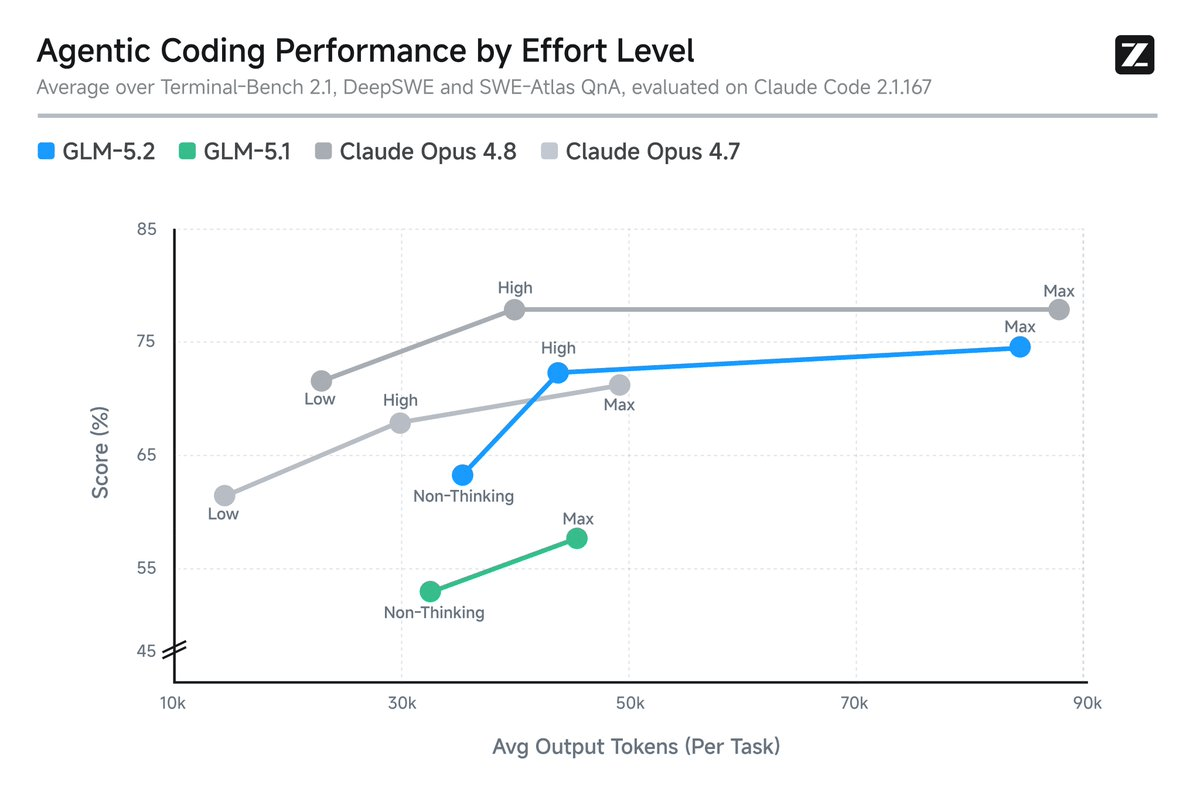
- Z.ai released GLM-5.2, a 744B MoE open-weight model with a 5x context jump to 1M tokens under MIT license.
- Two reasoning modes (High and Max) replace a single mode; Max is recommended for complex coding and agentic tasks.
- Available now on all GLM Coding Plan tiers (~$18–$80/month) at no extra charge; open weights on HuggingFace coming shortly.
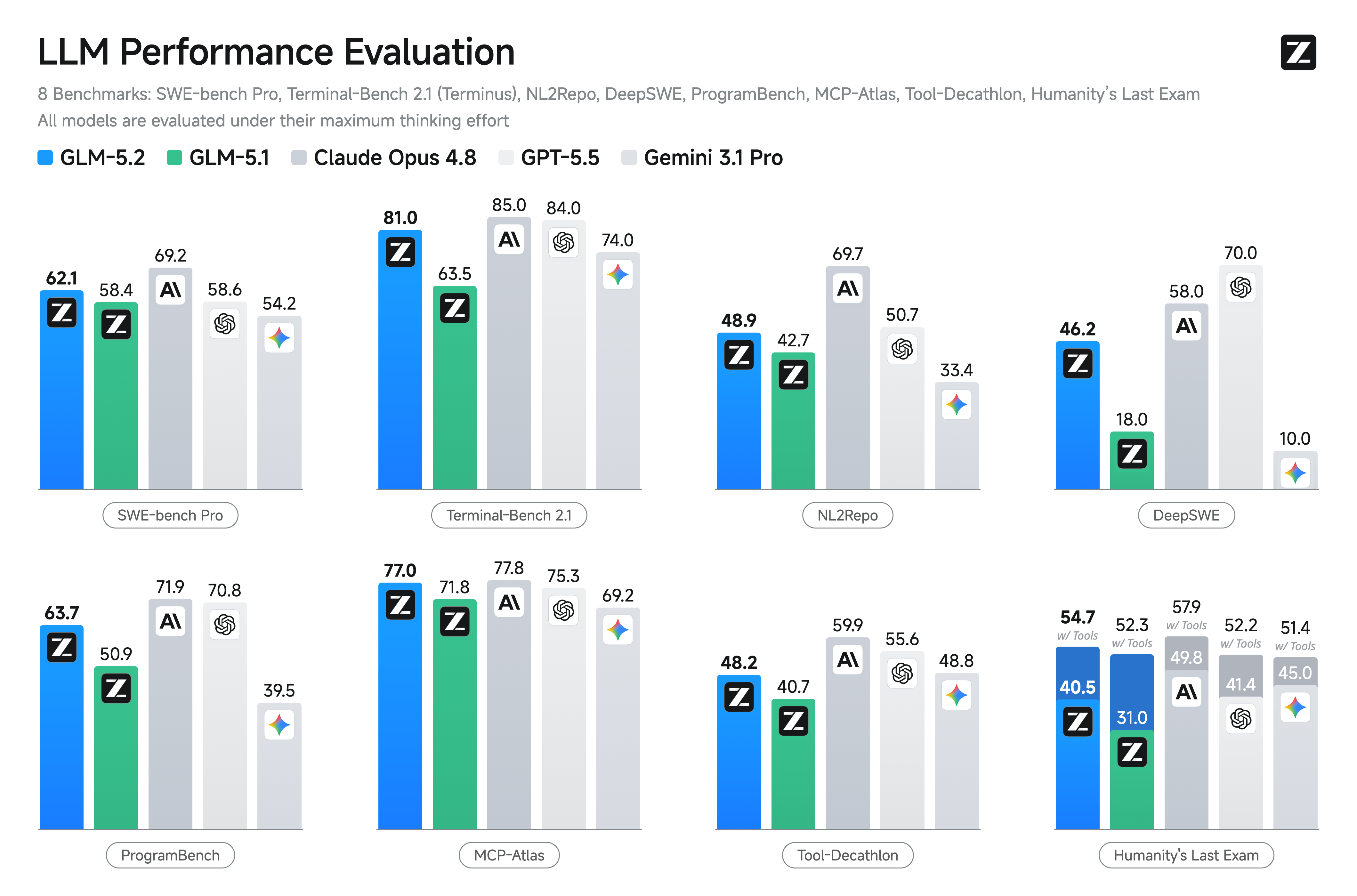
- No official benchmarks published at launch; predecessor GLM-5.1 scored 58.4 on SWE-bench Pro, edging past Claude Opus 4.6's 57.3.
- Trained entirely without NVIDIA chips, making it supply-chain independent from US export controls.
- Pricing is roughly 10x cheaper than comparable US frontier models, with prompt-based billing that doesn't penalize large context use.
GLM-5.2 is Z.ai's new flagship model, and it landed at a moment that felt almost scripted. GLM-5.2 dropped 48 hours after US export rules forced Anthropic to disable its top Fable 5 and Mythos 5 models for foreign nationals. Z.ai founder Jie Tang commented: "We deeply regret the sudden restrictions on certain frontier models. The path to AGI should not be surrounded by high walls; it requires cooperation from all of humanity." Whether you read that as principled or opportunistic, the timing put a spotlight on a model that deserves attention on its own merits.
What Just Shipped
GLM-5.2 is an open-weight Mixture-of-Experts language model from Zhipu AI, with ~744B total parameters (~40B active), a usable 1M-token context window, two reasoning modes, and an MIT license. It follows GLM-5 (February), GLM-5-Turbo (March), and GLM-5.1 (April) , meaning Z.ai has now shipped four flagship-tier coding releases in roughly four months. The pace is relentless, and each iteration has been meaningfully different from the last.
GLM-5.2 is a step-function jump from GLM-5.1 in context capacity. The usable context window expands from 200,000 tokens to 1,000,000 tokens , roughly five times larger. The output limit also increased to 131,072 tokens per response, which matters for long refactors, multi-file diffs, and migration scripts that need to output complete files.
The Architecture Under the Hood
GLM-5.2 inherits its foundation from GLM-5: a 744-billion-parameter Mixture-of-Experts model with 40 billion active parameters per token, trained on 28.5 trillion tokens and built on DeepSeek Sparse Attention to keep long-context inference affordable. MoE (Mixture-of-Experts) means the model has many specialized sub-networks but only activates a small fraction of them per token , so you get the quality of a 744B model at the compute cost of a ~40B one.
GLM-5.1 was described by Z.ai as an incremental post-training upgrade , same architecture, retargeted reinforcement learning aimed specifically at coding task distributions. The result was a model capable of sustaining roughly 1,700 autonomous agent steps in a single session, up from an industry-wide baseline of around 20 steps a year earlier, and able to run "plan, execute, test, fix, optimize" loops for up to eight hours without human intervention. GLM-5.2 builds on that foundation with the 1M context window and the new dual-effort reasoning system.
Every generation of GLM-5 has been trained without a single NVIDIA chip. That matters for supply-chain independence , and for developers in jurisdictions where US export controls may eventually restrict access to US-trained model weights.
Two Gears, Not One
One of the most practically useful additions in GLM-5.2 is the dual reasoning mode. Z.ai exposes two thinking-effort presets, High and Max. Zhipu's own guidance is that Max should be the default for coding work. There is no "Auto" or "Low" tier , both presets aim to be slow-and-thoughtful by default, which fits the long-horizon framing.
- High mode , Faster responses, good for everyday code completion, summaries, and tasks where the answer is fairly direct.
- Max mode , Spends extra compute reasoning before answering. Recommended for complex multi-file refactors, long agentic chains, and debugging sessions that require planning.
For coding tasks specifically, Z.ai recommends Max effort. The extra thinking time pays off on tasks that benefit from planning and verification passes , the same pattern Anthropic documented with Fable 5's effort levels.
What the 1M Context Actually Unlocks
In practice, a 1M-token window means a coding agent can hold an entire mid-sized repository , source files, tests, configuration, and a large chunk of conversation history , in working memory at once, without the constant summarization and re-fetching that smaller context windows force. This is the key practical difference from GLM-5.1's 200K window.
The use cases this directly enables:
- Repo-scale refactoring , load an entire codebase and make coordinated changes across dozens of files in one pass
- Long-horizon agentic debugging , trace a bug end-to-end without losing context mid-session
- Large-document analysis , compliance, legal, and research workflows where you need to reason over hundreds of pages at once
- AI slide generation and long-form writing , Z.ai specifically highlights improvements here
- Privacy-sensitive on-prem deployments , the open weights make GLM-5.2 viable where sending code to a US API vendor isn't allowed
The prompt-based pricing model means you don't need to worry about context window size inflating your bill. Whether you use 200K or the full 1M context, a prompt is a prompt , a significant advantage over token-based pricing for large-context workloads.
The Benchmark Elephant in the Room
As of launch, Z.ai has not published official benchmark scores for GLM-5.2. The launch announcement focused entirely on availability, the 1M context window, and the open-source roadmap , not a single SWE-bench, Terminal-Bench, or Code Arena number appears in it. For a model positioning itself against Claude and GPT-5, that's a conspicuous gap.
The best available proxy is GLM-5.1's track record. GLM-5.1 posted a 1530 Elo on Code Arena , third in the world, behind only Claude Opus 4.6 Thinking (1548) and Claude Opus 4.6 (1542) , and on SWE-bench Pro, its 58.4 score actually edged past Claude Opus 4.6's 57.3. That's a strong floor to build from.
For broader context on where the frontier sits today: Claude Fable 5 leads SWE-bench Verified at 95.0%, Claude Opus 4.8 follows at 88.6%, and GPT-5.5 comes in third at 82.6%. GLM-5.2 will need independent evaluation to show where it lands in that landscape , expected within a few weeks of launch.
The broader context here is the China AI gap: Chinese models tend to perform very well on benchmarks that can be trained against, and noticeably weaker on benchmarks specifically designed to resist gaming. This doesn't mean GLM-5.2 is a paper tiger , it clearly has real capability. It means you should test it on your actual workloads rather than trusting leaderboard numbers at face value.
Pricing and Access
GLM-5.2 pairs a usable 1-million-token context window with two selectable reasoning modes, an MIT open-source license, and pricing roughly 10x cheaper than Claude or GPT-5. Here's how the tiers break down:
| Tier | Monthly cost | Prompt budget |
|---|---|---|
| Lite | ~$18/month | ~400 prompts/week |
| Pro | ~$54/month | ~2,000 prompts/week |
| Max | ~$80/month | ~8,000 prompts/week |
| Team | Seat-based | Org-level |
If you already subscribe to a tier, you have GLM-5.2 now at no extra cost. The model ships under MIT license with open weights and day-one API support for eight coding agents, including Claude Code, Cline, and Roo Code. Plugging it into an existing agentic workflow is typically a one-line model name change , the endpoint is OpenAI-compatible.
For self-hosting, standalone API and official open weights were announced to follow within about a week of the initial launch on the zai-org HuggingFace repository under the MIT license. The full model is over 1.5 TB in Safetensors format, so realistic self-hosting means multi-GPU infrastructure or a quantized community build.
The Bigger Picture
GLM-5.2 is part of a broader trend that matters for the AI ecosystem. A year ago, frontier-level performance was essentially exclusive to closed models from OpenAI, Anthropic, and Google. The open-weight ecosystem was genuinely behind. That gap is closing.
What GLM-5.2 brings that the proprietary frontier doesn't is the combination of a 1M context window, MIT open weights, and aggressive pricing in one package. For teams that value vendor independence , or that want to eventually run the model on their own infrastructure , that's a compelling trade even if the raw benchmark lead belongs to Claude or GPT for now.
The practical 2026 playbook for many teams is increasingly a two-model stack: a frontier closed model for the hardest 10% of reasoning tasks, and GLM-5.2 handling the high-volume, cost-sensitive 90% , coding, refactors, structured generation, and long-context analysis. The 1M context window puts it in direct competition with Gemini's long-context offerings, while the MoE architecture keeps inference costs manageable. The 40B active parameters per token mean it runs on hardware that would choke on a dense 744B model. The missing benchmarks are a real gap, but the architecture and lineage make GLM-5.2 one of the most interesting open-weight releases of the year.
Comments
