



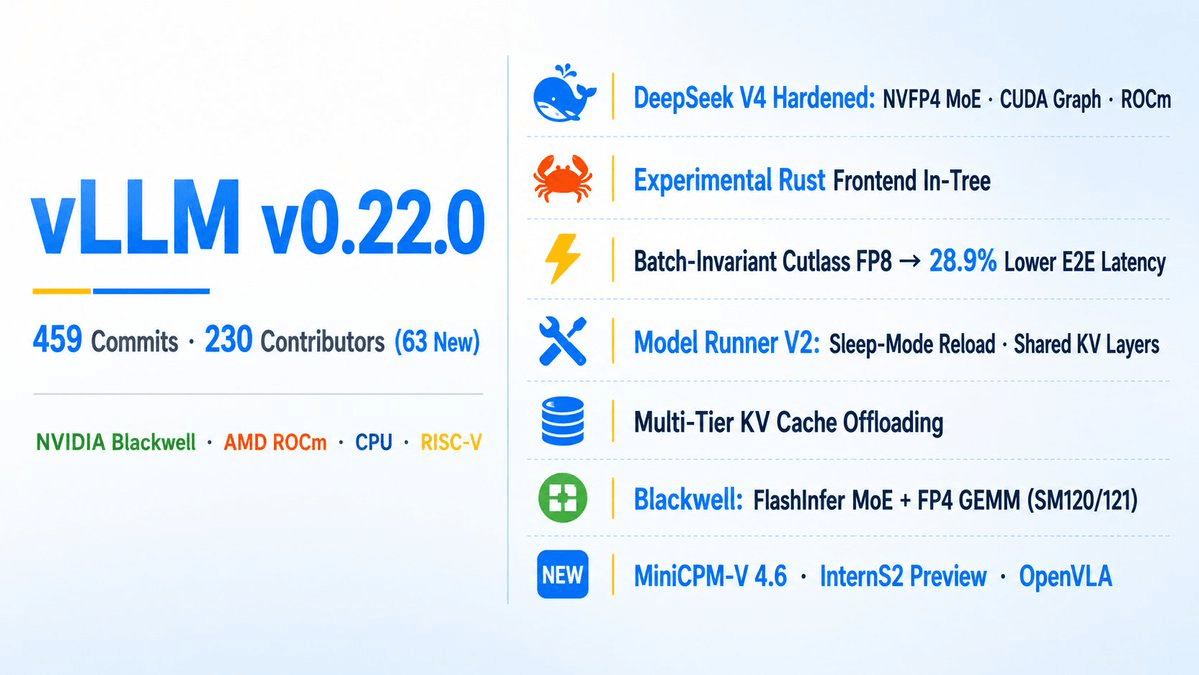
vLLM v0.22.0 is out, and it is one of the most architecturally ambitious releases the project has shipped. Batch-invariant inference now gains Cutlass FP8 support for a 28.9% end-to-end latency improvement, and an experimental Rust frontend has moved in-tree. Under the hood, this release is really about three converging bets: a new language for the serving layer, a maturing execution pipeline, and a hardware expansion that now stretches from NVIDIA Blackwell to AMD MI300X to RISC-V CPUs.
459 commits, 230 contributors, one big question
The scale of this release is notable. This release features 459 commits from 230 contributors, 63 of them new. But raw commit count is not the story. The real question is: what does this release change about how you run inference at scale? The answer is: quite a lot, and in ways that will compound over the next several releases.
Why Rust? The Python bottleneck is real
The most architecturally significant move in v0.22.0 is the experimental Rust frontend landing in-tree. This is not a cosmetic change. vLLM has always had a strong Python bias to make it accessible to contributors and to exploit ML libraries like PyTorch and Triton. But Python carries inherent performance downsides, including garbage collection and restricted parallelism due to the GIL.
As GPU latency continues to fall, request concurrency grows, and large-scale deployments become the norm, the CPU parts of the system have become a bottleneck. This is often seen in the frontend process where the asyncio event loop cannot keep up. In other words: GPUs got so fast that Python is now the slow part.
The Rust frontend is an experimental, high-performance alternative to the Python-based FastAPI server. It provides an OpenAI-compatible HTTP interface while leveraging Rust's concurrency model and memory safety, communicating with the vLLM Python engine via a ZeroMQ transport layer.
You can try it today by setting a single environment variable:
VLLM_USE_RUST_FRONTEND=1 vllm serve meta-llama/Llama-3.1-8B-InstructThe Rust frontend is still experimental and not yet feature-complete relative to the Python frontend. A roadmap issue tracks the remaining gaps in feature parity. Think of it as a preview of where vLLM's serving layer is heading, not a drop-in replacement for production today.


Don't miss what's next in AI
Join 300,000+ engineers and researchers who get the signal, not the noise.
- Full access to in-depth AI research breakdowns
- Be the first to know what's trending before it hits mainstream
- Daily curated papers, repos, and industry moves