

Tencent's Hy-MT2 Beats DeepSeek at Translation and Fits in 440MB
Tencent open-sources Hy-MT2, a purpose-built translation model family that beats commercial APIs at 440MB on-device — and outperforms frontier LLMs at translation tasks.
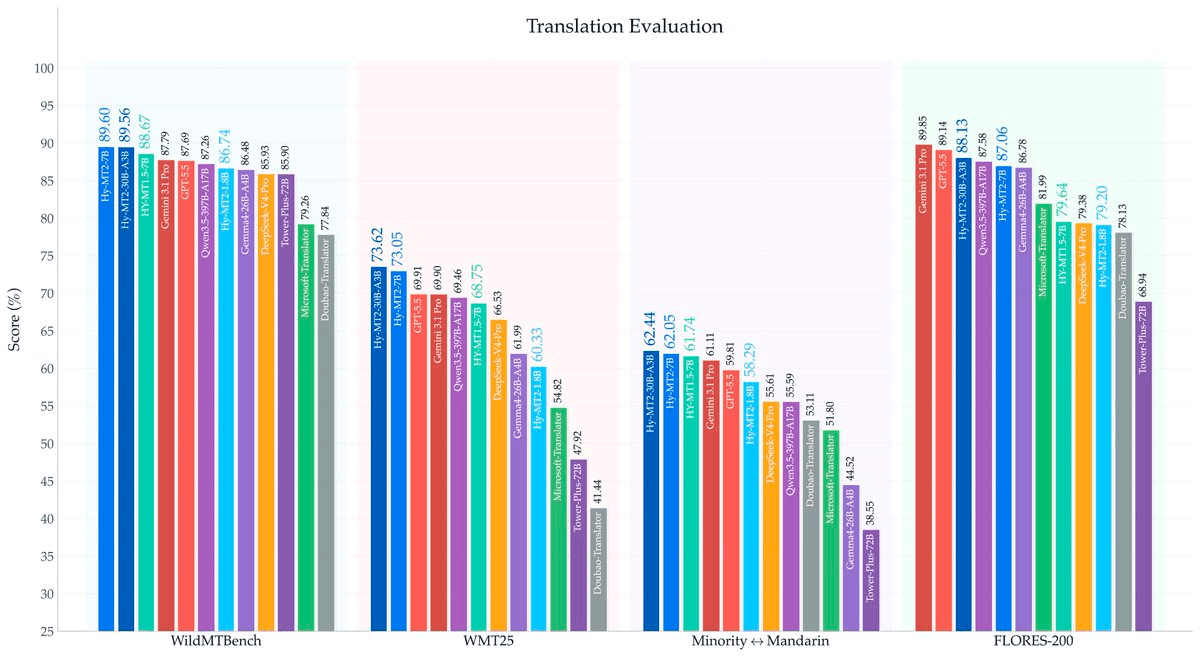
- Hy-MT2 is open-source and available now on Hugging Face and GitHub in 1.8B, 7B, and 30B-A3B (MoE) sizes.
- The 1.8B model fits in 440MB after 1.25-bit AngelSlim quantization, runs on mobile chips, and beats Microsoft Translator and Doubao APIs on benchmarks.
- The 7B and 30B models outperform DeepSeek-V4-Pro and Kimi K2.6 on translation tasks despite being purpose-built rather than general-purpose frontier models.
- Instruction-following is a core feature: the model handles terminology constraints, style control, structured data (JSON), delimiter preservation, and context-aware translation.
- IFMTBench is also open-sourced — a new benchmark for evaluating instruction-following translation quality, filling a gap in existing evaluation tooling.
- 33 languages supported, including low-resource languages like Tibetan, Uyghur, Khmer, and Burmese rarely covered by open-source models.
General-purpose LLMs have quietly become the default translation tool for most teams. But Tencent's Hunyuan group just made a strong case that a purpose-built model , one that thinks like a professional translator rather than a general reasoner , can beat them all, at a fraction of the size.
Hy-MT2 is a new open-source family of multilingual translation models, available in three sizes: 1.8B, 7B, and a 30B Mixture-of-Experts variant. All three sizes support translation among 33 languages and effectively follow translation instructions in multiple languages. The models are available now on Hugging Face and ModelScope, free to use.
The "Fast-Thinking" Bet
The key design philosophy here is what Tencent calls "fast-thinking." Traditional LLM translation uses a "slow thinking" approach , understand the full semantics first, then generate. Tencent introduced a "fast-thinking" paradigm: react like a professional human translator, cutting unnecessary reasoning overhead. In practice, this means the model is tuned to skip the verbose chain-of-thought that general LLMs use for translation and go straight to producing high-quality output.
The results back this up. The 7B and 30B-A3B models outperform open-source models such as DeepSeek-V4-Pro and Kimi K2.6 in fast-thinking mode, while the lightweight 1.8B model also surpasses mainstream commercial APIs from providers such as Microsoft and Doubao overall. Beating frontier general-purpose models that have hundreds of billions of parameters , on their own translation benchmarks , is a meaningful signal that task-specific training still closes the gap with scale.
440MB and Running on Your Phone
The headline number is the 1.8B model's quantized footprint. AngelSlim 1.25-bit extreme quantization reduces the storage requirement of the 1.8B model to only 440 MB and improves inference speed by 1.5x. To put that in perspective: this is a multilingual translation model that fits in less storage than most mobile apps, runs on mainstream mobile chips, and still beats commercial translation APIs on aggregate benchmarks.
AngelSlim is Tencent's own quantization toolkit , it compresses model weights to sub-2-bit representations using a technique called Stretched Elastic Quantization (SEQ). This aggressive ultra-low-bit strategy compresses weights to a 2-bit representation, resulting in a bit-equivalent model size of merely 0.3B , a 6x compression compared to the original model , which significantly alleviates inference latency and computational overhead. The 1.25-bit GGUF variant takes this even further.
The full model lineup, with their available formats:
- Hy-MT2-1.8B , base, FP8, GGUF, 2-bit GGUF, 1.25-bit GGUF (440MB)
- Hy-MT2-7B , base, FP8, GGUF
- Hy-MT2-30B-A3B (MoE) , base, FP8
Not Just "Translate This Text"
What separates Hy-MT2 from a wrapper around a general LLM is its instruction-following capability. It follows complex translation instructions: terminology consistency (provide reference translations, model keeps terminology unified), style control (specify formal/casual/literary tone), delimiter preservation (special characters in code/templates stay intact), structured data translation (JSON keys don't translate, only user-visible text), and personalized preferences.
This is a real pain point. Most "AI translators" break the moment they encounter structured JSON, subtitle formatting, or domain-specific terminology. Multi-dimensional evaluations show that Hy-MT2 delivers outstanding performance across general, real-world business, domain-specific, and instruction-following translation tasks.
To benchmark this capability, Tencent also released IFMTBench , a new open-source benchmark specifically designed to evaluate how well translation models follow instructions. In this release, they also open-source IFMTBench, a benchmark for evaluating translation instruction-following capabilities. This is notable: there was no standard benchmark for this before, so the field was essentially flying blind on instruction-following translation quality.
Getting Started
Inference is straightforward via transformers (requires transformers>=5.6.0), vLLM, SGLang, or llama.cpp. Here's the minimal usage pattern:
from transformers import AutoModelForCausalLM, AutoTokenizer
import torch
model_path = "tencent/Hy-MT2-7B"
tokenizer = AutoTokenizer.from_pretrained(model_path, trust_remote_code=True)
model = AutoModelForCausalLM.from_pretrained(
model_path, dtype=torch.bfloat16, device_map=Comments
