

Sakana AI Wires NVIDIA Nemotron Into Fugu, Beating Claude and GPT-5.5 on Coding
Sakana AI integrates NVIDIA's Nemotron open model family into its Fugu multi-agent orchestrator, creating a feedback loop that could redefine how open models get deployed in production.
- Sakana AI integrates NVIDIA Nemotron into its Sakana Fugu multi-agent orchestration system, expanding its pool of open-weight specialist agents.
- Fugu is not a single model -- it's a trained orchestrator that dynamically coordinates Claude Opus 4.8, GPT-5.5, Gemini 3.1 Pro, and now Nemotron behind one OpenAI-compatible API.
- Fugu Ultra scores 73.7 on SWE-Bench Pro (vendor-reported), ahead of Claude Opus 4.8 (69.2%) and GPT-5.5 (58.6%), though numbers are not yet independently verified.
- NVIDIA Nemotron is a fully open family (Nano/Super/Ultra) with open weights, training data, and recipes -- purpose-built for high-throughput agentic workflows with 1M-token context.
- The deal creates a feedback loop: Sakana gets deeper model specialization; NVIDIA gets real-world agentic performance data to improve Nemotron.
- Strategic context: the partnership deepens a relationship that started with NVIDIA's participation in Sakana's $200M Series A, and positions both companies in the growing sovereign/open AI movement.
Sakana AI, the Tokyo R&D lab, is deepening its partnership with NVIDIA in a move that goes well beyond a typical model integration. The next phase of this work will bring NVIDIA's open model stack, including NVIDIA Nemotron, into Sakana Fugu, Sakana AI's multi-agent orchestration system -- combining NVIDIA's open weights and accelerated computing with Sakana's Japan-born approach to collective intelligence.
This is not a cold partnership. NVIDIA participated in Sakana AI's Series A funding round, where the company raised approximately $200M, led by New Enterprise Associates, Khosla Ventures, and Lux Capital. The relationship has continued to deepen: Sakana raised a $135 million Series B in November 2025, valuing the company at approximately $2.65 billion. What's new here is the technical depth of the collaboration -- Nemotron is now being wired directly into Fugu's agent pool.
What Fugu actually is
Fugu bypasses the traditional monolithic model structure by dynamically routing queries to a swappable pool of specialized AI agents. The key insight is that instead of using domain knowledge to prescribe team organization, roles, or workflows, Fugu learns to dynamically assemble agents from a pool and coordinate them through non-obvious but highly efficient collaboration patterns.
The technology behind Sakana Fugu comes from two ICLR 2026 research papers: Trinity (an evolved LLM coordinator) and The Conductor (learning to orchestrate agents using reinforcement learning). Fugu can even read its own output and decide whether to try a better coordination strategy -- a capability called recursive orchestration -- without any retraining.
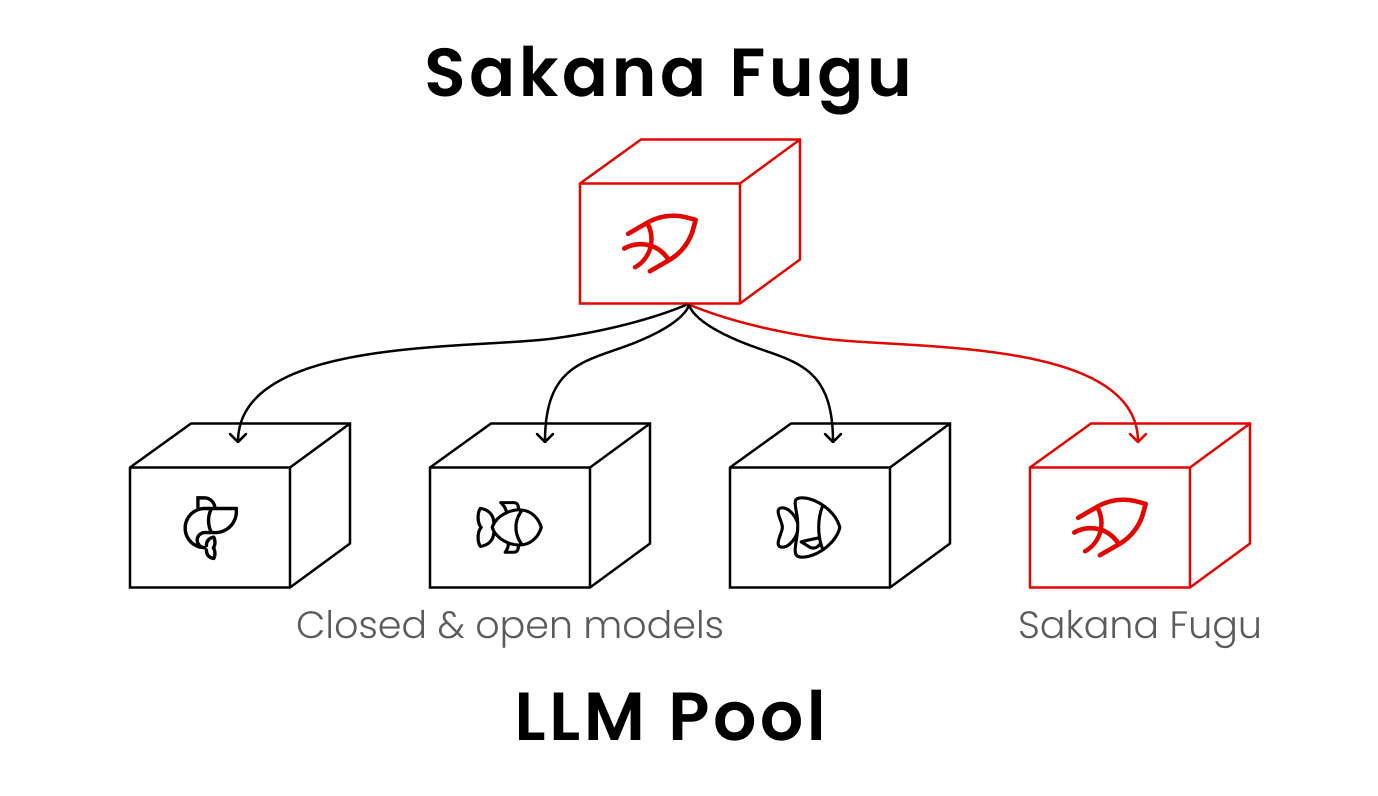
The system ships as two tiers behind a single OpenAI-compatible API:
- Fugu -- balanced performance and low latency, suited for everyday coding, chat, and review tasks.
- Fugu Ultra -- coordinates a deeper expert pool for hard, high-stakes problems like Kaggle competitions, paper reproduction, cybersecurity, and patent search.
For developers, integration doesn't require rearchitecting existing applications. You swap out an endpoint and suddenly have access to a coordinated multi-agent system instead of a single model.
The numbers that matter
Fugu Ultra scores SWE-Bench Pro 73.7, TerminalBench 2.1 82.1, and GPQA-Diamond 95.5 (vendor-reported). On SWE-Bench Pro, Fugu Ultra scores 73.7%, ahead of Claude Opus 4.8 (69.2%), GPT-5.5 (58.6%), and Gemini 3.1 Pro (54.2%). SWE-Bench Pro is a hard agentic coding benchmark that asks a model to resolve real software issues from production repositories -- it's a strong proxy for real-world engineering work.
A few important caveats: these are vendor-reported benchmarks, and the strongest models (Fable 5, Mythos) were excluded from the comparison as direct competitors rather than beaten head-to-head. These are vendor-published numbers, and they describe a system that routes across a pool of models, not a single LLM. A high score can reflect great routing as much as raw model power -- which is exactly what Fugu is built to do, but it means the numbers answer a slightly different question than a normal model card.
Why Nemotron is a natural fit
Nemotron is NVIDIA's fully open model family -- and "fully open" here means something specific. NVIDIA has released the training data, the reinforcement learning environments, the post-training recipes, and the fine-tuning code. The three models are Nano (31.6 billion total parameters), Super (120 billion total parameters), and Ultra (550 billion total parameters).
The architecture is purpose-built for agentic workloads. The NVIDIA Nemotron 3 family introduces a hybrid Mamba-Transformer mixture-of-experts (MoE) architecture, enabling high-throughput, long-context agentic AI systems with native 1M-token context windows and superior reasoning capabilities, specifically optimized for multi-agent workflows. Each tier has a distinct role:
- Nano -- outperforms comparable models in accuracy while remaining extremely cost-efficient for inference. Super is optimized for collaborative agents and high-volume workloads.
- Ultra -- the largest model, provides state-of-the-art accuracy and reasoning performance.
- Across the family -- Nemotron models excel in agentic AI tasks including reasoning, multimodal vision, retrieval-augmented generation (RAG), speech, and safety.
Nemotron wins on a different axis than raw benchmark charts: inference efficiency on NVIDIA hardware. That makes it a particularly attractive agent to slot into Fugu's pool -- it can handle high-throughput sub-tasks cheaply while frontier models handle the heavy reasoning.
The feedback loop no one is talking about
The most strategically interesting part of this deal is not the integration itself -- it's what happens after. Sakana Fugu gains access to a deeper pool of specialized model capabilities, while NVIDIA can evaluate how its models perform when coordinated as part of agentic, multi-step workflows. Developers and enterprises benefit from more choice, greater flexibility, and less dependence on any single model or provider.
In plain terms: NVIDIA gets real-world signal on how Nemotron performs inside complex agentic pipelines -- the kind of data that's hard to get from static benchmarks. Sakana gets a highly efficient, open-weight specialist to add to its pool. Over time, these real-world signals can help improve both the models and the orchestration layer, turning practical usage into a feedback loop for more capable, open AI systems.
The geopolitical subtext
There's a broader story running underneath the technical announcement. Ten days before Fugu's commercial launch, the US ordered Anthropic to suspend access to Fable 5 and Mythos Preview. Sakana, a Tokyo lab, shipped Fugu with the pitch: "frontier capability without the risk of export controls." A modular orchestration system that can swap out any individual model is structurally resilient to that kind of disruption.
Fugu is a strategic positioning play that addresses two of the most pressing concerns in enterprise AI adoption: export control risk and vendor lock-in. By orchestrating multiple models from different providers, Sakana AI is essentially building redundancy into the AI stack. Adding Nemotron -- an open-weight model that anyone can run on their own infrastructure -- deepens that resilience further.
145 papers at ICML 2026 cite NVIDIA Nemotron as the foundation for new research, which signals that Nemotron is becoming a genuine research platform, not just a product. NAVER developed its own model using the Nemotron architecture, extending the foundation for Korean-language AI research -- a sign that the open model ecosystem NVIDIA is building is already producing sovereign AI derivatives across Asia.
What comes next
The collaboration has a concrete technical roadmap. Once Nemotron is integrated as a specialized agent in an upcoming version of Fugu, both teams will collaborate to observe and improve Nemotron's performance inside multi-step workflows. NVIDIA will provide technical guidance on Nemotron recipes and evaluation best practices, and the findings will feed back into future improvements to both Nemotron and Fugu.
For teams already using Fugu, the Nemotron integration means access to a new class of efficient, open-weight agents -- particularly useful for high-throughput coding, tool-calling, and instruction-following tasks where Nemotron has demonstrated distinct strengths. For teams evaluating Fugu, the addition of open-weight models to the pool also addresses a compliance concern: users can control which agents participate in Fugu's model pool, and opt out of specific providers or models to meet data, privacy, compliance, or organizational requirements.
The broader bet here is that orchestration becomes the critical layer for the next stage of AI -- not the models themselves. Fugu-Ultra finishes with the best mean performance ahead of individual frontier model baselines, suggesting that orchestrating multiple strong models can outperform any individual frontier model on agentic ML research tasks. If that holds as open models continue to improve, the Sakana-NVIDIA collaboration may be positioning itself at exactly the right layer of the stack.
Comments
