



Sakana AI is formalizing its bet on AI that builds AI. The Tokyo-based startup just announced the Sakana AI Recursive Self-Improvement (RSI) Lab, a dedicated research group whose explicit mandate is to redesign the AI development process itself using AI. Rather than spinning up a new agenda from scratch, the lab consolidates a portfolio of self-improvement systems the company has been shipping over the last two years into a single, focused effort aimed at building open-ended architectures that collectively rewrite and upgrade themselves.
Two years of groundwork, now under one roof
The RSI Lab inherits a surprisingly concrete lineage rather than a theoretical wishlist. Sakana AI, working with the University of British Columbia and the Vector Institute, introduced the Darwin Gödel Machine (DGM), a self-modifying AI system designed to evolve autonomously. The system evolves by continuously editing its own code, guided by performance metrics from real-world coding benchmarks such as SWE-bench and Polyglot. To drive this self-improvement loop, DGM uses frozen foundation models that facilitate code execution and generation. The headline result is hard to ignore: on SWE-bench, the DGM automatically improved its performance from 20.0% to 50.0%. On Polyglot, the DGM jumped performance from an initial 14.2% to 30.7%, which far surpasses the representative hand-designed agent by Aider.
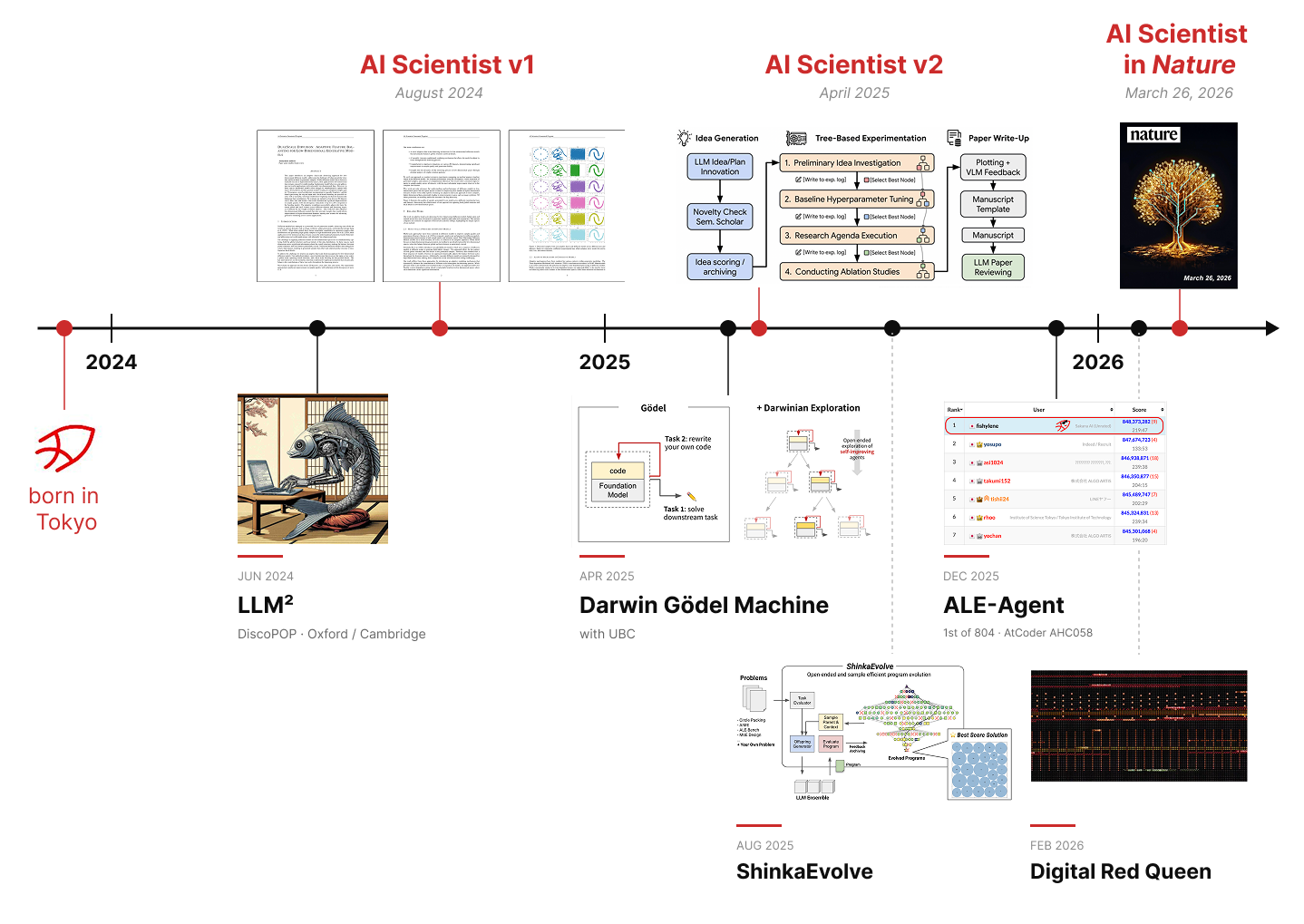
That is only one piece. The lab also folds in LLM-Squared, which used an evolutionary loop to invent DiscoPOP, a preference optimization algorithm written entirely by an LLM. It includes ShinkaEvolve, an open-source program-evolution framework that, per Sakana, solved complex optimization problems with only 150 samples and produced a novel load-balancing loss function for Mixture-of-Experts models. ALE-Agent took first place out of 804 human competitors in an AtCoder heuristic contest by extracting structured lessons from its own failures. Digital Red Queen, a collaboration with MIT, set up adversarial coevolution inside Core War as a sandbox for RSI in cybersecurity. And a paper describing The AI Scientist has been published in Nature, the result of collaboration between researchers at Sakana AI, the University of British Columbia (UBC) and the Vector Institute, and the University of Oxford.


Don't miss what's next in AI
Join 300,000+ engineers and researchers who get the signal, not the noise.
- Full access to in-depth AI research breakdowns
- Be the first to know what's trending before it hits mainstream
- Daily curated papers, repos, and industry moves