

Reve AI's Reve 2.0 Hits #2 on Image Leaderboard Using 10x Fewer GPUs
Reve 2.0 debuts at #2 on the Artificial Analysis Image Arena, introducing a layout-first architecture that makes generated images editable like code

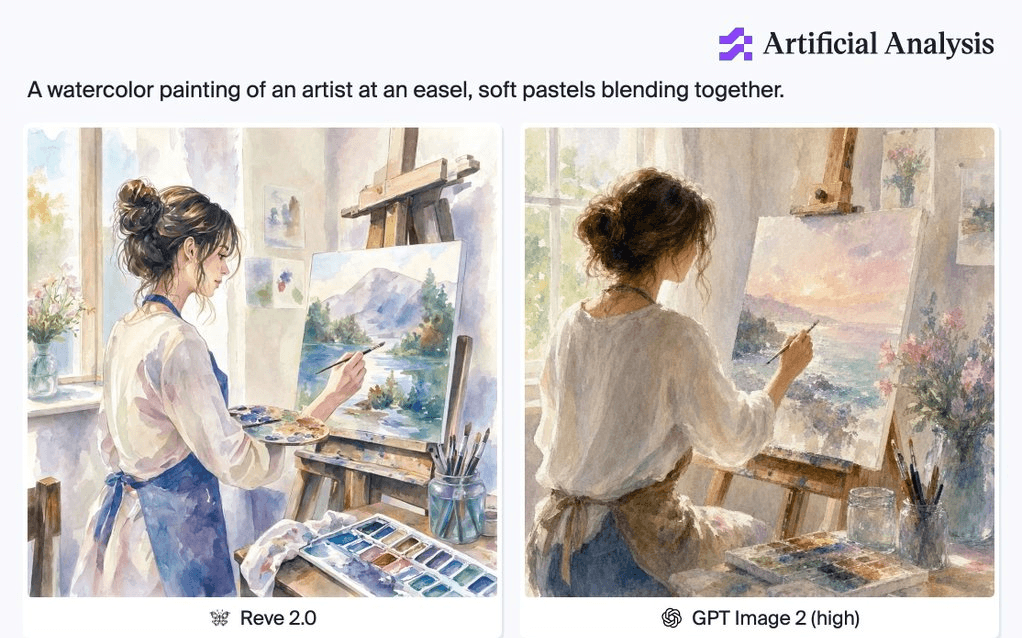
- Reve 2.0 debuts at #2 on the Artificial Analysis Text-to-Image Leaderboard, behind only OpenAI's GPT Image 2, scoring 1280 from 3,455 blind votes.
- Layout-first architecture: every image is built as a structured, code-like layout where each element has a position, size, and description -- editable before and after rendering.
- Native 4K (16MP) output with no upscaling step, plus reliable in-image typography -- two historically hard problems for image generators.
- Efficiency claim: Reve says it achieved top-2 quality trained on 10x fewer GPUs than larger competitors, with a ~$0.0067 per-image API price.
- Agent-native API exposes create, edit, and remix endpoints so LLM agents can reason over the structured layout, not just flat pixels.
- Industry shift: Ideogram 4 launched the same day with a similar layout-control bet, signaling a broader move from prompt-first to layout-first image generation in 2026.
Reve AI, a Palo Alto startup of roughly 50 people, just gatecrashed the frontier of image generation. Its new model, Reve 2.0, debuted at #2 on the Artificial Analysis Text-to-Image Leaderboard -- behind only OpenAI's GPT Image 2 -- on launch day. That alone would be a headline. But the more interesting story is how it got there, and what it means for the way image generation works.
The Prompt Is No Longer the Plan
Instead of going straight from a text description to pixels, Reve 2.0 first builds a layout: a structured, hierarchical description of the image where every element has a location, a size, a local description, and optional attributes like color or image references. Reve compares this to how the web works -- a layout is to an image what HTML is to a webpage or SVG is to a vector graphic.
Diffusion models produce beautiful images but are hard to steer. Autoregressive language models are highly intelligent but slow and not especially aesthetic, and their native modality is text, not pixels. By separating planning from rendering, Reve uses each kind of model for what it is genuinely good at, rather than forcing one to do both jobs badly.
The model is a single Large Layout Model -- a new model class -- built by training open-source Qwen language models on billions of images for spatial reasoning. The result is what Reve calls an "agent-native" image: the structured-layout representation gives an LLM something it can actually reason about -- Reve's positioning is that images-as-code is the missing primitive for agent-driven creative workflows.
What This Actually Unlocks
The practical payoff is something image generation has never had: stable, surgical editing. With Reve 2.0, every image is segmented and labeled, so you can target a single region -- move an object, recolor it, swap it, or rewrite its description -- without redrawing everything else. Anyone who has spent serious time with generative images knows what late-stage upscaling does. You finally lock in a composition you like, run the upscale, and watch small details shift. Upscaling becomes one final dice roll on top of a long line of dice rolls. Generating at 4K from the start removes that step.
There is also a typography story. Text rendering -- historically a failure mode for most generators -- improves materially in 2.0. Logos, posters, neon signs, and structured typography land closer to brief, which combined with 4K output makes the model viable for marketing assets that previously required Photoshop cleanup after generation.
The capabilities that matter most for production workflows:
- Layout-first editing: change one element without re-rolling the whole image
- Native 4K (4096x4096): 16 megapixels generated directly, no upscaler artifacts
- Reliable in-image text: headlines, labels, and packaging copy render legibly and correctly spelled
- Multi-reference composition: Reve 2.0 borrows character, lighting, material, or environment from each reference and merges them into one coherent scene
- Agent-native API: the 2.0 API exposes create, edit, and remix endpoints designed for programmatic workflows -- an agent or pipeline can call these directly without round-tripping through a human prompt at each step
The Numbers That Matter
On launch day, the model debuted at number two on the Arena.ai text-to-image leaderboard with a score of 1280 plus or minus 11 from 3,455 votes, behind OpenAI's GPT Image 2 and narrowly ahead of Google's Gemini 3.1 Flash Image. That represents a 125-point jump over the previous version, while training on 10x fewer GPUs.
Reve says it reached that level "trained on 10x fewer GPUs" and with "1/10 to 1/100" the resources of its larger competitors. These are Reve's own claims and have not been independently audited, but the leaderboard result is real. A team of 50 people has built one of the world's best visual generative models using a fraction of the training compute of their much larger competitors.
On pricing: paid plans are Lite at $7.99 per month and Pro at $19.99 per month, with a free tier that refreshes daily. The company is positioning Reve 2.0 around native 4K-by-4K generation, layout-first control, create/edit/remix API workflows, direct manipulation in the app, and a base API price of roughly $0.0067 per image.
A Small Lab in a Capital-Heavy Race
Reve AI, Inc. is a Palo Alto-based startup founded in 2023 by Michael Gharbi, Mike Speiser, and Taesung Park that develops an AI-powered platform for image generation and editing. Reve has raised $390M. The founding team has kept the company lean by design -- their thesis is that a better architecture beats raw compute, not that they can out-spend OpenAI or Google.
Natural language is expressive, but it is ambiguous -- and ambiguity is the enemy of efficiency and control. Reve made a different bet. They replaced text with a better, code-like semantic representation -- a layout. Layout is the reason they can compete with, and beat, models trained on 10x their compute.
The leaderboard position is also notable in context. Reve 2.0 ranks #2 with a score of 1280 from 3,455 votes, ahead of Google Gemini 3.1 Flash Image Preview and behind only OpenAI GPT Image 2. However, the current live leaderboard has since shifted -- newer models like MAI-Image-2.5 and HiDream-O1-Image-1.5 have entered the rankings, so the exact position will move over time.
The Broader Shift: Layouts Are Having a Moment
On the same day, two image-AI startups shipped models built on the same wager: that the future of generation is precise layout control, not ever-longer prose prompts. Ideogram, the Toronto company founded by former Google Brain researchers, made Ideogram 4 its first open-weight foundation model -- at just 9.3 billion parameters it delivers the best in-image text rendering of any open-weight release benchmarked, beating much larger models like FLUX.2 (32B) and HunyuanImage 3.0 (80B).
Together they signal a shift from treating an image as one block of text to be diffused into existence, toward treating it as a structured, editable arrangement of regions. Expect bounding-box and structured-layout prompting to graduate from a startup differentiator to a default control surface -- with at least one major incumbent shipping explicit layout controls in its image API before year-end.
Who Wins, Who Watches Their Back
The clearest winners are teams doing revision-heavy creative work. If Reve's layout-first approach makes complex visuals easier to control, it can become useful in places where generic image generators still frustrate serious users: campaign production, brand systems, presentation design, storyboarding, ecommerce imagery, and agentic design workflows.
The competitive picture is nuanced. Against GPT Image 2, Reve concedes a small quality edge but wins decisively on layout control and editability. Against Midjourney, Reve is far more useful for commercial work that needs text and precise placement. Against FLUX 2, Reve's code-based editing is a structural advantage for revision-heavy projects. And against Ideogram, Reve counters with native 4K and a deeper editing model, though Ideogram's open-weight option appeals when local deployment matters.
The model that has the most to lose is GPT Image 2. Whether OpenAI's GPT Image 2 or Google's Nano Banana line answer with their own layout-editing features would confirm Reve found the right primitive. If they do, Reve's architectural insight becomes an industry standard. If they don't, Reve has a durable moat.
What Comes Next
Reve 2.0 is available now in the Reve app, with API access coming soon. The model is closed-source and proprietary. Three things are worth watching over the next few months:
- Whether Reve publishes a technical report backing the Large Layout Model architecture and GPU-efficiency claims
- Whether the major labs ship layout-editing features in response
- Whether designers actually adopt the layout workflow in daily use rather than defaulting back to prompts out of habit
The right way to judge Reve 2.0 is not cost per generation. It is cost per accepted asset. A cheaper generation that needs ten retries is not cheap. A more expensive generation that lands first time can be a bargain. For anyone building image-heavy pipelines -- ad variants, product mockups, campaign assets -- that framing is worth sitting with.
Comments
