

Poolside's Laguna S 2.1 Gets 10x Rate Limits After Hitting 250B Daily Tokens
Poolside's 118B open-weight coding model gets 10x rate limit boost and a bug fix after a looping-in-thinking issue, with usage already hitting 250B tokens/day on OpenRouter alone.

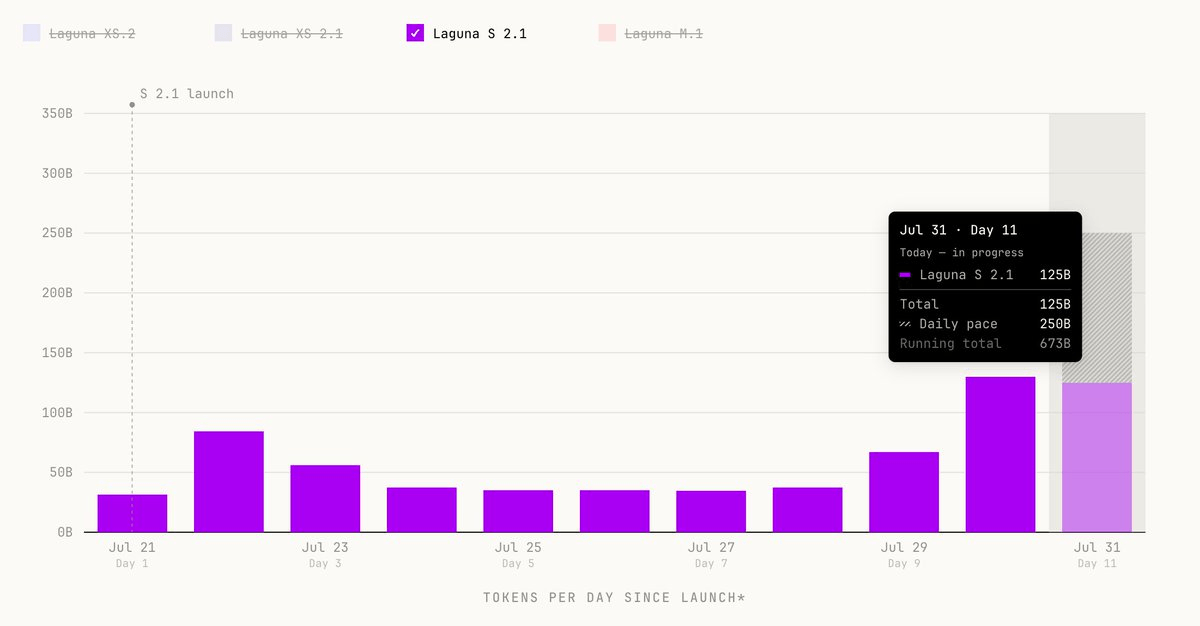
- Poolside increased Laguna S 2.1 rate limits by 10x on OpenRouter and Vercel AI Gateway, live now.
- A looping-in-thinking bug caused by a DFlash + TensorRT-LLM interaction has been fixed; recommended temperature is 1.0.
- Usage hit ~250B tokens/day on OpenRouter alone, 4x the weekly daily average, after the update.
- The paid OpenRouter endpoint (full 1M context) is now 10% cheaper: $0.10/$0.20 per 1M input/output tokens.
- Laguna S 2.1 is a 118B MoE model (8B active params) scoring 70.2% on Terminal-Bench 2.1 and 40.4% on DeepSWE -- beating DeepSeek-V4-Pro-Max on both with far fewer active parameters.
- Weights are open on Hugging Face under OpenMDW-1.1; runs locally via vLLM, SGLang, Ollama, llama.cpp, or MLX.
Poolside just pushed a significant serving update to Laguna S 2.1, its flagship open-weight coding model. Rate limits are up 10x across OpenRouter and Vercel AI Gateway, a critical looping bug in the model's thinking mode has been fixed, and the paid endpoint on OpenRouter is getting a 10% price cut. The timing matters: the model was already on pace for roughly 250 billion tokens in a single day on OpenRouter, about 4x its daily average for the week prior.
What Laguna S 2.1 actually is
Released just ten days ago, Laguna S 2.1 is a 118B-parameter Mixture-of-Experts (MoE) model built specifically for agentic coding. MoE means the model has many specialized sub-networks ("experts") and only routes each token through a small fraction of them. It activates just 8B parameters per token, which means inference is far cheaper than a dense 118B model would be. All 118B parameters stay resident in memory, but only ~8B route through the network per step -- that sparsity is why a mid-size model can behave like a larger one while staying cheap to serve.
It supports a context window of up to 1M tokens in both thinking and no-thinking modes. The weights are on Hugging Face under an OpenMDW-1.1 license, and the model is small enough to run on a single NVIDIA DGX Spark. That last point is significant: frontier-class agentic coding performance on a single workstation is a new bar.
The numbers that got people's attention
On SWE-Bench Multilingual it scores 78.5%, topping the published table outright. On Terminal-Bench 2.1 -- a benchmark of long-horizon terminal tasks -- it scores 70.2% with thinking enabled, placing it first among open, disclosed-size models on Poolside's compiled leaderboard, behind only larger or closed systems.
The DeepSWE result is the most striking. Laguna S 2.1 scores 40.4% against DeepSeek-V4-Pro-Max's 9.0%, with roughly one-sixth the active parameters. DeepSWE is notable because it still has real headroom -- tasks are long-horizon and hard to partially solve, so scores actually spread across models rather than clustering near the top.
Thinking mode is doing a lot of the heavy lifting here. The model ships with both thinking and non-thinking modes, and the difference is massive: Terminal-Bench goes from 60.4% to 70.2%, and DeepSWE goes from 16.5% to 40.4% -- a 145% relative improvement. Thinking mode nearly triples the model's score on the hardest agentic coding benchmark. For complex multi-file tasks that require planning, you absolutely want thinking enabled.