

Perplexity Swaps GPT-5.6 Terra and Luna Into Its AI Agent Platform
GPT-5.6 Terra and Luna are now the default models powering Perplexity Computer's subagents and scheduled automations, with Terra scoring 11 points above Claude Sonnet on WANDR.

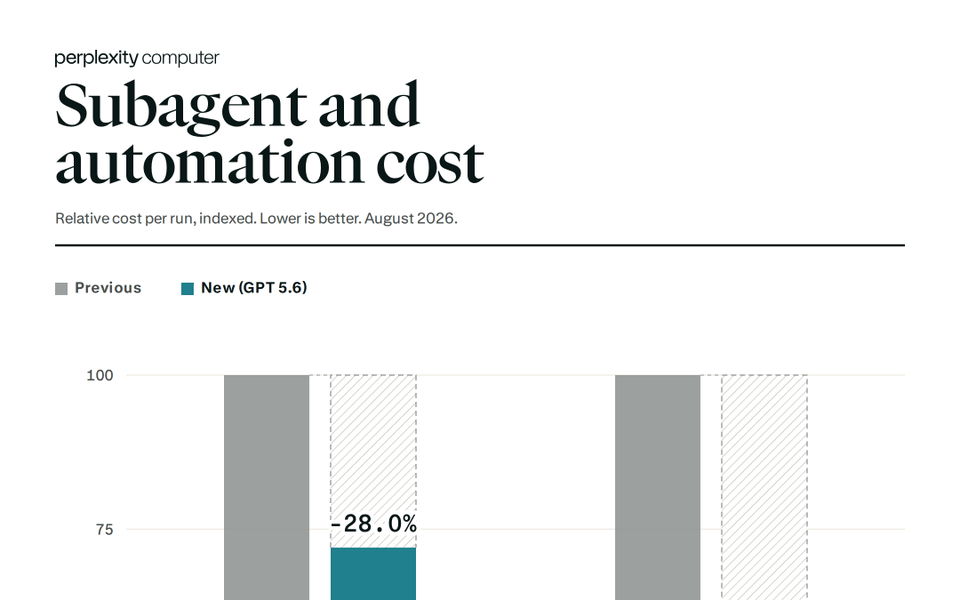
- Terra and Luna are live: GPT-5.6 Terra is now the default subagent and optional orchestrator in Perplexity Computer; Luna handles scheduled automations.
- WANDR benchmark edge: Terra scores 11 points above Claude Sonnet on Perplexity's own open-source research benchmark, while costing significantly less.
- Pricing: Terra is $2.50/$15 per 1M input/output tokens; Luna is $1/$6 — both substantially cheaper than Sol ($5/$30).
- What WANDR measures: 500 evidence-backed wide research tasks; even the top system (Perplexity's own) scores only 0.363 soft F1, showing how hard the problem is.
- Perplexity Computer architecture: An orchestrator decomposes tasks and routes sub-tasks across 20+ frontier models running asynchronously in an isolated cloud sandbox.
- Available now: Both models are live for Pro and Max subscribers with no configuration needed.
Perplexity just swapped in two members of OpenAI's GPT-5.6 family as the backbone of its agentic platform. GPT-5.6 Terra is now the default model for all Computer subagents and is also selectable as an orchestrator, while GPT-5.6 Luna takes over as the primary model for scheduled automations. This isn't just a model upgrade , it's a deliberate assignment of the right tool to the right job inside a system that already routes work across 20+ frontier models.
A quick primer on the GPT-5.6 family
GPT-5.6 is OpenAI's three-tier model generation, where the number marks the generation and the name marks the capability level. The family spans Sol (the flagship), Terra (a lower-cost model with performance competitive with GPT-5.5), and Luna (the fastest and most affordable). Think of it like Anthropic's Haiku/Sonnet/Opus split, but with a naming convention that makes the tier immediately obvious.
- Sol , highest reasoning ceiling, best for hard multi-step problems, most expensive
- Terra , balanced default; competitive performance with GPT-5.5 while being about 2x cheaper
- Luna , the efficiency tier: smaller, faster, and significantly cheaper, built for high-volume, latency-sensitive tasks where raw reasoning power is less important than speed and cost per query
The models are priced per 1M input/output tokens: Luna at $1/$6, Terra at $2.50/$15, and Sol at $5/$30. All three share a 1 million token context window and 128,000 maximum output tokens.
What Perplexity Computer actually is
Perplexity Computer is a meta-orchestration system launched in early 2026. It takes one complex prompt, breaks it into subtasks, and asynchronously coordinates specialized sub-agents to complete the work end-to-end. The key word is